
Tag Archives: control

Bti honeypot traps for killing mosquito larvae

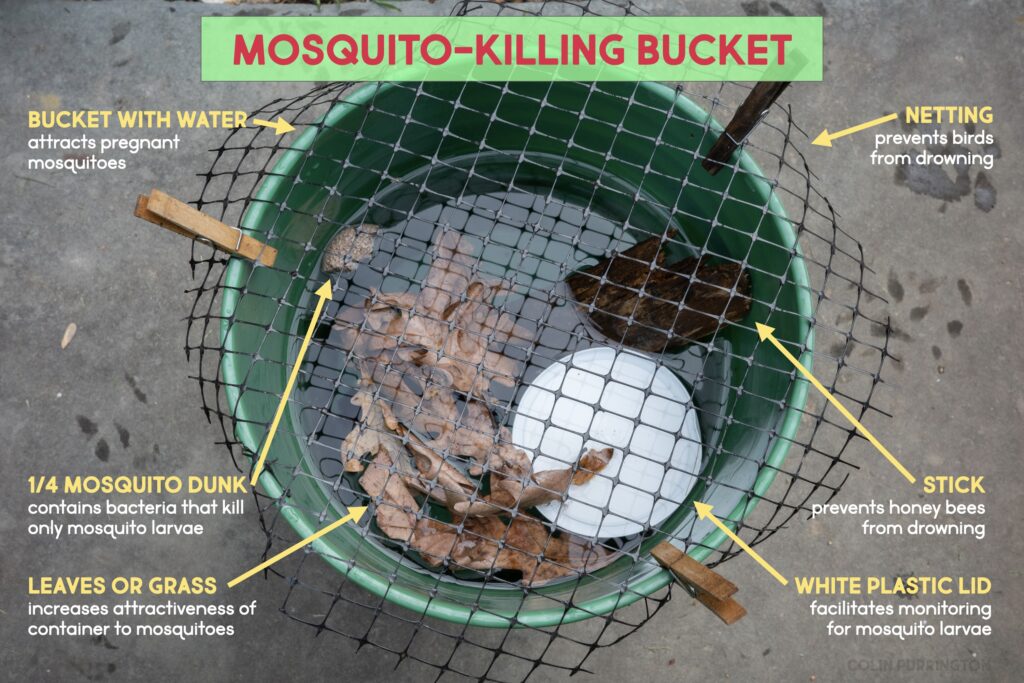
An easy way to kill thousands of mosquitoes each summer is to set out a container of water, add a handful of leaves or hay, then drop in 1/4 of a Mosquito Dunk, a compressed, shelf-stable form of Bacillus thuringiensis israelensis (“Bti”) that kills larvae. Pregnant females will oviposit onto the water surface as well as onto the sides of the container and when the larvae begin to feed they’ll be killed by the toxins produced by the bacteria. Just add a fresh crumble of Mosquito Dunks every three weeks to ensure the system is operating as needed.
Tips

  1. Cover the container with chicken wire or netting to prevent birds and chipmunks from drowning. Secure it with something more than clothespins (as in above pic) if you have toddlers around (drowning risk).
  2. Add a long stick that can fit through the mesh so that innocent insects that fall into the water have a way to crawl back out. Bonus: some mosquito species increase oviposition rate when wet wood is present.
  3. Add a white yogurt lid so that you can more easily see whether there are larvae wriggling around. I like to cut the rim off the lid so that it sinks a few mm lower. Alternatively, spray-paint the bottom of the bucket white.
  4. Deploy multiple traps to maximize the effect. I have six in my 1/4 acre yard.
  5. Set traps out in early spring so that the leaves have time to decompose and become attractive to female mosquitoes.
  6. Site near vegetation or at the bases of larger trees. Avoid areas that get a lot of direct sunlight.
  7. Set up a reminder on your phone to add more Mosquito Dunks. NB: if you forget, the buckets will be generating mosquitoes.
  8. If you’re traveling for more than three weeks during the summer, dump out all your buckets and start over when you return.
  9. Purge your yard of all other objects that might retain stagnant water so that mosquitoes are forced to leave their eggs in the trap.
  10. Make some for your neighbors, especially those who are spraying pyrethroids.
  11. Get local folks on board by writing a letter to your local paper (e.g., here’s my March 2026 blurb in The Swarthmorean). The more people who use these traps the better.

Are they working?

To determine whether mosquitoes are ovipositing, look for egg rafts on the surface of the water. You can also check for eggs of Asian tiger mosquitoes (Aedes albopictus) on the edges of the container, above the waterline, or on pieces of wood that are floating on the surface. If there are eggs and no larvae, the Bti is doing its thing. If you see larvae in the water (video below) dump everything and start over or add some fast-acting Mosquito Bits (kills in minutes, just as safe) along with a fresh chunk of Mosquito Dunk. If you don’t trust yourself to ID larvae, send me a pic or tag me on social media.

Safety

Bti toxins are completely nontoxic to mammals, birds, and all insects except mosquitoes, black flies, and fungus gnats. For an excellent overview of the mode of action and safety, please see this report (PDF).

Sources of Bti

The instructions above mention Mosquito Dunks but there are other products that contain live Bti. Just search for any of the following: Biosolutions Bactive, Bonide Mosquito Beater Water Soluble Pouches, Bactimos mosquito dunks, Terro Mosquito Larvacide Pouches, VectoBac Water Dispersible Granules.

Other sites with similar information

Spartan Mosquito Pro Tech deployed in a yard

Does the Spartan Mosquito Pro Tech attract mosquitoes?

This post evaluates the claim on the label, “mosquitoes will gather near them”. Per the company, it is the first step in how the device kills mosquitoes. I.e., the device needs to attract mosquitoes if it is going to work.

mosquitoes will gather

Evaluating the claim

I used a security camera to record activity around the cap area. Here’s a photograph of how I arranged everything:

Spartan Mosquito Pro Tech with security camera

Below is a 15-second time-lapse to show that small insects such as ants were easily visible, even at night. I think they are Prenolepis imparis, which are 3-4 mm long —mosquitoes are larger and thus would be detectable even in flight.

On the day that began filming (September 2nd, 2020) I counted over a dozen mosquitoes (all Aedes albopictus) landing on my arms and legs within 30 seconds. According to the instruction sheet, the device begins to work instantly, as soon as water is added, so an hour of remote, video observation should be a sufficient amount of time to evaluate the attraction claim.

Spartan Mosquito Pro Tech begins working instantly

I collected continuous footage for over a week, ending observations on September 10th. The mosquitoes were still plentiful on that day.

Results

During 183 hours of footage, I couldn’t find a single mosquito on or near the device. Here are the contents. I also posted a photograph to iNaturalist.

Conclusion

Because the Spartan Mosquito Pro Tech did not attract any mosquitoes, it therefore did not kill any mosquitoes. If my results are generalizable to other yards, the device is worthless as mechanism of mosquito control.

It is noteworthy, I think, that Spartan Mosquito has not made public a single video of mosquitoes gathering around a Pro Tech (or an Eradicator) when it is deployed outside. My guess is that the company has tried many times to get such footage but has not succeeded in attracting a mosquito. It will be interesting to know whether they will be compelled to disclose their efforts in a court of law. I.e., because the company has formally claimed to the EPA that “mosquitoes will gather” around the Pro Tech, the company would be in substantial legal jeopardy if that statement turned out to be false. If that’s what is going on then it seems likely that the EPA Enforcement Office might coordinate with the FTC as well.

Please also see my page, “Spartan Mosquito Pro Tech review“.

Footage

In case anyone might be skeptical of my results, I decided to upload all 183 hours of footage onto YouTube. I had to break it into 16 segments due to size limits on YouTube.

Yeast-and-sugar mosquito control devices

In the United States, three companies — Spartan Mosquito, Aion Products, and Tougher Than Tom — are selling devices that supposedly kill mosquitoes by luring them inside with carbon dioxide. I tested them in my yard last year and they all killed exactly the same number of mosquitoes: zero. Below are details about how they are marketed, why they don’t work, and why people still buy them.

Spartan Mosquito Pro Tech

Company says tubes kill mosquitoes for up to 30 days. Spartan Mosquito (also known as AC2T, Inc.) was the first to commercialize a yeast-and-sugar tube; the other two companies are copying it to some extent. Based in Hattiesburg, Mississippi, and owned by Josephine Tatum Hood. website: spartanmosquito.com

Aion Mosquito Barrier

Company claims device will kill and repel mosquitoes for 90 days. Much of the advertising seems to be AI-generated. The box claims that part of the profits go to saving marine turtles, but I seriously doubt this happens. Based in Memphis, Tennessee, and owned by Wade Whitely. aion-products.com

Tougher Than Tom’s Mosquito TNT

Company claims they work for 30 days. This company spends a lot of money targeting people with cheesy ads on Facebook, Instagram, YouTube, and Tiktok. Based in Austin, Texas, and owned by Zachary Snyder Collins. website: tougherthantom.com

Do they work?

To my knowledge, there’s no evidence that any of these devices kill mosquitoes. I tested all three of them in my yard in Pennsylvania and none was able to even attract mosquitoes. This is not surprising given the small amount of sugar and yeasts that are included. I.e., even though some carbon dioxide will be produced by the yeast, it will never be enough to fool a mosquito. One would likely needs pounds of sugar to produce the necessary volume of carbon dioxide. Moreover, you would need to keep adding sugar daily to maintain the required output. It is pretty obvious, even before testing, that they can’t work as described.

Another reason why mosquitoes are not attracted to these devices is that mosquitoes use more cues than just carbon dioxide to find hosts. For example, most species also use odor, heat, and visual detection.

Although these devices do not control mosquitoes, they do attract and kill other insects such as flies, beetles, wasps, and ants. Many people view these non-target deaths as evidence that the devices are working.

I have full reviews of the Spartan Mosquito Pro Tech and the Tougher Than Tom Mosquito TNT if you need details. For the Aion Mosquito Barrier, please see my review of the device it copies, the Spartan Mosquito Eradicator (per court order it is longer manufactured).

Why are these companies still in business?

Grifters thrive in the United States because state and federal regulators rarely punish businesses that make false claims about pesticides. It’s also sadly true that we have a generally poor level of science education in the country, and that leaves citizens open to being deceived by even obvious scams. And we have a huge population, so there are hundreds of thousands of people each summer who might give one of these products a chance. For a grifter, it doesn’t really matter than 99% of these people will never buy it again — there will always be hundreds of thousands of new (naive) customers next summer.

There are also people who will keep buying a scam year after year. This happens for a variety of reasons:

  1. Towns, municipalities, and regional health departments often spray insecticides from trucks and airplanes, in the middle of the night, without many residents being aware. And if some of those people have yeast-and-sugar tubes hanging in their yards, they might wrongly assume the lack of mosquitoes is related to the tubes. This scenario is probably common because spraying happens pretty much at the exact time of the year that homeowners place the yeast-and-sugar containers around their yards. For those curious about Mosquito Abatement Districts, this article has a nice summary. You can also ask your local government for details on whether your house is being treated.
  2. Sometimes due to sudden and extended drought conditions, mosquito populations plummet. Again, people might not appreciate that the lack of water is preventing mosquitoes from completing their life cycle and will mistakenly attribute the drop to yeast-and-sugar devices they have deployed around their yards.
  3. Many of the companies encourage homeowners to hang the tubes before the start of the mosquito season. It might seem to some that the tubes are keeping the mosquitoes at bay but in reality it’s because the mosquito season hasn’t started.
  4. Finally, some homeowners spray pyrethroid-based insecticides (like those used by Mosquito Shield and the like) in addition to deploying the yeast-and-sugar contraptions. I’ve seen comments on the internet suggesting that these people believe both are necessary even though in reality the tubes are merely decorative.

Once a person becomes convinced that one of these devices works, they are unlikely to abandon that belief even when presented with clear evidence to the contrary. That’s probably especially true if a person tells multiple friends that a device works. I.e., people can become more and more invested in a false belief over time. Indeed, when the tubes fail in future summers (or during gaps in municipal spraying), true fans of these tubes go to great lengths to blame themselves. For example, they might say, “I don’t think I used the correct temperature of water”, “I may have placed them too close to my house”, or “I should have used a few more tubes.” The companies use the same lines in response to consumer complaints, never acknowledging that the failure is with the tubes themselves.