
Category Archives: Science

Judge dismisses Spartan Mosquito’s SLAPP against me

Good news! In a March 14th ruling (below), the judge presiding over AC2T v. Purrington dismissed the case with prejudice. The decision came after Jeremy Hirsch, the company’s chairman-of-the-board, emailed the court to say he no longer wanted to pursue the defamation suit against me, citing lack of money. I suspect the real reason is that he and co-founder Chris Bonner didn’t want to comply with several of the judge’s recent orders, such as coming to Pennsylvania to be deposed (for 6 hours, with me in the room) and handing over documents (emails, texts, experimental data) that they really didn’t want anyone to see. And they likely wanted to avoid the trial, too, which would have been a complete disaster. The 2-page ruling is below:

Although this is great news, the judge did not order the company to reimburse me for my legal costs (approximately $90,000), so I’ll need to sue Spartan Mosquito for malicious litigation. And the judge did not order the company to retract any of its allegations against me (for example, that I am a secret employee of a big pharmaceutical company). And I never got my day in court, which after four years I was looking forward to.

But the biggest bummer is that this company is still selling its tubes to the public.

As a reminder, these are the two guys behind the scam: Chris Bonner and Jeremy Hirsch. They both live in Hattiesburg, Mississippi, in large houses with pools.
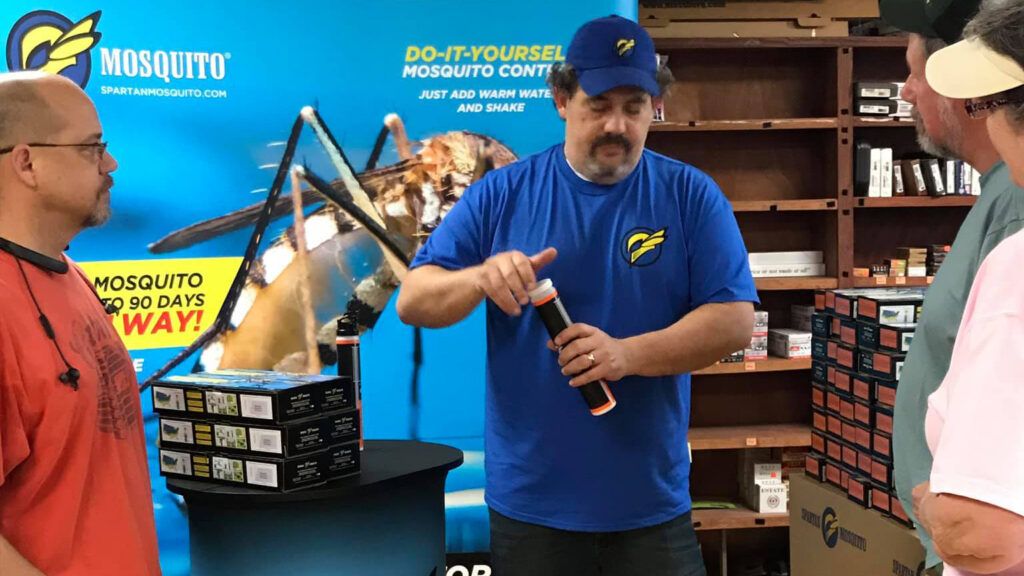
Chris Bonner and Jeremy Hirsch at a feed store demonstrating their invention, the Spartan Mosquito Eradicator.

For more information

Please see my other posts on Spartan Mosquito.

Ice prism in a wheelbarrow

I’d heard of ice spikes before — those strange horns that grow out of ice cube trays. And a quick internet search pulls up the rarer ice pyramid, too, like this one. But I’ve never heard of a trapezoidal prism being reported, but that’s what I found in my wheelbarrow recently. It was extremely smooth and organized, plus was thin-walled and filled with liquid water. I’m not at all confident the formation is even related to ice spikes and such. I’m sharing photographs and videos in in case anyone can tell me more.

I’d estimate its dimensions at 4″ long, 1 1/5″ wide, and 3 1/2″ high. The temperature the night before dropped to approximately 26 °F. Below is some video footage from different angles, plus shows that the structure is filled to the top with liquid water.

After another cold night it formed a cap and lost most of its liquid filling.

And on the day after that, the roof started to break apart.

If anyone can explain to me how it formed, I’d be grateful.

When it snows, look for snow flies

It’s going to snow all day here in Swarthmore, Pennsylvania, so I thought I’d post a quick note about a snow fly I found years ago in New York. I’m pretty it was a male Chionea scita (Limoniidae), one of 16-18 species north of Mexico. All members of the genus are wingless, and it’s my understanding that they use snow as an opportunity to better find mates. If you have snow, too, I highly recommend looking for them.

Here’s a photograph of a mating pair. That’s all the adults do, I gather. The larvae likely hang out in rodent nests, perhaps eating the fungi that grow on the feces (don’t judge). But that’s just a guess among biologists who study the genus.

If you find one, definitely take a photograph and post to either BugGuide or iNaturalist, sites that can better help biologists and snow-fly enthusiasts track which species occur where. And you can also get an identification from experts on those sites. As you can see from the distribution map on BugGuide, snow flies have never been reported in approximately 20 states, and other countries have similar issues because the flies are so rare. You’d have a few seconds of fame if you could fill in one of these distribution gaps.

And take some closeups of the head region if your camera can do that — there’s apparently a nematode (or its eggs, I’m unsure of which) that can sometimes be found coiled around their necks inside a thin-walled collar. Also take closeups of any missing legs, which is of interest because they have the ability to jettison limbs that begin to freeze as a way to prevent the crystallization from spreading to the rest of the body (nice trick).

If you’re a science fan and live near a post office, consider packing up the specimen and sending it to the folks running The Snow Fly Project. If you are in the snow a lot, sign up for an account at Adventure Scientists to facilitate your collections.