
Tag Archives: trap

Red wine trap for controlling Houdini flies at bee hotels

Per posts on Reddit and Facebook, jars baited with malbec can trap Houdini flies (Cacoxenus indagator), an invasive kleptoparasite of solitary bees in the genus Osmia. The species was first reported in New York in 2011 and has since appeared in Maryland, Massachusetts, New Jersey, Oregon, Pennsylvania, Virginia, Washington, and British Columbia. For anyone with an insect hotel in an affected area, brood losses can be considerable so the news of a control method is welcome news. Currently hotel owners deal with the parasites by squishing them one by one, vacuuming them up, or trapping them on sticky cards situated in the eaves. All of these techniques seem futile given that a single Houdini fly can leave hundreds of eggs.

The trap

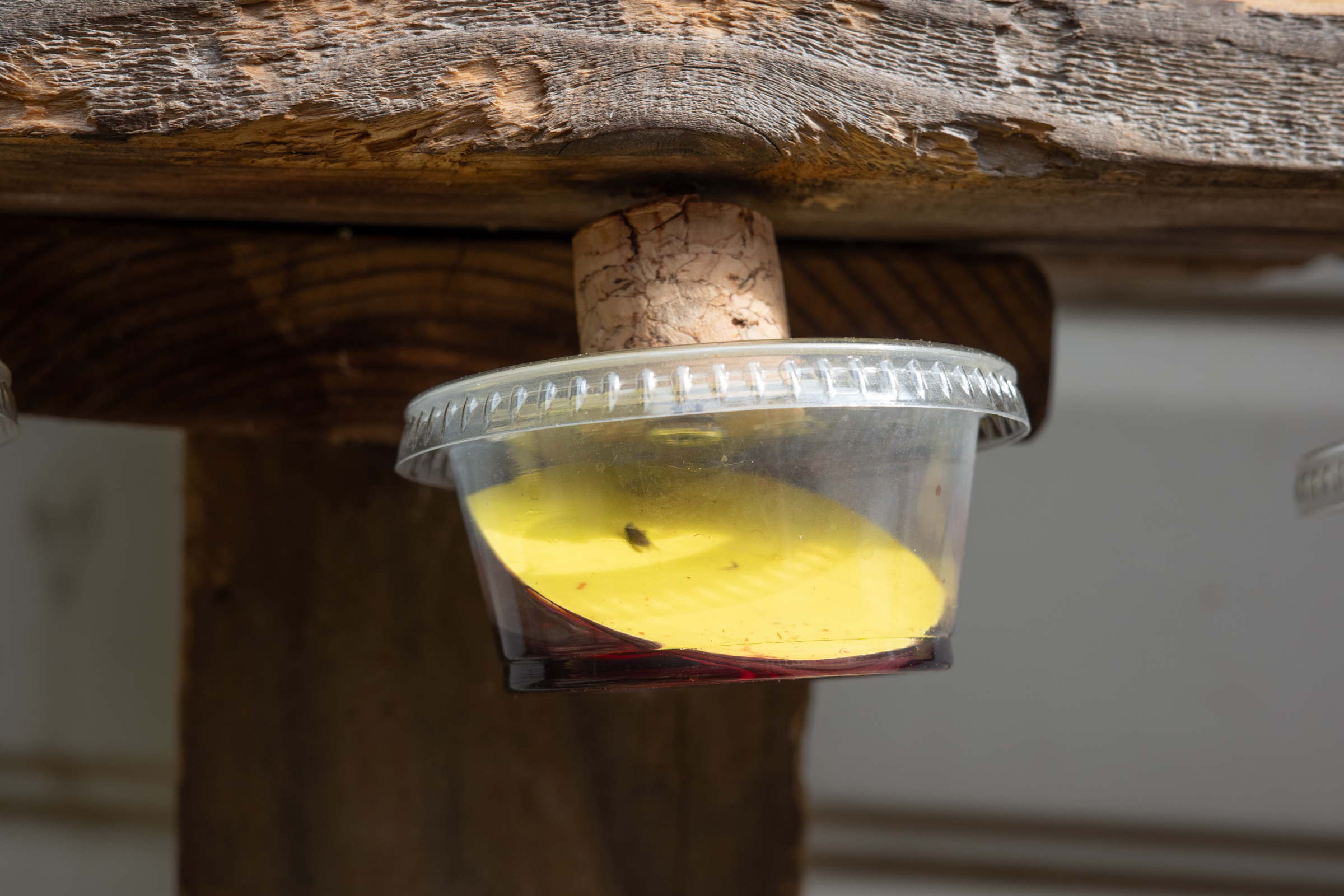
The general idea is to put the wine into a container that has small, fly-sized holes, then situate in a nook in your insect hotel. I opted to use 2-oz containers that I had sitting around but several posters on reddit use small mason jars. I then drilled four, 1/8″ holes in the lids, attached segments of cork with a 1 5/8″ screw to either the side of the container or the lid, and then screwed it to the hotel.

Evidence that it works

I set mine up too late in the season to estimate how many Houdini flies can be trapped per day, but I can confirm that some did go inside the traps and drown. Here are two:
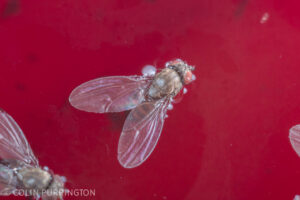
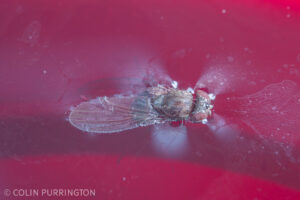
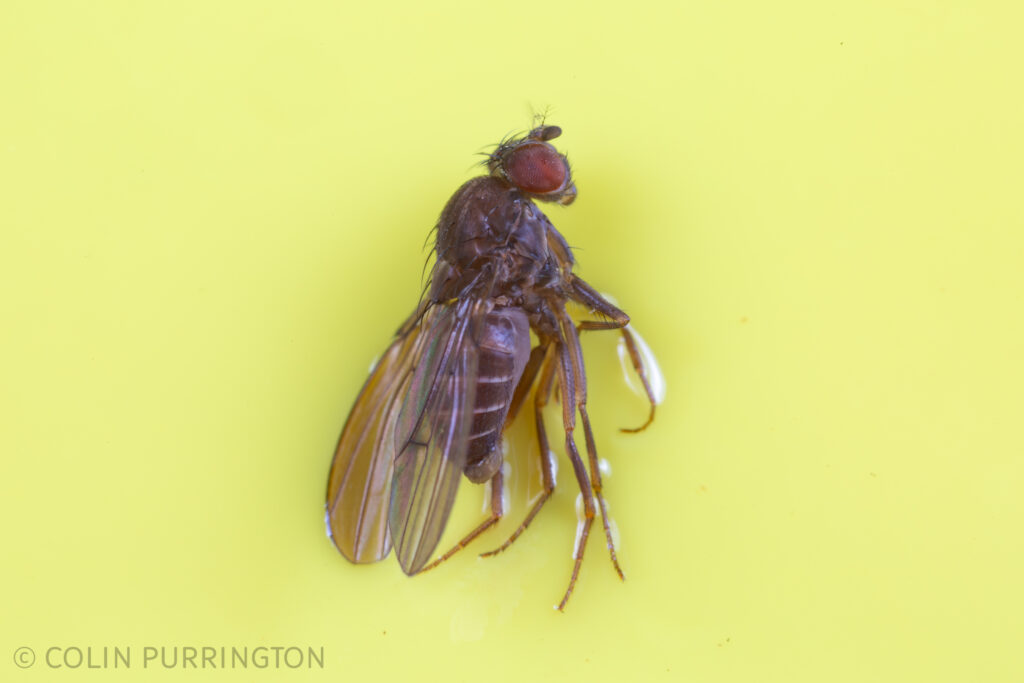
Small waterlogged flies are difficult to identify even when you have decent photographs, so I eventually fitted the containers with sticky cards that would immobilize insects before they drowned. Here’s a trap attached via the lid and a Houdini fly that got stuck:
I should emphasize that my traps also caught dozens of small fruit flies that were not Houdini flies. So if you are trying this trap method be cautious in deciding whether it’s actually working or whether it’s just attracting small flies that happen to like red wine. I encourage everyone to use sticky cards and to submit photographs for ID confirmation to either BugGuide (North America only) or iNaturalist. If you opt for the latter you’ll likely get input from me within 24 hours (I’ve ID’d 200 Houdini flies already).

Is it safe for bees?

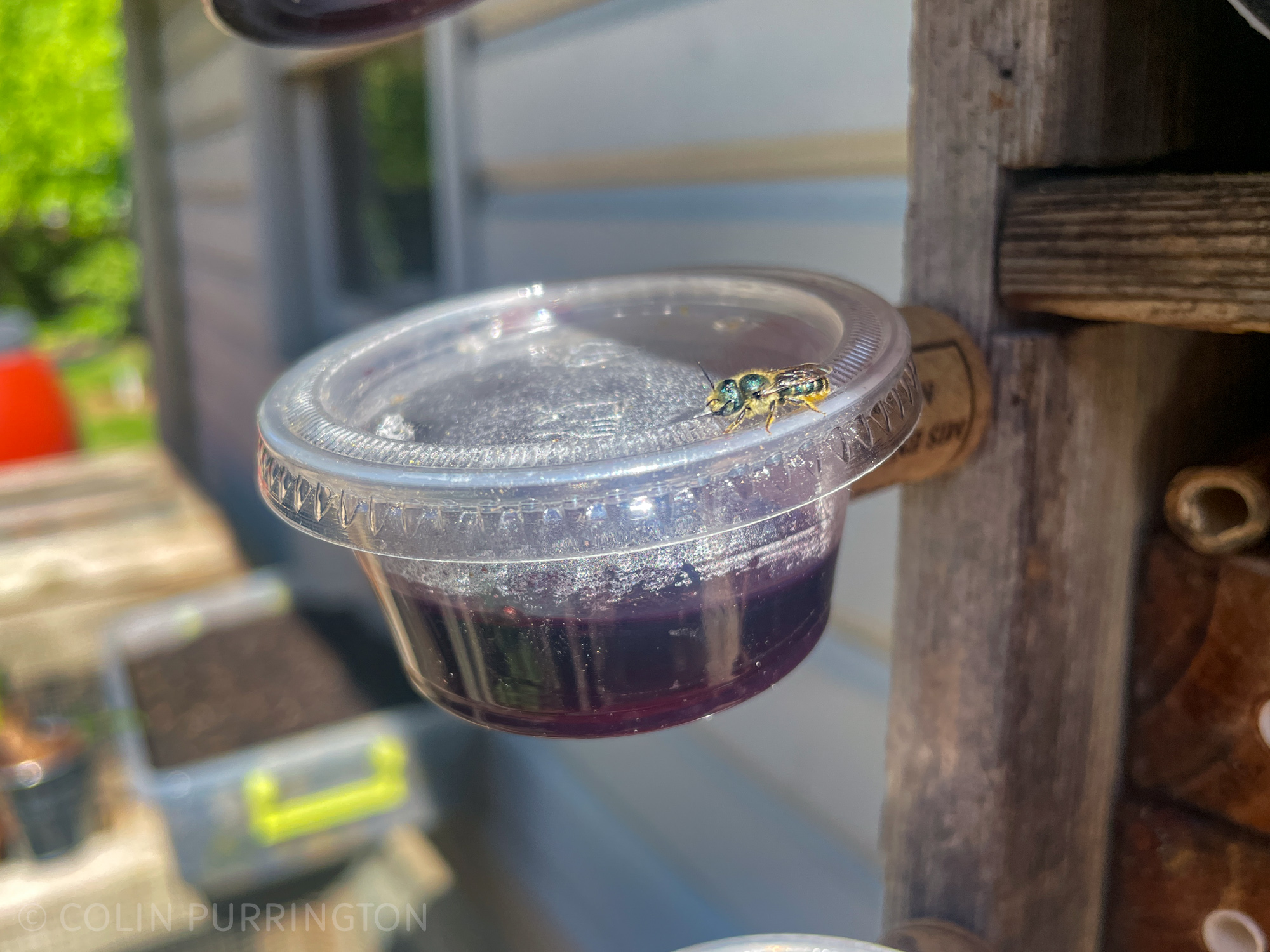
The holes are too small for many mason bee species but there are plenty of solitary bees that could fit into 1/8″ holes if they wanted to try. So far, however, none has become stuck in any of my nine traps. Some of the bees even use them as landing platforms because the sun hits them in the afternoon.
Design tips

Some thoughts that I’ll update as I continue with testing.

  • Opt for clear-sided containers so you have a better view of what is inside.
  • I’m now using a slightly smaller drill bit because 1/8″ allows rather big flies to enter.
  • Reddit user atrailofdisasters uses a red-pepper shaker, a solution that might work well for those who don’t have a drill and collection of small bits.

What wines work best?

Per reddit, the person who came up with the trap idea, Nicole Kenney, of Portland, Oregon, tested different wines for several years and decided that red wine, especially Argentinian malbec, is best. I have no idea how she did the tests but I’ll link to more information when I can find it. I’ve only tried malbec in mine but will do some comparisons next year during peak Houdini-fly season. Malbec is an old grape grown around the world but apparently thrives in Argentina and much of the acreage is in the mountains. It would be very interesting to know exactly which component is attracting the Houdini flies, of course.

Why does it work?

Houdini flies are members of the vinegar fly family (Drosophilidae) and are known to like fermenting fruit juice (source) so it’s not a surprise they are attracted to wine. And all animals are lazy so if there is food near where females are busy ovipositing, they will happily take a break to a have a drink.

More information

If you’d like to see photographs of Houdini flies I have about 20 on iNaturalist.

Please also see my blog post, “Houdini fly alert for owners of insect hotels.”

Cucumber beetle trap

My vegetable garden has always been plagued by cucumber beetles, so this year I finally made an attempt at DIY traps, inspired by instructions posted by Lee & Pinero (2016) and Shee (2019). I’m posting details below in case anyone would like to make their own or might be able to suggest improvements.

Cucumber beetle trap

For the traps I repurposed some Spartan Mosquito Pro Techs and one Spartan Mosquito Eradicator that I had sitting around, first spray-painting the tubes with Krylon Gloss Sun Yellow and the caps with Oleum Spring Green — to emulate yellow flowers subtended by green calyces.

Then I drilled multiple 11/64″ holes in the tube and in the cap (which already had several) to allow entrances for the beetles.

To attract the beetles I purchased a packet of lures made by AgBio, which I cut up into 5 pieces and stuck to strips of yellow sticky cards. These strips were then placed inside the tubes.

Inside of cucumber beetle trap

I’ve caught several beetles in each of the tubes, though not the hundreds I was hoping for. All of them were striped cucumber beetles (Acalymma vittatum). Not quite a complete failure, but close.

One likely explanation for the low number of beetles is that cutting the lure into small pieces reduced the attractiveness below some needed threshold. But those lures are so expensive I can’t really stomach using one per tube. What I’d ideally like is a way to use cheaper aromatic oils and scents to make a more affordable lure. I suspect some combination of corn silk oil, cucumber oil, clove oil, etc., would work if I had infinite time to test.

Another possible explanation is the shape of the tube or the number and orientation of the holes, as per discussion in the articles liked above. Perhaps cucumber beetles just prefer gallon milk jugs over thin tubes. Indeed, Shee found that gallon milk jugs seemed to attract plenty of cucumber beetles without even a lure, at least at the start of the season.

If anyone out there has made traps and can offer some suggestions, I’d be grateful.

Spartan Mosquito Pro Tech deployed in a yard

Does the Spartan Mosquito Pro Tech attract mosquitoes?

This post evaluates the claim on the label, “mosquitoes will gather near them”. Per the company, it is the first step in how the device kills mosquitoes. I.e., the device needs to attract mosquitoes if it is going to work.

mosquitoes will gather

Evaluating the claim

I used a security camera to record activity around the cap area. Here’s a photograph of how I arranged everything:

Spartan Mosquito Pro Tech with security camera

Below is a 15-second time-lapse to show that small insects such as ants were easily visible, even at night. I think they are Prenolepis imparis, which are 3-4 mm long —mosquitoes are larger and thus would be detectable even in flight.

On the day that began filming (September 2nd, 2020) I counted over a dozen mosquitoes (all Aedes albopictus) landing on my arms and legs within 30 seconds. According to the instruction sheet, the device begins to work instantly, as soon as water is added, so an hour of remote, video observation should be a sufficient amount of time to evaluate the attraction claim.

Spartan Mosquito Pro Tech begins working instantly

I collected continuous footage for over a week, ending observations on September 10th. The mosquitoes were still plentiful on that day.

Results

During 183 hours of footage, I couldn’t find a single mosquito on or near the device. Here are the contents. I also posted a photograph to iNaturalist.

Conclusion

Because the Spartan Mosquito Pro Tech did not attract any mosquitoes, it therefore did not kill any mosquitoes. If my results are generalizable to other yards, the device is worthless as mechanism of mosquito control.

It is noteworthy, I think, that Spartan Mosquito has not made public a single video of mosquitoes gathering around a Pro Tech (or an Eradicator) when it is deployed outside. My guess is that the company has tried many times to get such footage but has not succeeded in attracting a mosquito. It will be interesting to know whether they will be compelled to disclose their efforts in a court of law. I.e., because the company has formally claimed to the EPA that “mosquitoes will gather” around the Pro Tech, the company would be in substantial legal jeopardy if that statement turned out to be false. If that’s what is going on then it seems likely that the EPA Enforcement Office might coordinate with the FTC as well.

Please also see my page, “Spartan Mosquito Pro Tech review“.

Footage

In case anyone might be skeptical of my results, I decided to upload all 183 hours of footage onto YouTube. I had to break it into 16 segments due to size limits on YouTube.