
Tag Archives: sugar

Birds are eating my pea plants

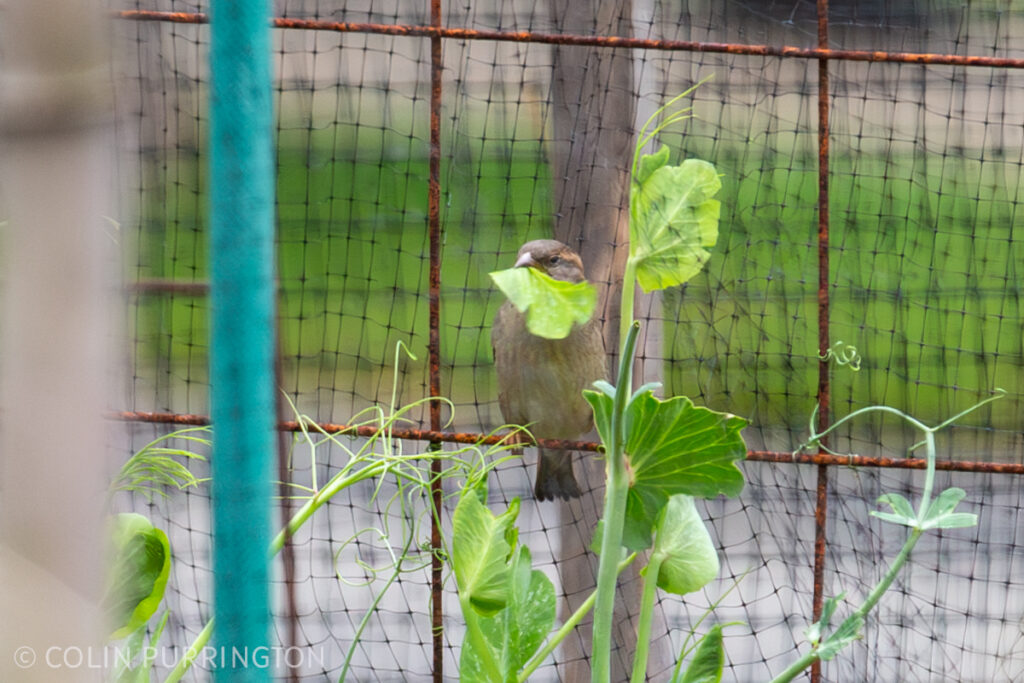
This spring I decided to figure out which bird species are decimating my peas, with the hope that an ID might help me better protect my crop next year. Sneaking up on my allotment so as not to spook the birds, it didn’t take me long to figure out that the culprits were mainly house sparrows. Usually a large flock of them. As proof, here’s Exhibit A, a female house sparrow with a big chunk of a leaf in her mouth.
But I’ve also observed northern cardinals and American goldfinches doing the same, so I can’t blame everything on the sparrows. Indeed, I suspect I’d see additional species helping themselves if I camped out under cover of a bird blind for a day. Pea shoots are just that good.

Naturally, I immediately ran out and purchased bird netting and fully enclosed my trellises in a large box, complete with multiple doors made from overlapped netting, all pegged at the ground with rocks. The netting is delicate and black so it’s hard to see in the photograph below but trust me, it’s there and it covers everything rather tightly.

But after I set it all up the damage to the pea plants continued at pretty much the same level as before. Please refer to Exhibit A, above, and note how the background of the photograph shows the bird netting — the birds just found tiny gaps in the netting, ate their fill, then let themselves out. The cardinals and finches weren’t deterred much, either, and at one point I saw all three species inside, happily munching away.

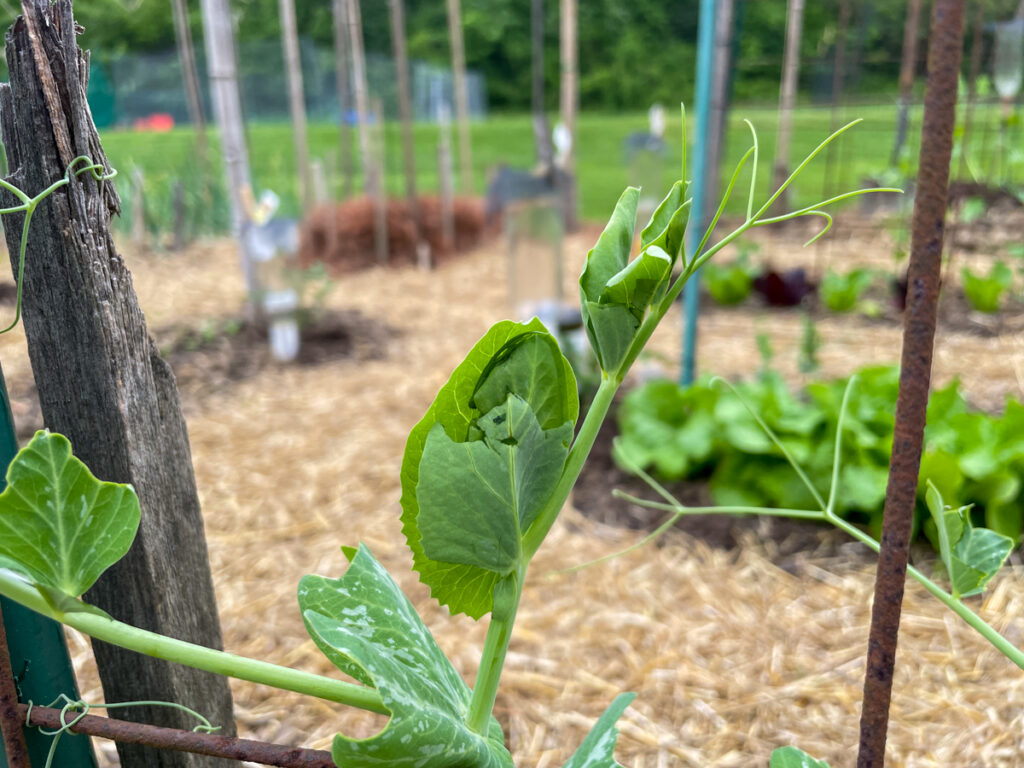
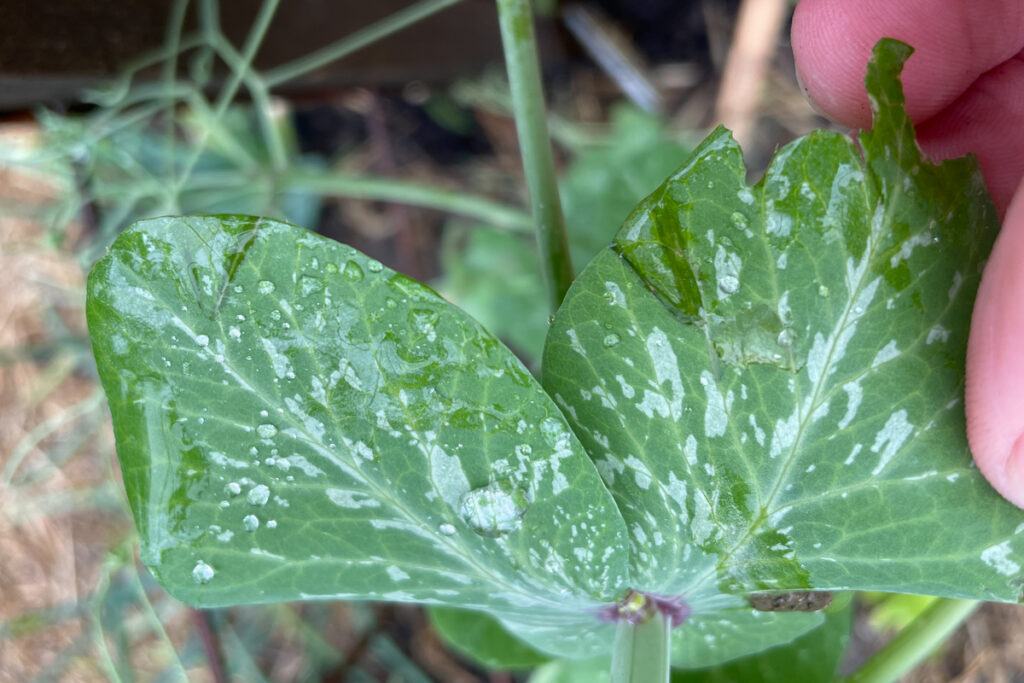
Below are photographs of the damage in case you’re interested why I’m so worked up about this situation: growth on primary meristems are nibbled off, leaves covered in tiny beak-shaped compression wounds, shoots bent when fat birds perch on the stem while foraging, severed branches left on the ground. When I surprised the birds I could see them flying off with pieces still in their beaks.
I should point out that my allotment is just one of many, and other people have completely unprotected pea plants (gasp!). So I’m wondering, why bother navigating my cage system when there is plenty to eat elsewhere?? Although other people’s plants certainly show damage, whenever I spy on the gardens from afar the birds seem to be on mine plot, on my peas. I’m thinking they must prefer the varieties I’ve planted, all heirloom varieties that climb (‘First 13’, ‘Magnolia Blossom’, ‘Tall Telephone’, and ‘Purple Podded’).

Perhaps the dwarf, self-supporting varieties that most people grow have more lignin and such in the stems and leaves, rendering them less palatable to birds. In support, I’d note that of the varieties I have the birds seem to prefer ‘Magnolia Blossom’, a sugar snap pea (Pisum sativum var. macrocarpon, I think) which Burpee says has “edible tendrils” (tendrils = shoots to pea folks, I think). The Ottawa Gardener, writing about peas with edible shoots and tendrils, says something similar: “I’ve noticed that most recommended varieties are those with edible pods which may be [sic] because the shoots are less fiborous [sic] or sugary.” Andrew Barney says something similar about peas with edible leaves: “any variety with both p / v genes for low fiber in the pod would be a good candidate for this. Plants with lower fiber in the pods also have lower fiber in the leaves,” adding that leafcutting bees (Megachile spp.) also seem to have a preference for tender-leafed types.

So, what to do? I think for this season I’m just going to keep fussing with the netting to minimize the damage. But next year I’ll replace it all with stiffer netting that can be better fastened together with twist ties and such. It will be a lot of work but man I love fresh peas and I don’t like to share.

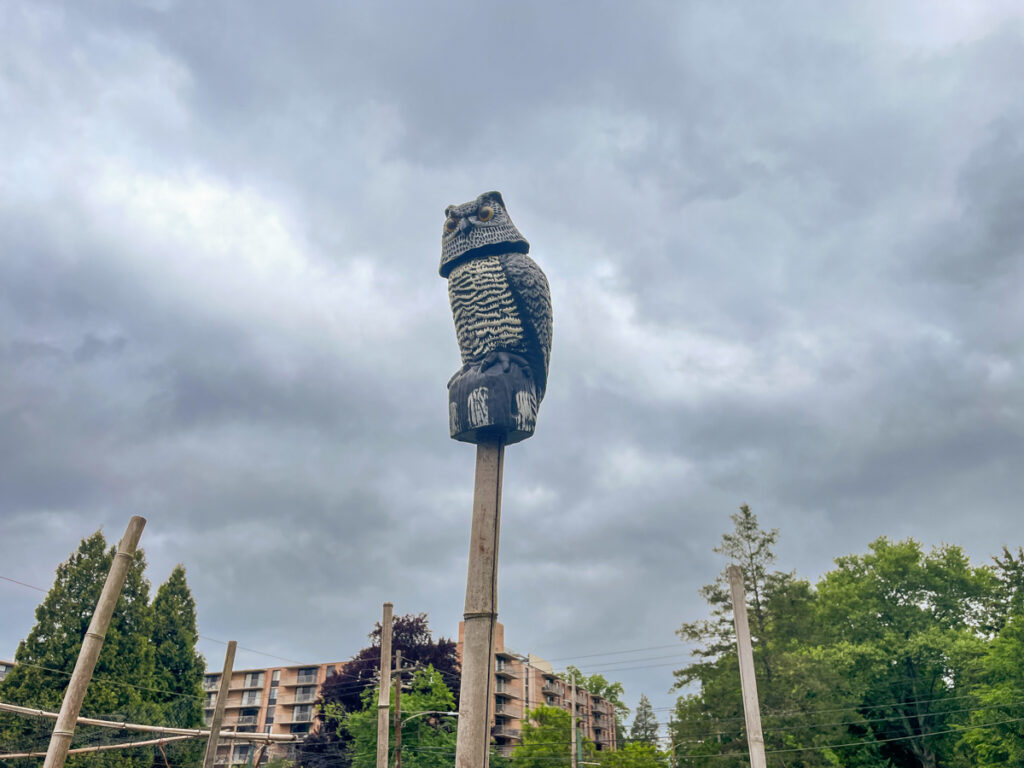
Anyone have suggestions? I’ve tried a fake owl (birds don’t care at all) but I haven’t yet experimented with holographic tape, threatening mylar balloons, or CDs suspended from monofilament. I’m think none of these will work. What I’d really like to do is leave a hungry cat inside the trellis cage. But I know that would be frowned upon by the locals. Same for the laser defense systems that some vineyards use.
Spartan Mosquito’s attorneys quit over unpaid bills

In filings on January 30, 2024, the firm representing Spartan Mosquito in its SLAPP against me requested permission from the judge to withdraw as counsel. The stated reason was failure to pay. Alan L. Frank Law Associates (Jenkintown, PA) has been representing Spartan Mosquito since 2019, so the unpaid bills could have been substantial. Here’s the withdrawal motion:

If Spartan Mosquito doesn’t come up with a new attorney by February 28th, the judge can issue sanctions and/or dismiss the charges against me (see order, below).

This will be an interesting year for Spartan Mosquito. Most states in the country still allow sales of the Spartan Mosquito Eradicator (active ingredient: table salt), but regulators aware of the class-action settlement might decide that it’s finally time to enforce state laws and ban the scam. E.g., states are not supposed to allow sales of pesticides that make false claims about efficacy (e.g., “table salt kills mosquitoes”) but dozens do.

Word of the class-action settlement is also likely to turn off some consumers, too. I think the company will always have a core number of true believers but likely not enough people to float a company as large as Spartan Mosquito.

I also see resignations in the company’s near future as salaries and bonuses are cut and employees realize they are working for a company that is based on fraud. Some of the employees now have “Open to Work” badges on their LinkedIn profiles. And then there are the people who don’t even list Spartan Mosquito as their employer on LinkedIn, a group that now includes Jeremy Hirsch (co-founder, chairman of the board), Chris Bonner (co-founder, vice president), Anthony Brett Conerly (president), Karen Bonner (secretary), and Josey Hood-Hirsch (treasurer). The CEO, Christopher Spence, left the company in November, 2023, and deleted all mention of Spartan Mosquito from his profile (he was there for four years). Rats, sinking ship.

If you want more details on the company’s tubes, I’ve listed my past posts here.

Consider donating to my GoFundme campaign

My legal battle with Spartan Mosquito is over but I’m still $36,000 in the hole. Donations and/or shares would be hugely appreciated: https://gofund.me/fe59f642.

Boxes of Spartan Mosquito Eradicators and Spartan Mosquito Pro Techs.

Spartan Mosquito settles class-action fraud suit for $3.6 million

This week, details of the settlement in the class-action lawsuit against Spartan Mosquito (Hattiesburg, Mississippi) were revealed. The lawsuit accused Spartan Mosquito of falsely advertising that the Spartan Mosquito Eradicator (yeast, sugar, table salt) and the Spartan Mosquito Pro Tech (yeast, sugar, boric acid) attract and kill mosquitoes, and that the company did so with the full knowledge that such claims were false.

Components of the settlement

  1. Spartan Mosquito will pay approximately $3,600,000.
  2. People who purchased either of the products between December 21, 2016 and August 2, 2023 can submit claims for compensation.
  3. Spartan Mosquito will no longer make or sell the Spartan Mosquito Eradicator.
  4. Spartan Mosquito will conduct efficacy tests on the Spartan Mosquito Pro Tech for 18 months, and if testing reveals lack of efficacy the company will change the formulation or cease sales.

Here is the full text of the two non-monetary provisions (bolding mine):

  1. 12.1. As of the Final Effective Date, Defendant will no longer manufacture or sell the Spartan Mosquito Eradicator. However, the Parties acknowledge that some third-party wholesalers, distributors, or retailers outside of Defendant’s control who previously purchased the Spartan Mosquito Eradicator for resale may continue to list the product for sale, and such sales will not be attributed to Defendant for the purposes of this Section 12.1. This Court shall have continuing jurisdiction if a dispute arises between Class Counsel and Defendant concerning Section 12.1.”
  2. 12.2. During the 18-month period following the Final Effective Date, to the extent not already performed, Defendant will conduct research regarding the efficacy of the Spartan Mosquito Pro Tech. Following the 18-month period, to the extent such testing shows a lack of efficacy for the Spartan Mosquito Pro Tech, Defendant will either update the formulation or cease sales of the Spartan Mosquito Pro Tech. This Court shall have continuing jurisdiction if a dispute arises between Class Counsel and Defendant concerning Section 12.2.”

The first part is uninteresting because the company stopped producing and selling the Spartan Mosquito Eradicator in 2020. It made this decision presumably because approximately 18 states had banned sales and more are likely to do that in the future. More importantly, the company decided to advertise that the new version (Pro Tech) needed to replaced every 30 days (instead of every 90 days) and that twice the number of tubes were needed per acre. I.e., the new tube would generate much more profit.

The second part is concerning. Although it says that if the company can’t show efficacy of the Spartan Mosquito Pro Tech by early 2025 then it must stop sales, the wording suggests that the company will be allowed to conduct its own efficacy testing. The wording also appears to allow Spartan Mosquito to assert that it already has such data. Such wording virtually guarantees that the company will be allowed to continue making and selling its tubes even though they do not attract or kill mosquitoes. I.e., examination of the company’s testing data (which I obtained via public records requests) shows that Spartan Mosquito does not have any field testing that shows (1) mosquitoes are attracted to the Pro Tech, that (2) mosquitoes drink the fluid inside the tubes, or that (3) the numbers of mosquitoes are reduced in a given area. The testing documents (which include details on experimental design) also show that Spartan Mosquito doesn’t currently employ personnel who have the requisite qualifications to run field trials or even basic laboratory experiments. Indeed, all of their tests are so poorly done that they were labelled, “not conducted in full compliance with Good Laboratory Practices” (an EPA term).

The second part also says that if efficacy cannot be shown, that Spartan Mosquito must “update the formulation.” Under this scenario, the company would need to submit an entirely new registration application to the EPA, complete with new efficacy tests. I think the EPA would be extremely unlikely to ever grant another registration to this company. I suspect the company knows this, which will motivate them to claim, despite evidence to the contrary, that the current formulation has efficacy.

Both parts contain an interesting phrase, however: “This Court shall have continuing jurisdiction if a dispute arises between Class Counsel and Defendant.” Optimistically, I take that to mean that if Spartan Mosquito sells the Pro Tech without ever sharing convincing evidence of efficacy, the presiding judge, the Honorable Katherine Levine, may intervene in whatever way she sees fit. Attorneys on both sides signed off on that binding language so it will be very interesting to see how this goes down. I will make sure she’s kept up to date.

Why did Spartan Mosquito settle?

Aside from avoiding paying the full $5 million asked for in the original charge, Spartan Mosquito was likely concerned, or should have been, that the evidence that would be revealed during a trial would be used by attorneys at the Environmental Protection Agency, which has apparently been collecting information on the company. In particular, the EPA can ask for prison terms for any individuals who knowingly mislead the government about pesticide efficacy. The co-founders, Jeremy Hirsch and Chris Bonner, could have been advised by their attorneys that they had some exposure in that regard. For example, if both of them have known for years that the tubes don’t produce enough carbon dioxide to attract mosquitoes, then asserting to federal regulators that the tubes attract mosquitoes would be a knowingly false claim. And that appears to be what they did.

More information

Please see my previous posts about Spartan Mosquito, or email me.

Consider donating to my GoFundme campaign

My legal battle with Spartan Mosquito is over but I’m still $36,000 in the hole. Donations and/or shares would be hugely appreciated: https://gofund.me/fe59f642.