
Tag Archives: entomology

Annual cleaning of the insect hotels

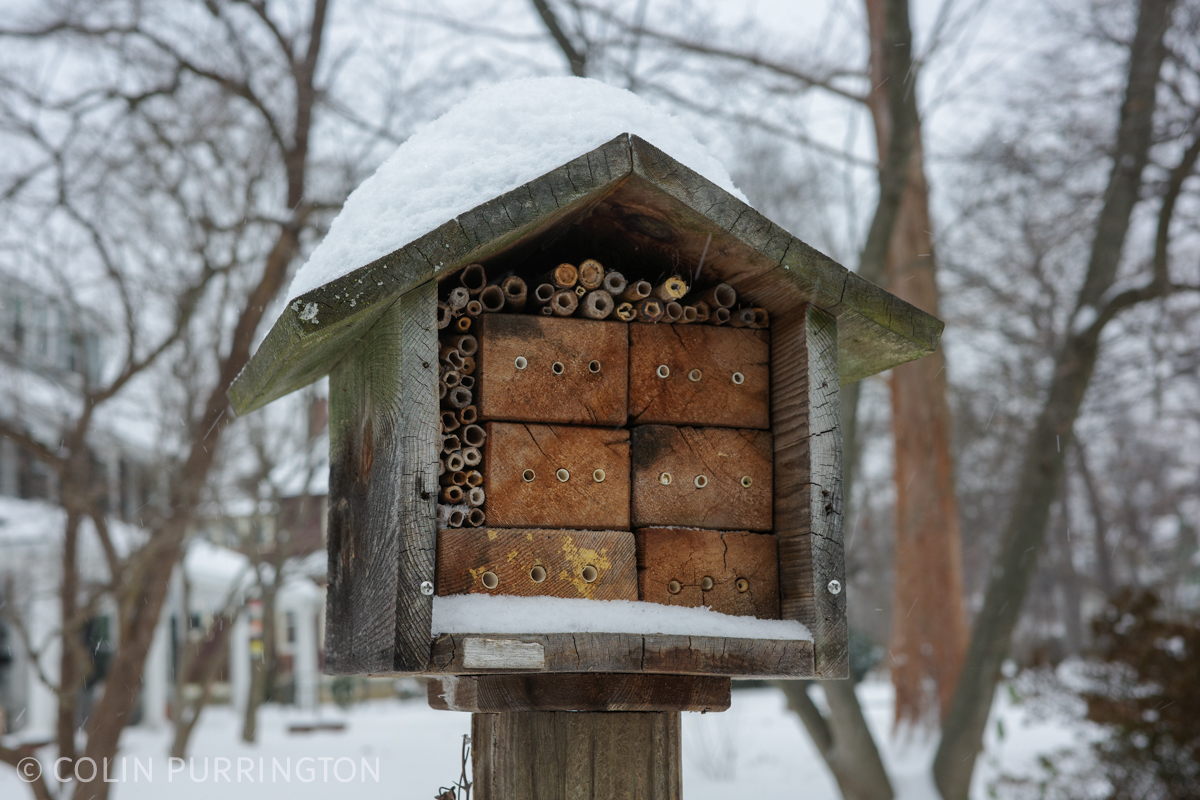
The cold and snow this winter have prevented me from taking many nature photographs, so it was a treat to have a look inside my two insect hotels. The one below is in the front yard. As you can see, it has a mix of hollow stems and wood blocks that have holes lined with paper straws. I split open the stems and unravel the straws to see who is inside, a process that is interesting but also allows me to kill any non-native, invasive parasites I find. I.e., I don’t want my hotels to be a breeding facility for pests and pathogens that might spread out and harm populations of local bees and wasps.
Bees

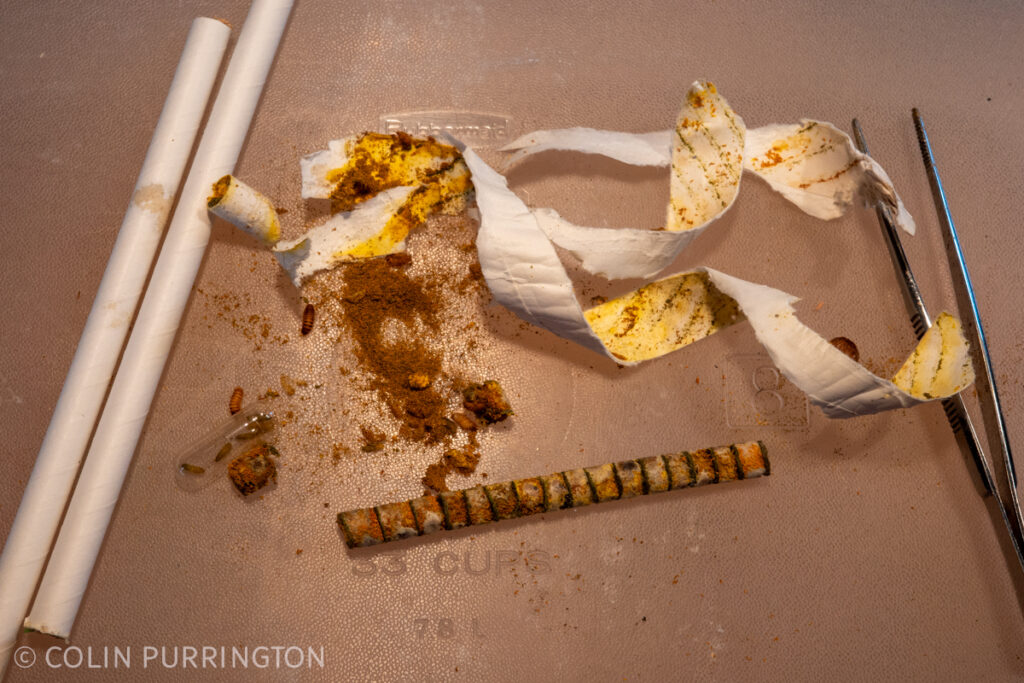
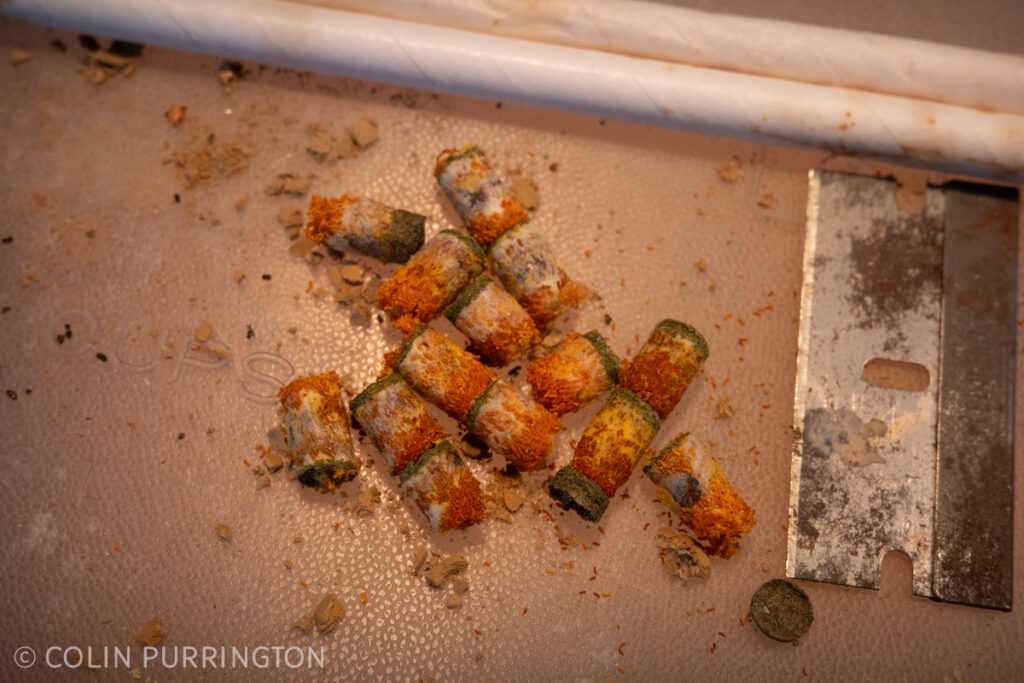
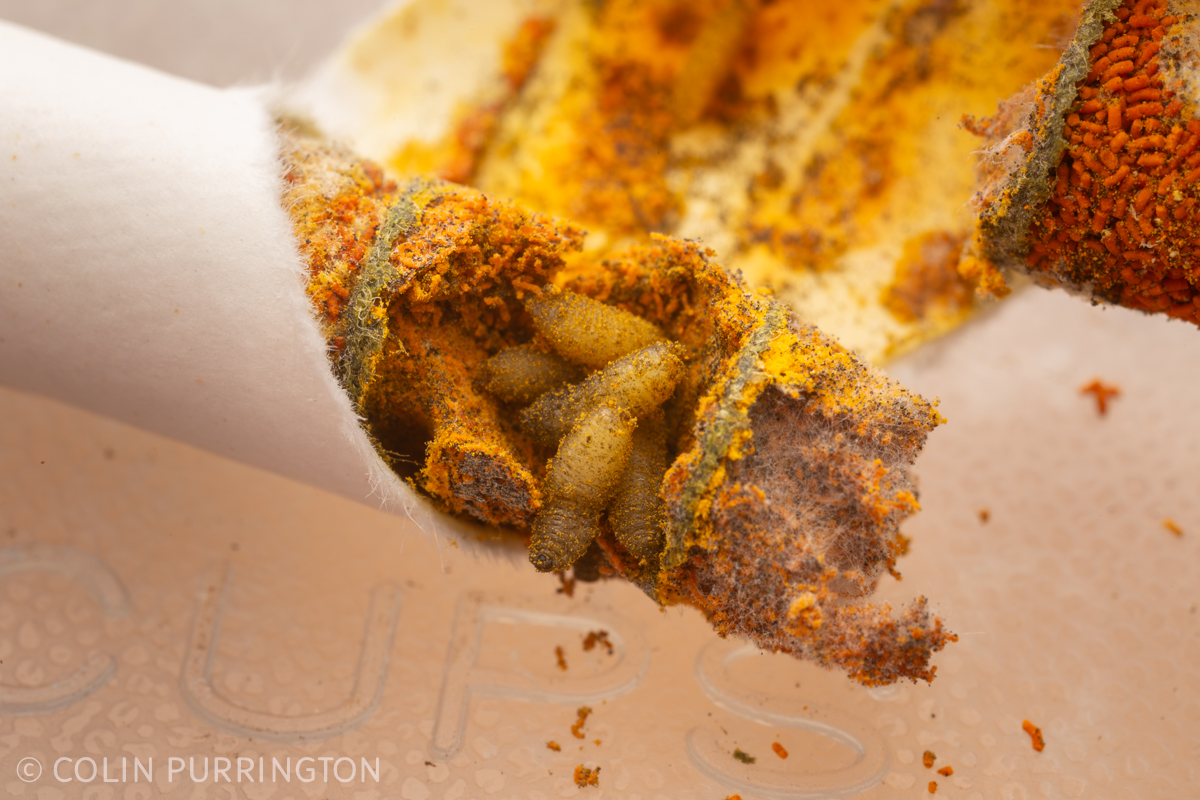
The most common mason bee this year was Osmia georgica, a native that can be recognized by its bright orange frass and circular, green, felt-like plugs that separate the cocoons inside the nesting tunnel. Here’s an adult if you’re curious what they look like.
There was also a mystery bee that is currently in a vial and will hopefully emerge sometime this spring. It’s unlike anything I’ve found before but somewhat resembles the cocoon of a resin bee. But much smaller than the cocoon of a sculptured resin bee (pic) that I often find in my hotels; this species is non-native and kind of a bully toward native species so they are unwelcome visitors.
Wasps

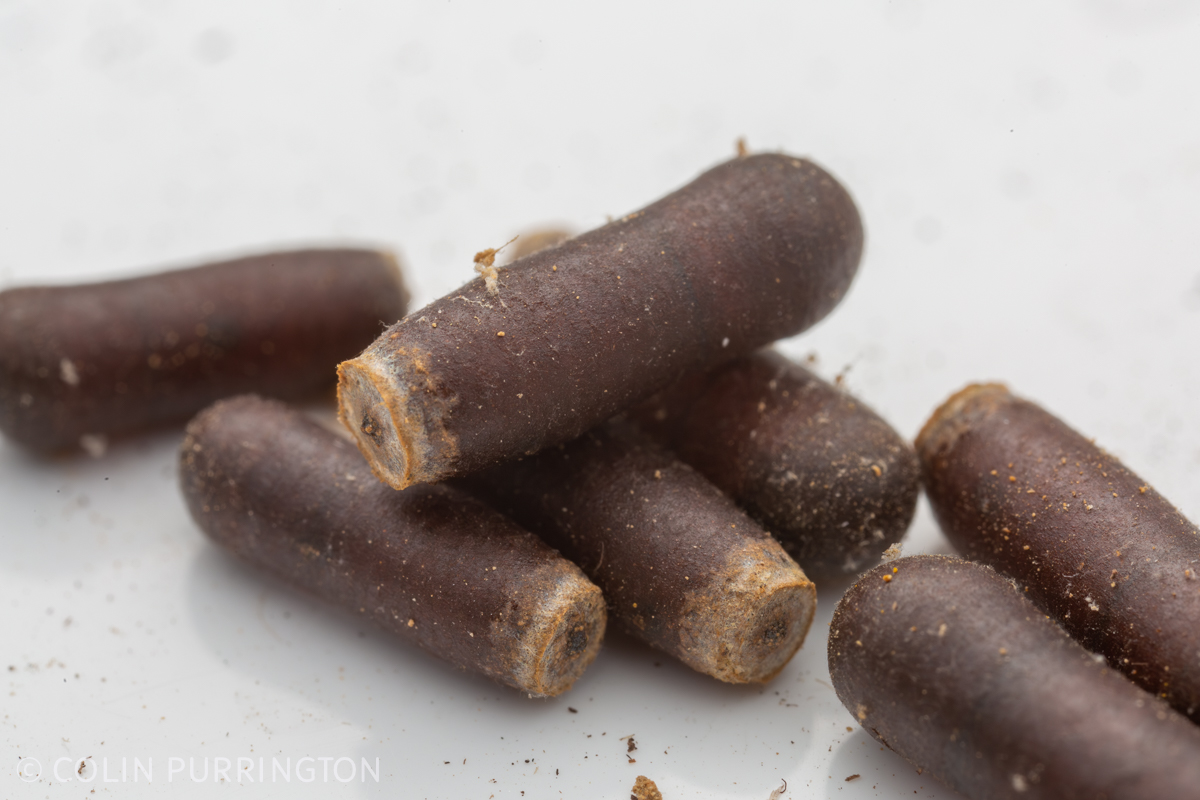
These are cocoons of Trypoxylon collinum, a spider-provisioning wasp (pic of adults) that I also get every year, especially in the front yard (maybe they like morning sun?).
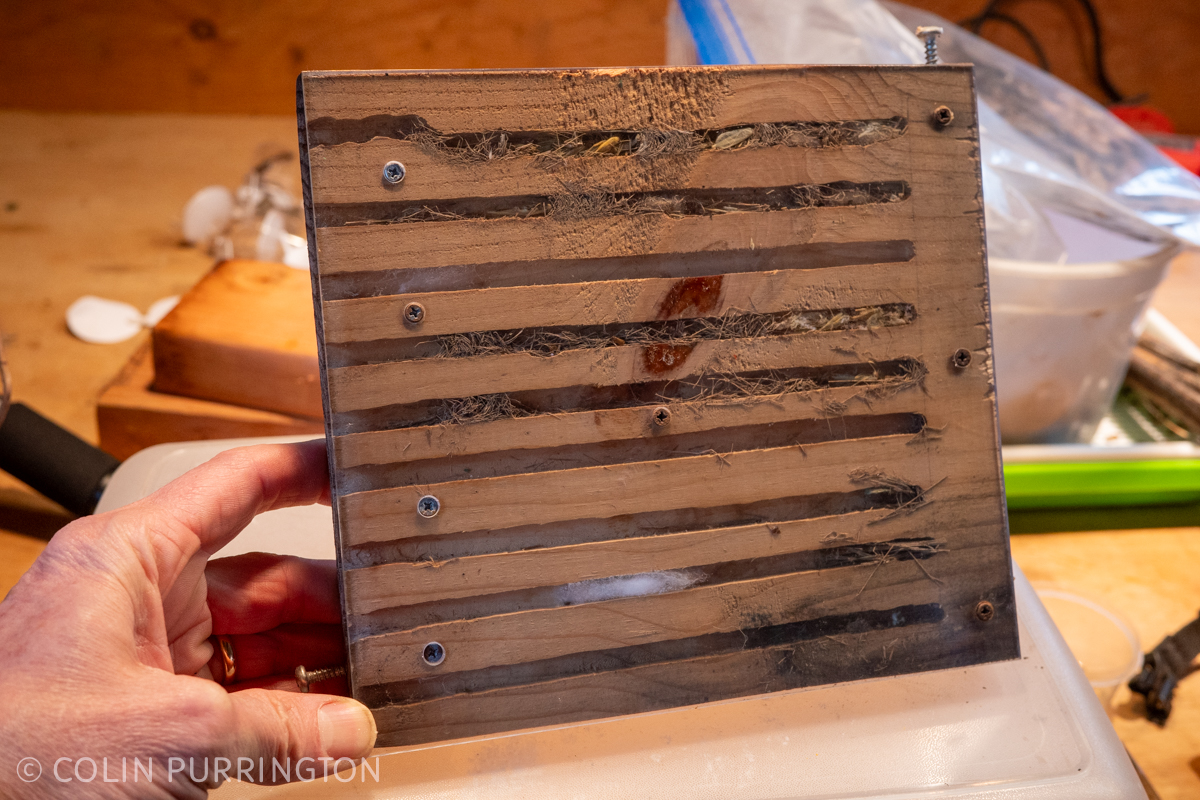
I also got a few grass-carrying wasp pupae but I forgot to take any closeups (here’s one from past). For some reason the females prefer to nest in observational panel. The tunnels are full of grass and dead crickets but the larvae are there.
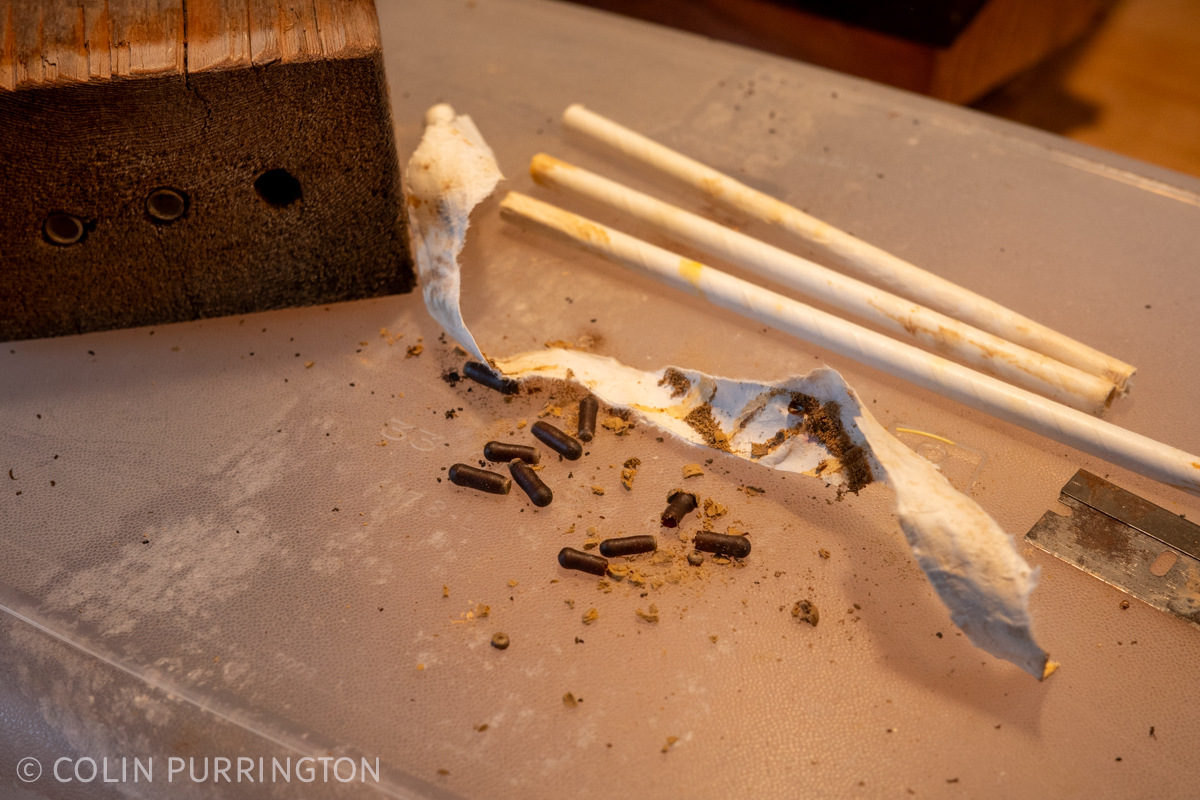
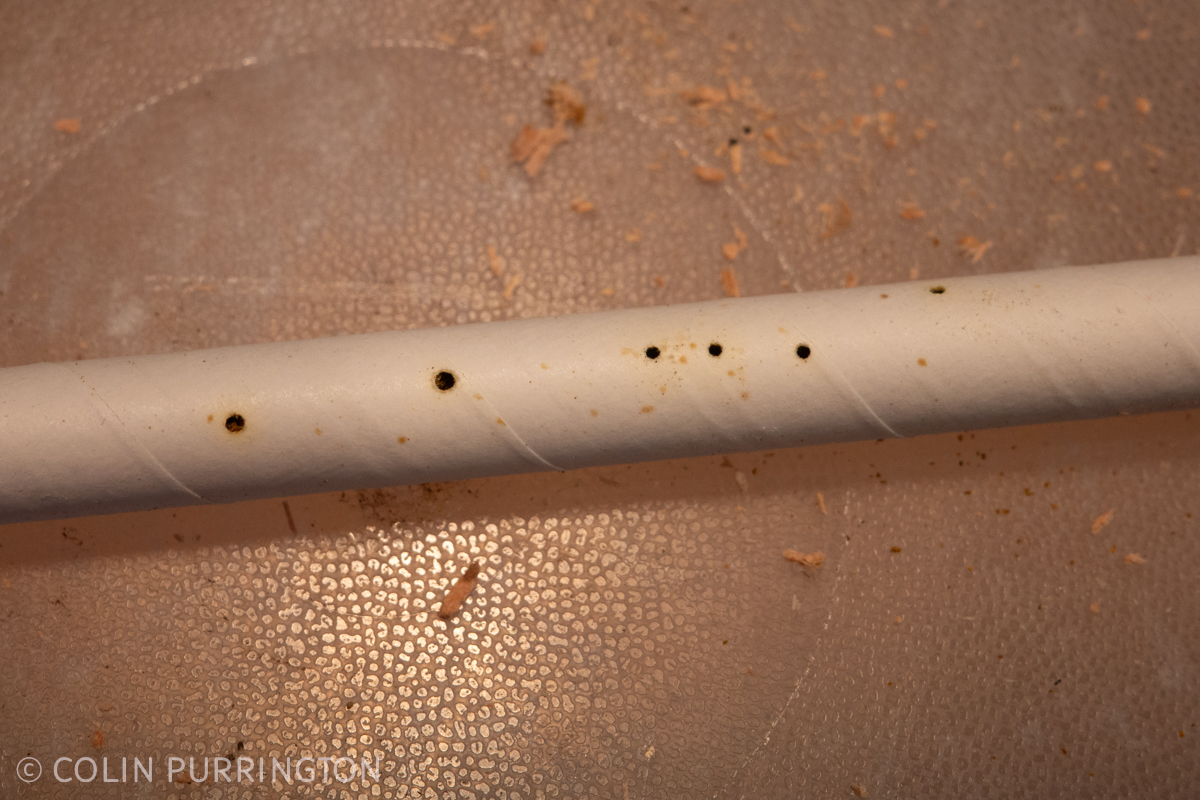
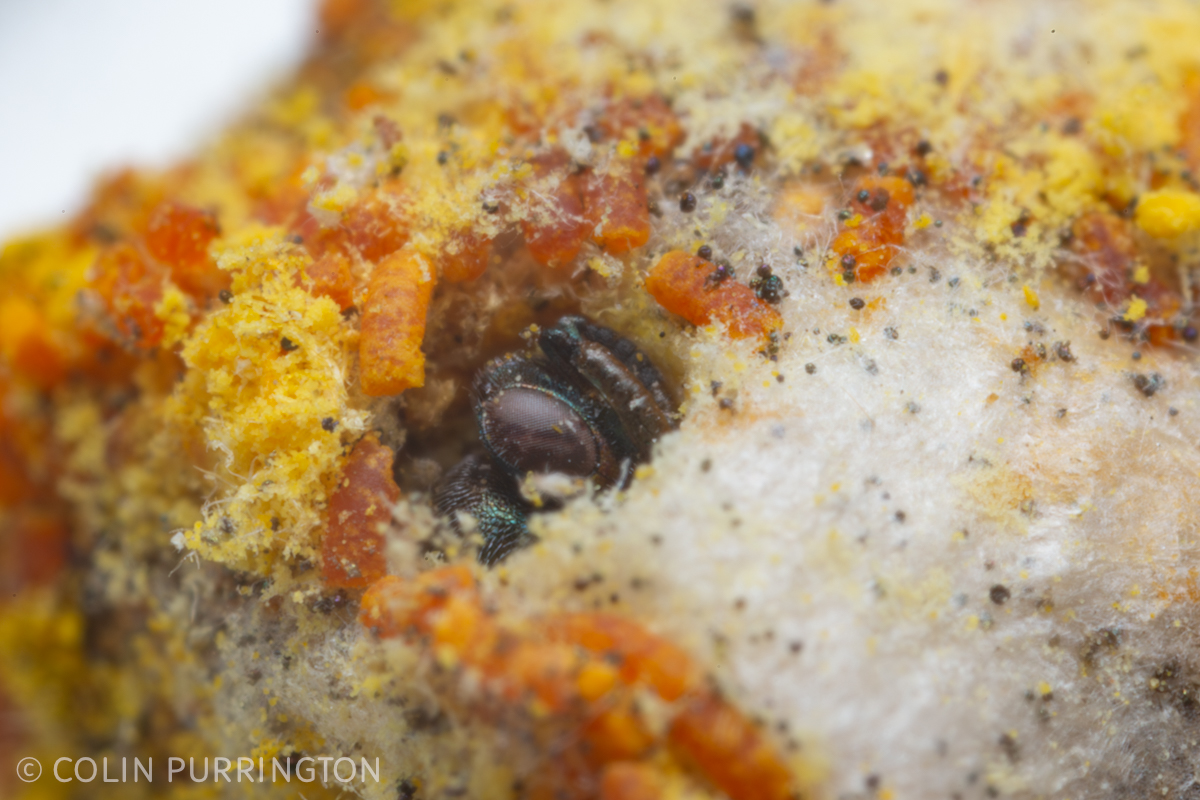
As always, some of the mason bee cells were filled with adult, dead Monodontomerus sp., a parasitoid. I can easily tell they are inside because they have partially chewed exit holes through the straw. When you unwrap the straw the adults are still inside the bee cocoon, apparently unable to exit because the straw is wedged into the drilled hole tightly. In the real world the wasps would chew through the stem and be able to escape. I have pics of larvae, trapped adults, and a female).
Flies

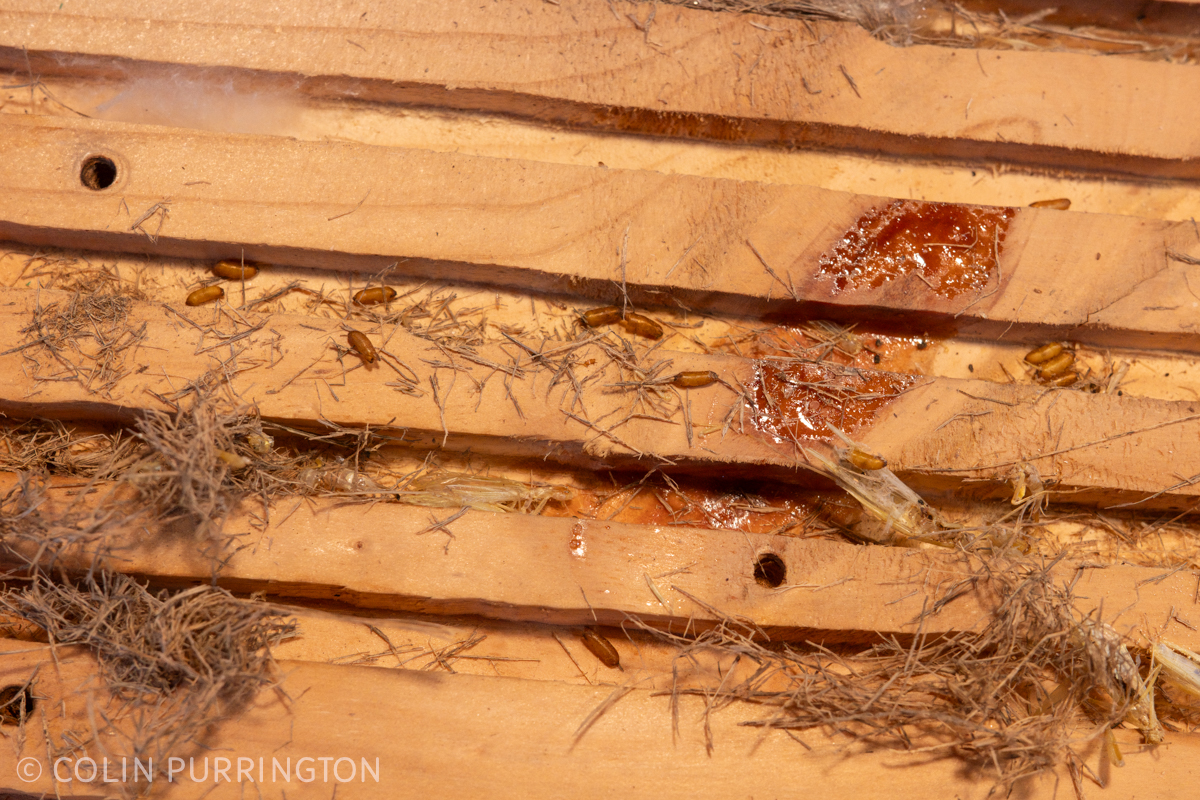
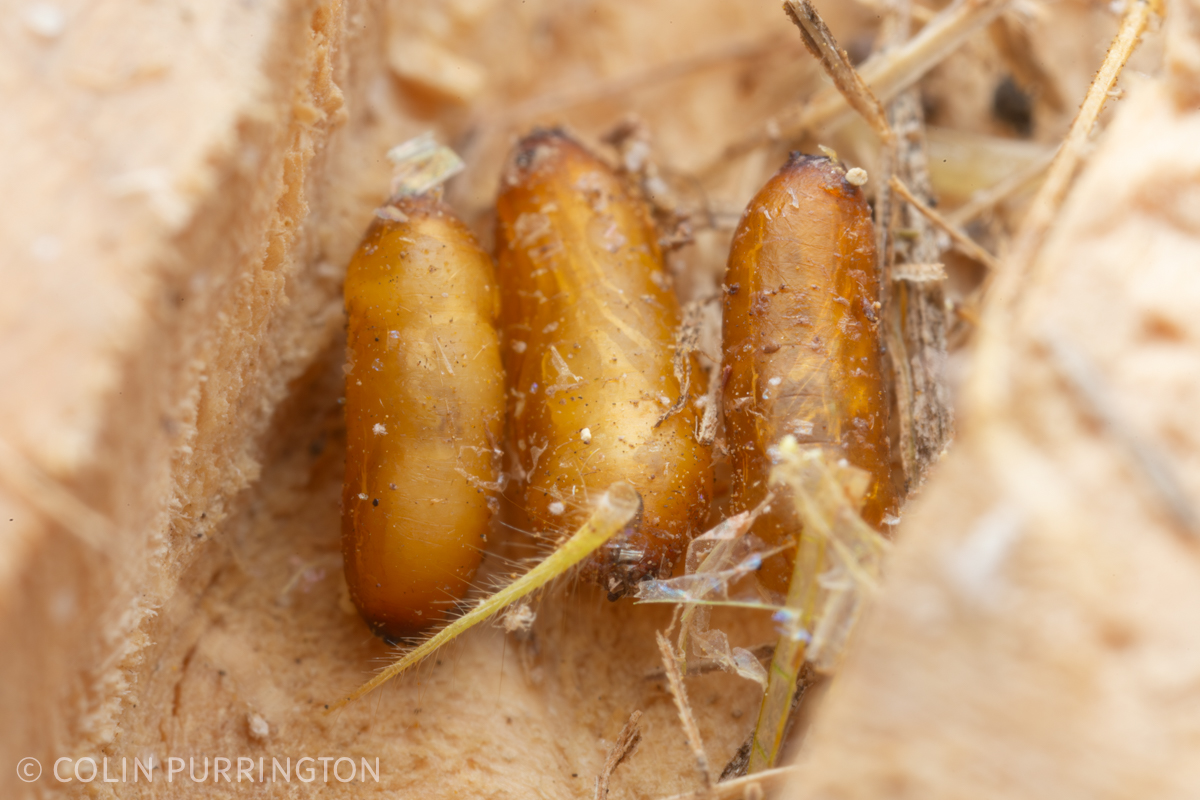
I’m not sure of the ID, but I found small dipterous (I think) pupae scattered around the observation window. Given their small size and the fact that grass-carrying wasps were the only residents, I’m wondering whether they might be scuttle flies, which are known to be parasites. E.g., Megaselia aletia (Medler 1965). I’ve saved the pupae and will attempt to get photographs of the adults.
Several of the mason bee cells were infested with the kleptoparasitic, non-native Houdini flies (Cacoxenus indagator, adult). I usually kill them but this batch is bound for a researcher who needs them.
Bugs

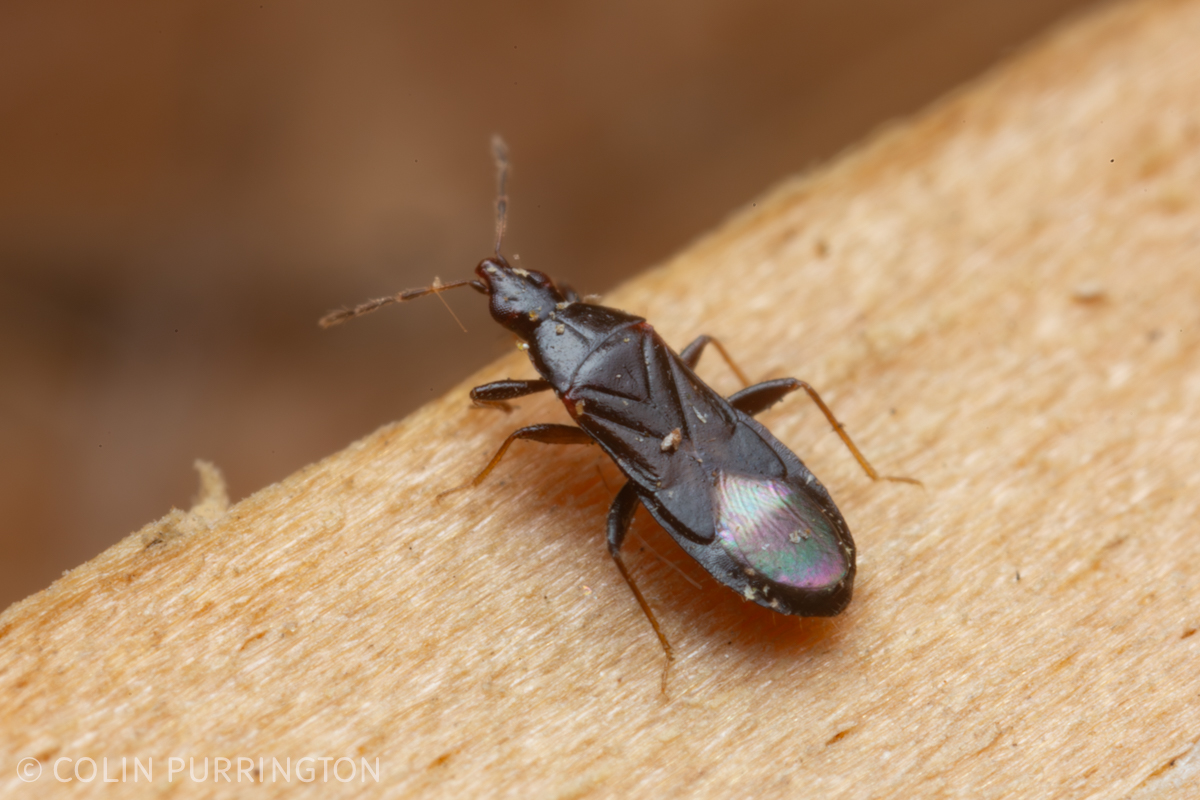
As in most years, the observation panel had several Dufouriellus ater individuals, members of the minute pirate bug family (Anthocoridae). I can confirm that they are minute but also that they rarely sit still and are thus a royal pain to photograph. The nymphs are bright red and even smaller.
Beetles

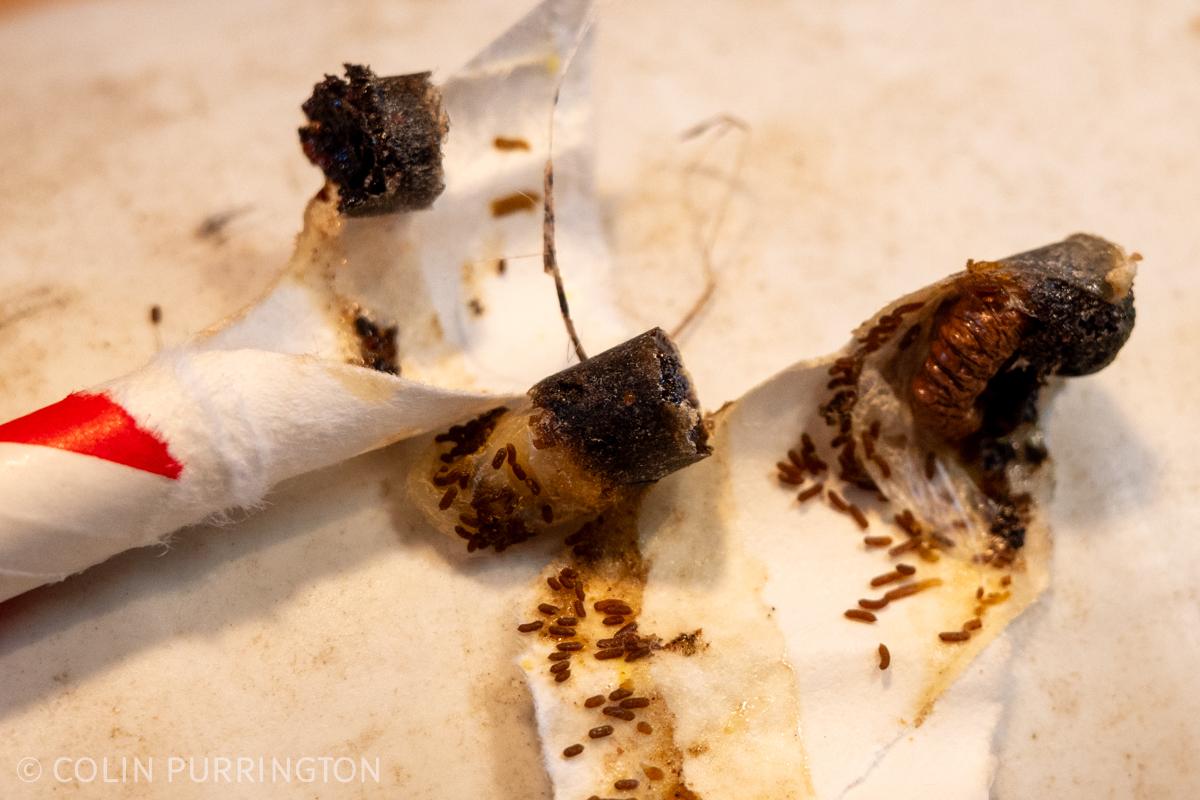
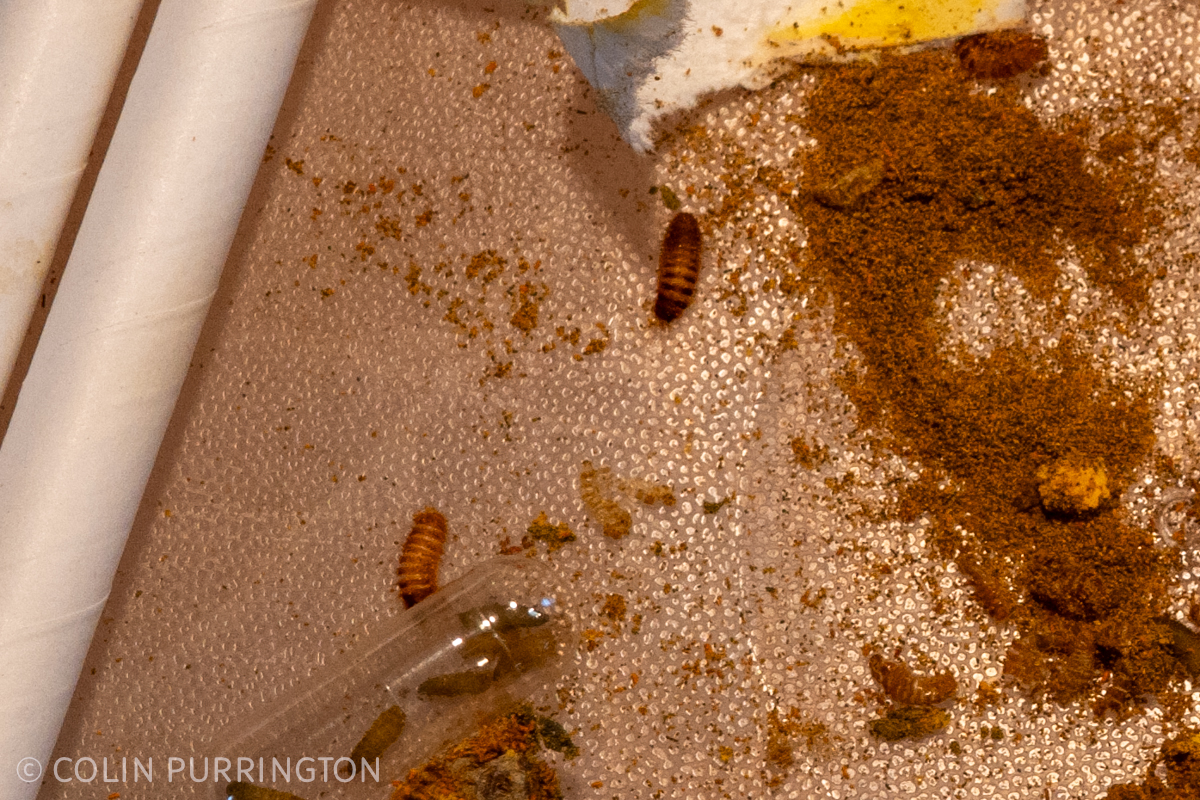
These two larvae are dermestids and were found inside mason bee nests where they had eaten several of the pupae. They are unwelcome residents and are an important reason why it’s important to clean insect hotels.
Spiders

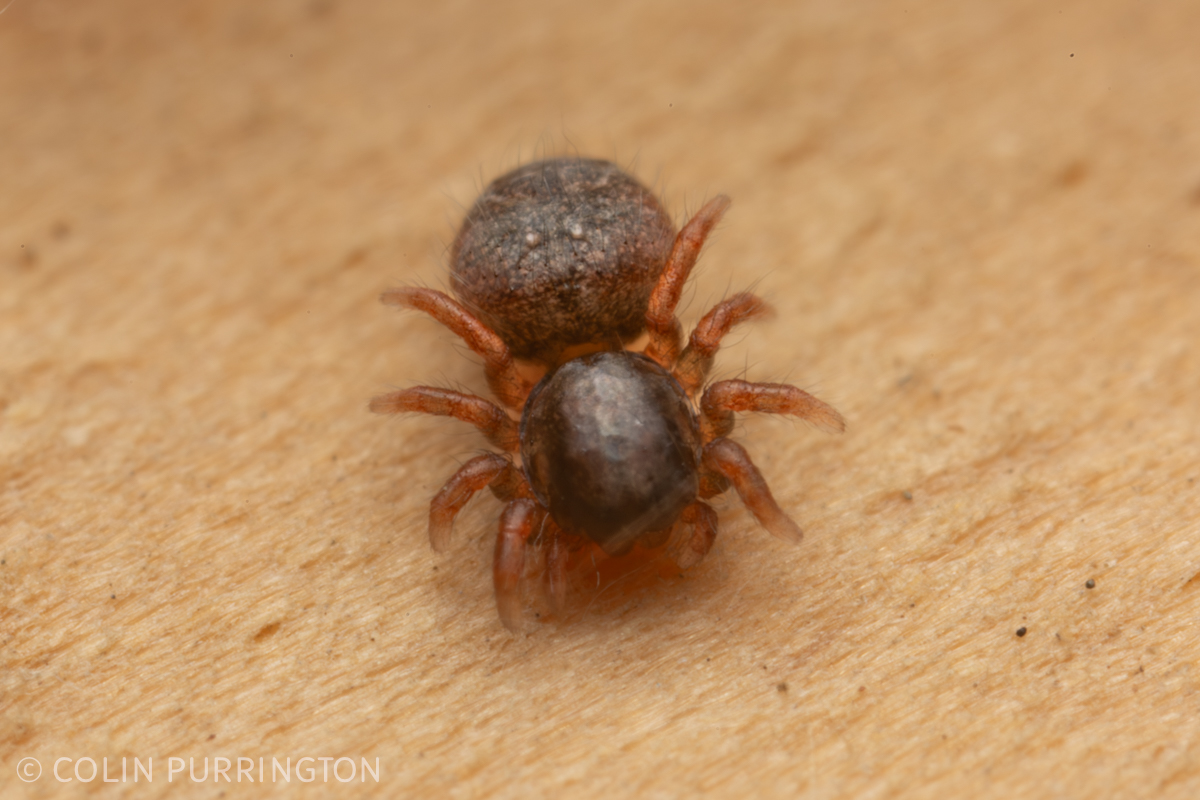
There was a nest of spiderling jumping spiders in the observation window and they were unspeakably cute, with a thorax that looked liked hammered copper. Note that I typically relocate spiders when I find them on the hotel grounds during the season. For reasons.
Cleaning and restocking

In case of interest, all the pupae go into containers and placed in protected locations outside so that when they emerge in late March they can go on to live their lives. If I’m outside I’ll stop by the location multiple times per day to look for emergers to photograph.

I then bake the wood blocks to kill any remnant dermestid larvae, pollen mites, and pathogens that might be lurking inside. I also sweep out the house structure and drench it with a bleach solution. After everything is dry I’ll restock the house with blocks and stems.

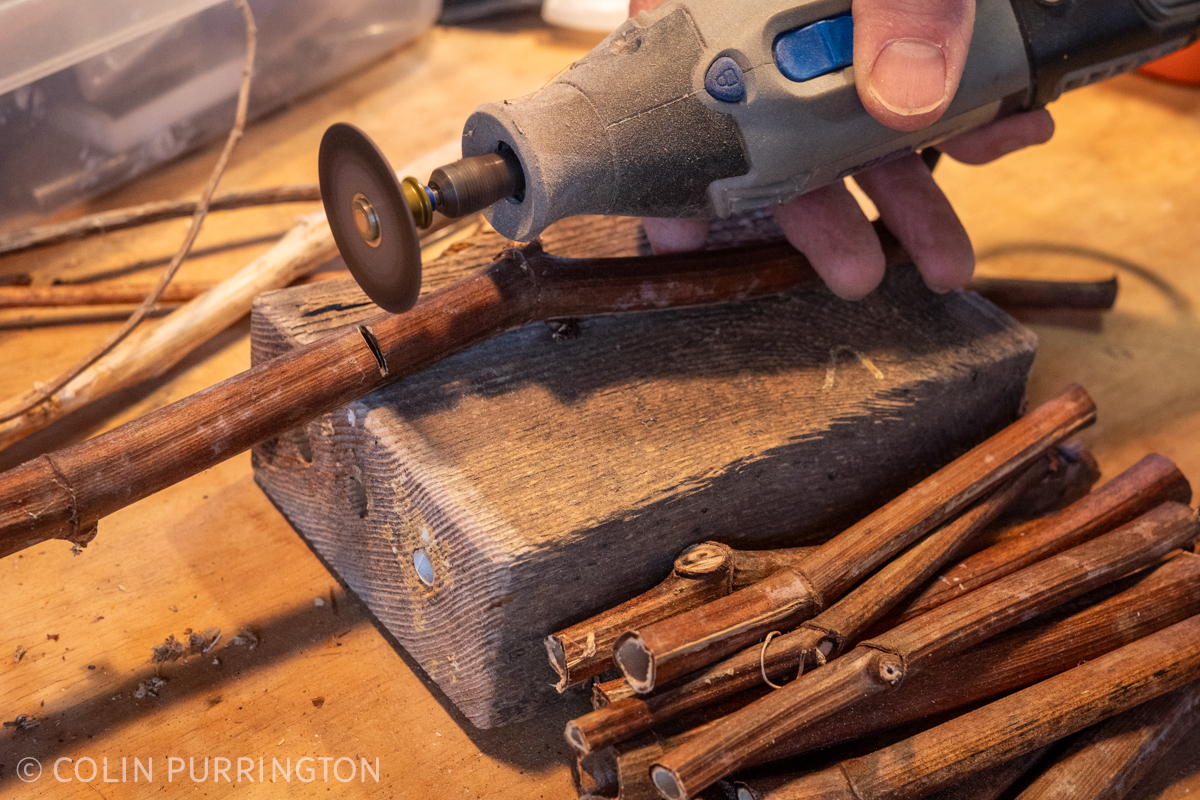
Here’s an action shot of me making new stems sections with a cut-off blade attached to a Dremel.
If you’re envious, here’s where to buy an insect hotel. Or you can build your own. For help identifying a resident, please browse the “Bee and Wasp Hotels” project on iNaturalist. Send me a message if you have questions.

Sorting through guests at my insect hotels

When the weather is cold and rainy in winter, I entertain myself by bringing the nests from my bee and wasp hotels inside for photo ops and cleaning. With a hot cup of tea (I’m in a cold basement), I carefully open up all the occupied nesting tunnels, then put the cocoons and larvae into vials so I can see who eventually hatches out in the spring. Here’s my set-up before I made a complete mess:

Removing the paper liners (here, straws from a local supermarket) from the nesting blocks is much easier with a pair of forceps. The blocks are necessary because if I just crammed paper straws into my bee hotel, every single nest would be parasitized by wasps that could easily get access to the larvae along the length of every straw.

Below are the cocoons of a mason bee, separated by mud plugs and covered with frass. They are probably Osmia cornifrons (pic of adult) or Osmia taurus (pic of adult), both introduced species that are frequent visitors at my hotels. Unwrapping the straws is usually pretty easy, but sometimes you need to use the forceps to grab onto the edges to complete the job.

I also had two stems filled with Georgia mason bees (Osmia georgica), a native species that has a beautiful blue body (pic of adult). It has smaller, bright orange frass and uses chewed plants to seal partitions. It also smells different.

Below is a visual reminder of why I need to sort through my nests each year: Houdini flies (Cacoxenus indagator). These kleptoparasitic dipterans eat the pollen balls that mason bees feed on, resulting in the death of the bee. So when I find them send them along to fly heaven. The common name is from their ability to bust open the mud plugs (they have inflatable heads for the job). Here’s a pic of an adult.

I also had grass-carrying wasps move into the observation panel, below, that I built a few years ago. There’s one nest near the top, and one at the very bottom, possibly provisioned by the same female. Because this panel slides in and out of the hotel easily, I was able to get a photographs of the adult, an egg, and a larva last year.

Here’s a close-up of the cocoon from the panel. It’s quite large. A photograph of a cleaned-up cocoon from a previous year is on my iNaturalist account if you want a better view. If you have a good eye, you might be able to make out a book louse (Liposcelis sp.) on the left-hand side of the cocoon. Here’s a close-up from a previous season if you’re curious.

One of my bee hotels is packed full of hollow stems, so for these I use a knife to split them open. Here’s a brood of potter wasps inside one of them. I’m not sure what species they are (or even genus) but I’ll know in several months when they hatch and I can get an identification on iNaturalist. And there’s a possibility that one or more of the larvae is harboring an internal parasite, too. Or at least that’s what happened in a previous year, when a beetle appeared (see my post about it). A beetle parasitizing one of my wasps was not on my Bingo card that year. I love surprises like that.

In the smaller stems I get lots of these cocoons, likely Trypoxylon collinum (pic of adult), a charming little wasp that feeds very small spiders to its young.

Although I enjoy looking through the nesting tubes, the main reason I do it is to make sure I’m not just breeding Houdini flies, pollen mites (pic), and pathogens that could easily spill out into bee and wasp populations near my house. I.e., if during my cleanings I felt that I was doing more harm than good to local native species, I’d shutter my hotels and find alternate entertainment.

As you may have noticed during the above, I love wasps. So if you have a bee hotel and get wasps, that’s a bonus, not a problem. And thus I implore everyone to not kill the larvae and the pupae simply because they are not mason bees. They both pollinate plants, plus wasps are fantastic at patrolling your vegetable gardens for pests, which they take back to their nests to feed to their young. If you’re on the fence about wasps, consider treating yourself to book on their biology and identification. I have Heather Holm’s fantastic Wasps: A Guide for Eastern North America. I’ve also heard great things about Eric Eaton’s Wasps: The Astonishing Diversity of a Misunderstood Insect and Seirian Sumner’s Endless Forms: The Secret World of Wasps.

More information

Below are my other posts about insect hotels if you want to learn more. If you have a question, send me an email via my Contact page.

Boxes of Spartan Mosquito Eradicators and Spartan Mosquito Pro Techs.

Spartan Mosquito settles class-action fraud suit for $3.6 million

This week, details of the settlement in the class-action lawsuit against Spartan Mosquito (Hattiesburg, Mississippi) were revealed. The lawsuit accused Spartan Mosquito of falsely advertising that the Spartan Mosquito Eradicator (yeast, sugar, table salt) and the Spartan Mosquito Pro Tech (yeast, sugar, boric acid) attract and kill mosquitoes, and that the company did so with the full knowledge that such claims were false.

Components of the settlement

  1. Spartan Mosquito will pay approximately $3,600,000.
  2. People who purchased either of the products between December 21, 2016 and August 2, 2023 can submit claims for compensation.
  3. Spartan Mosquito will no longer make or sell the Spartan Mosquito Eradicator.
  4. Spartan Mosquito will conduct efficacy tests on the Spartan Mosquito Pro Tech for 18 months, and if testing reveals lack of efficacy the company will change the formulation or cease sales.

Here is the full text of the two non-monetary provisions (bolding mine):

  1. 12.1. As of the Final Effective Date, Defendant will no longer manufacture or sell the Spartan Mosquito Eradicator. However, the Parties acknowledge that some third-party wholesalers, distributors, or retailers outside of Defendant’s control who previously purchased the Spartan Mosquito Eradicator for resale may continue to list the product for sale, and such sales will not be attributed to Defendant for the purposes of this Section 12.1. This Court shall have continuing jurisdiction if a dispute arises between Class Counsel and Defendant concerning Section 12.1.”
  2. 12.2. During the 18-month period following the Final Effective Date, to the extent not already performed, Defendant will conduct research regarding the efficacy of the Spartan Mosquito Pro Tech. Following the 18-month period, to the extent such testing shows a lack of efficacy for the Spartan Mosquito Pro Tech, Defendant will either update the formulation or cease sales of the Spartan Mosquito Pro Tech. This Court shall have continuing jurisdiction if a dispute arises between Class Counsel and Defendant concerning Section 12.2.”

The first part is uninteresting because the company stopped producing and selling the Spartan Mosquito Eradicator in 2020. It made this decision presumably because approximately 18 states had banned sales and more are likely to do that in the future. More importantly, the company decided to advertise that the new version (Pro Tech) needed to replaced every 30 days (instead of every 90 days) and that twice the number of tubes were needed per acre. I.e., the new tube would generate much more profit.

The second part is concerning. Although it says that if the company can’t show efficacy of the Spartan Mosquito Pro Tech by early 2025 then it must stop sales, the wording suggests that the company will be allowed to conduct its own efficacy testing. The wording also appears to allow Spartan Mosquito to assert that it already has such data. Such wording virtually guarantees that the company will be allowed to continue making and selling its tubes even though they do not attract or kill mosquitoes. I.e., examination of the company’s testing data (which I obtained via public records requests) shows that Spartan Mosquito does not have any field testing that shows (1) mosquitoes are attracted to the Pro Tech, that (2) mosquitoes drink the fluid inside the tubes, or that (3) the numbers of mosquitoes are reduced in a given area. The testing documents (which include details on experimental design) also show that Spartan Mosquito doesn’t currently employ personnel who have the requisite qualifications to run field trials or even basic laboratory experiments. Indeed, all of their tests are so poorly done that they were labelled, “not conducted in full compliance with Good Laboratory Practices” (an EPA term).

The second part also says that if efficacy cannot be shown, that Spartan Mosquito must “update the formulation.” Under this scenario, the company would need to submit an entirely new registration application to the EPA, complete with new efficacy tests. I think the EPA would be extremely unlikely to ever grant another registration to this company. I suspect the company knows this, which will motivate them to claim, despite evidence to the contrary, that the current formulation has efficacy.

Both parts contain an interesting phrase, however: “This Court shall have continuing jurisdiction if a dispute arises between Class Counsel and Defendant.” Optimistically, I take that to mean that if Spartan Mosquito sells the Pro Tech without ever sharing convincing evidence of efficacy, the presiding judge, the Honorable Katherine Levine, may intervene in whatever way she sees fit. Attorneys on both sides signed off on that binding language so it will be very interesting to see how this goes down. I will make sure she’s kept up to date.

Why did Spartan Mosquito settle?

Aside from avoiding paying the full $5 million asked for in the original charge, Spartan Mosquito was likely concerned, or should have been, that the evidence that would be revealed during a trial would be used by attorneys at the Environmental Protection Agency, which has apparently been collecting information on the company. In particular, the EPA can ask for prison terms for any individuals who knowingly mislead the government about pesticide efficacy. The co-founders, Jeremy Hirsch and Chris Bonner, could have been advised by their attorneys that they had some exposure in that regard. For example, if both of them have known for years that the tubes don’t produce enough carbon dioxide to attract mosquitoes, then asserting to federal regulators that the tubes attract mosquitoes would be a knowingly false claim. And that appears to be what they did.

More information

Please see my previous posts about Spartan Mosquito, or email me.

Consider donating to my GoFundme campaign

My legal battle with Spartan Mosquito is over but I’m still $36,000 in the hole. Donations and/or shares would be hugely appreciated: https://gofund.me/fe59f642.