
Tag Archives: bees

Red wine trap for controlling Houdini flies at bee hotels

Per posts on Reddit and Facebook, jars baited with malbec can trap Houdini flies (Cacoxenus indagator), an invasive kleptoparasite of solitary bees in the genus Osmia. The species was first reported in New York in 2011 and has since appeared in Maryland, Massachusetts, New Jersey, Oregon, Pennsylvania, Virginia, Washington, and British Columbia. For anyone with an insect hotel in an affected area, brood losses can be considerable so the news of a control method is welcome news. Currently hotel owners deal with the parasites by squishing them one by one, vacuuming them up, or trapping them on sticky cards situated in the eaves. All of these techniques seem futile given that a single Houdini fly can leave hundreds of eggs.

The trap

The general idea is to put the wine into a container that has small, fly-sized holes, then situate in a nook in your insect hotel. I opted to use 2-oz containers that I had sitting around but several posters on reddit use small mason jars. I then drilled four, 1/8″ holes in the lids, attached segments of cork with a 1 5/8″ screw to either the side of the container or the lid, and then screwed it to the hotel.
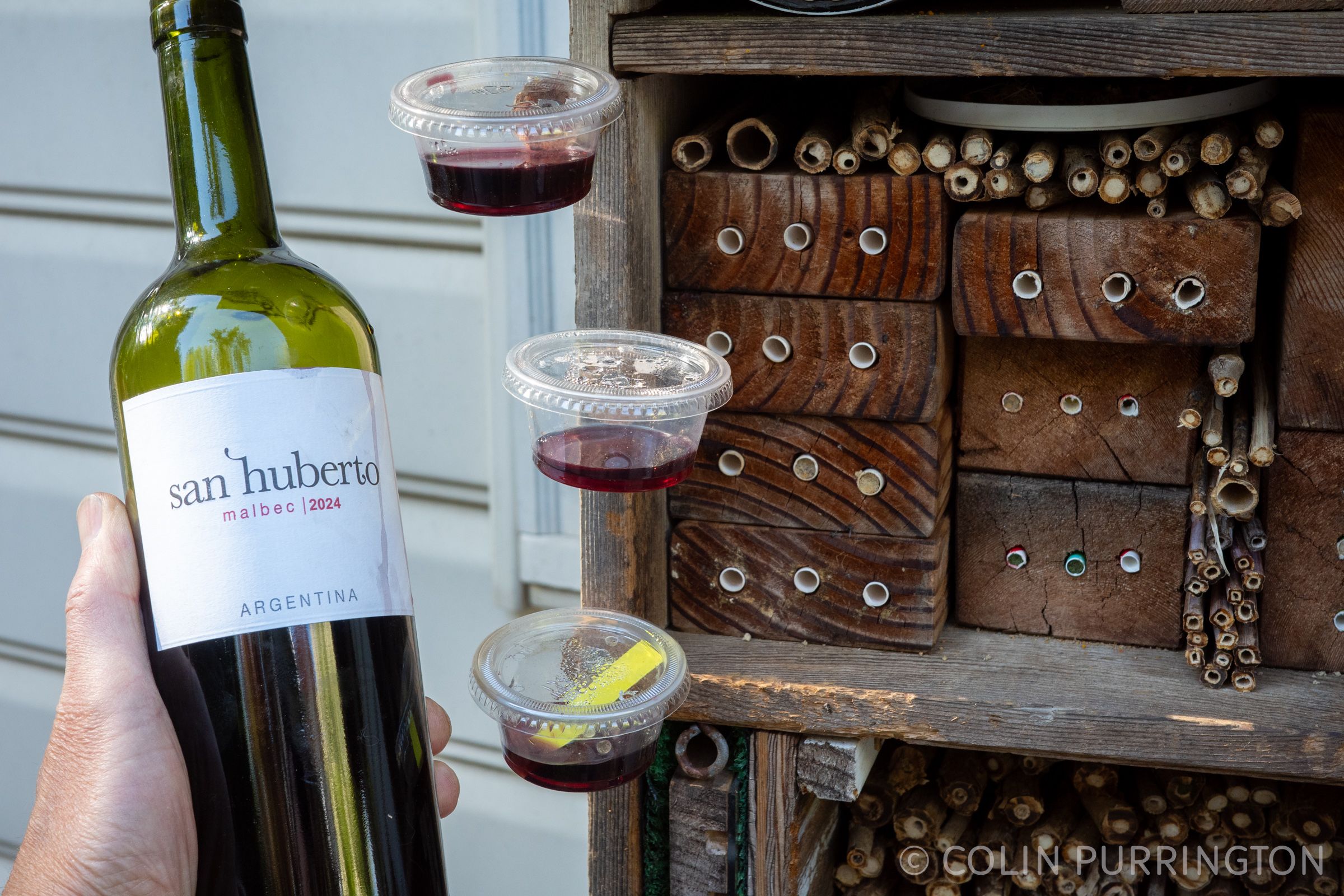
Evidence that it works

I set mine up too late in the season to estimate how many Houdini flies can be trapped per day, but I can confirm that some did go inside the traps and drown. Here are two:
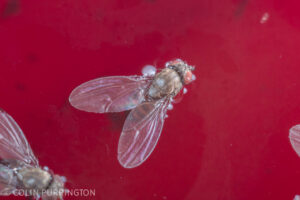
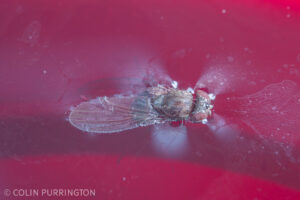
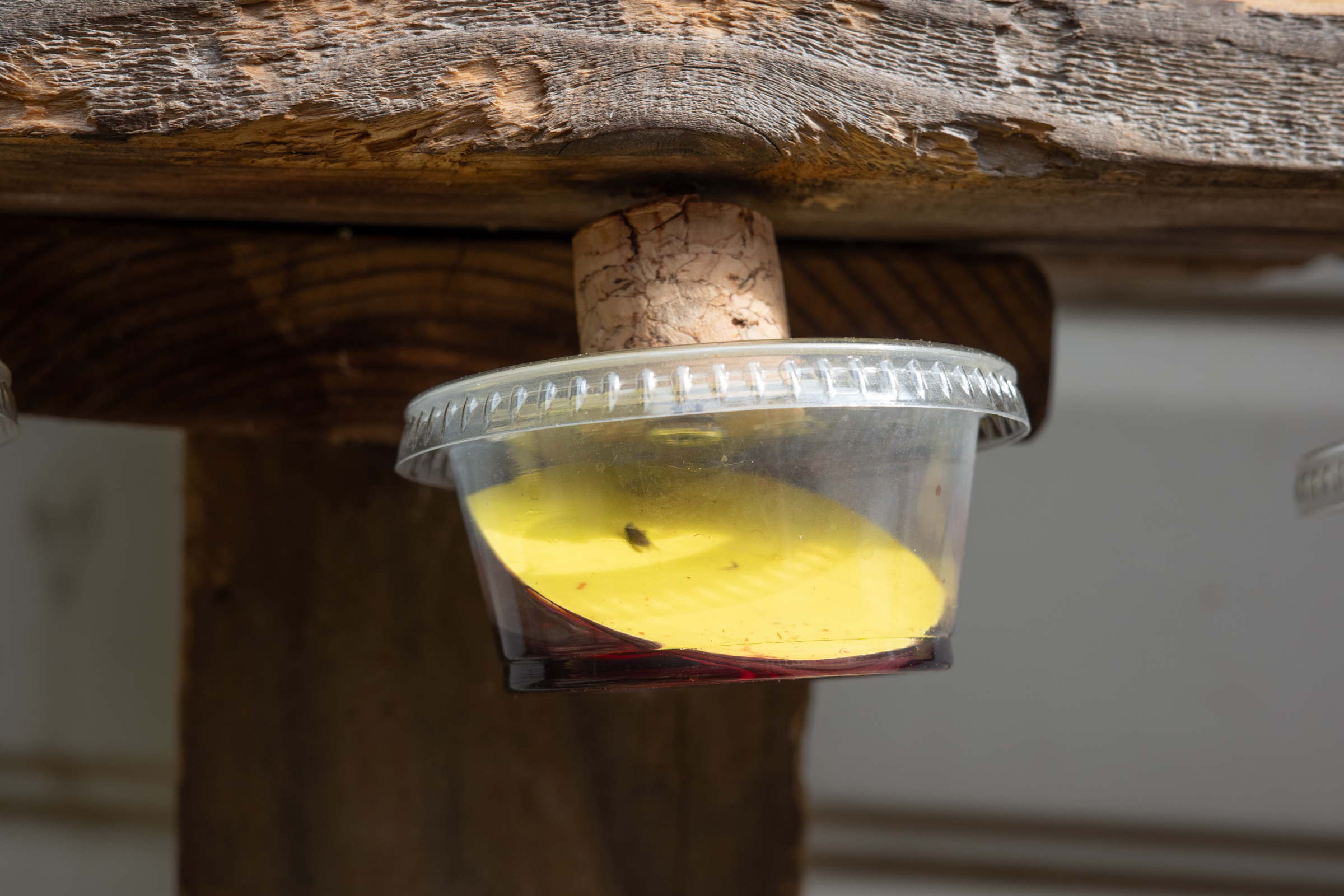
Small waterlogged flies are difficult to identify even when you have decent photographs, so I eventually fitted the containers with sticky cards that would immobilize insects before they drowned. Here’s a trap attached via the lid and a Houdini fly that got stuck:
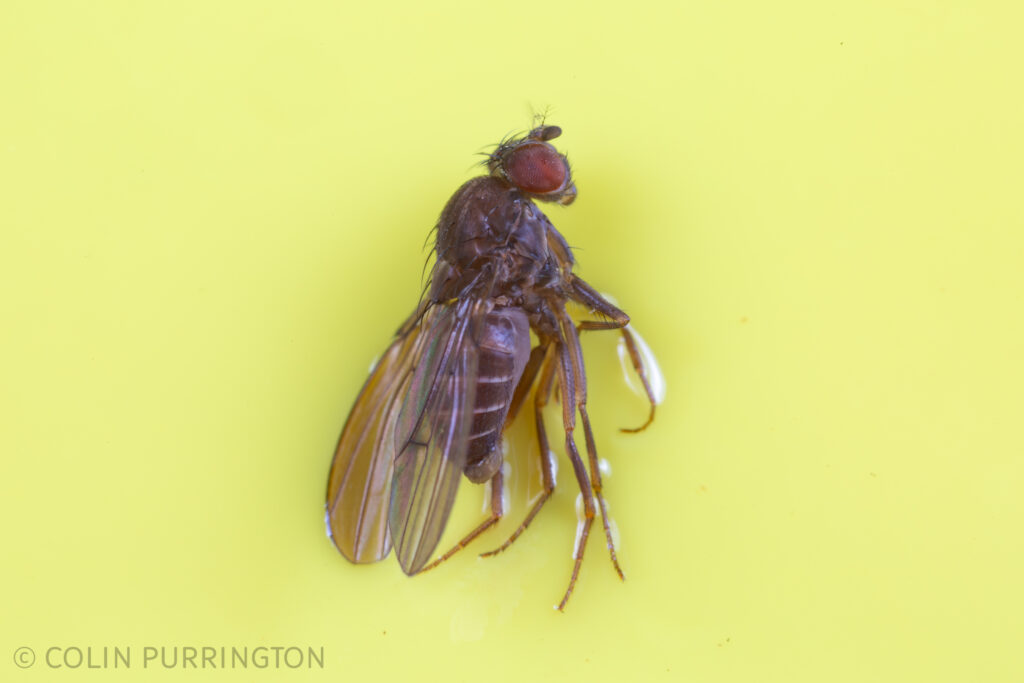
I should emphasize that my traps also caught dozens of small fruit flies that were not Houdini flies. So if you are trying this trap method be cautious in deciding whether it’s actually working or whether it’s just attracting small flies that happen to like red wine. I encourage everyone to use sticky cards and to submit photographs for ID confirmation to either BugGuide (North America only) or iNaturalist. If you opt for the latter you’ll likely get input from me within 24 hours (I’ve ID’d 200 Houdini flies already).

Is it safe for bees?

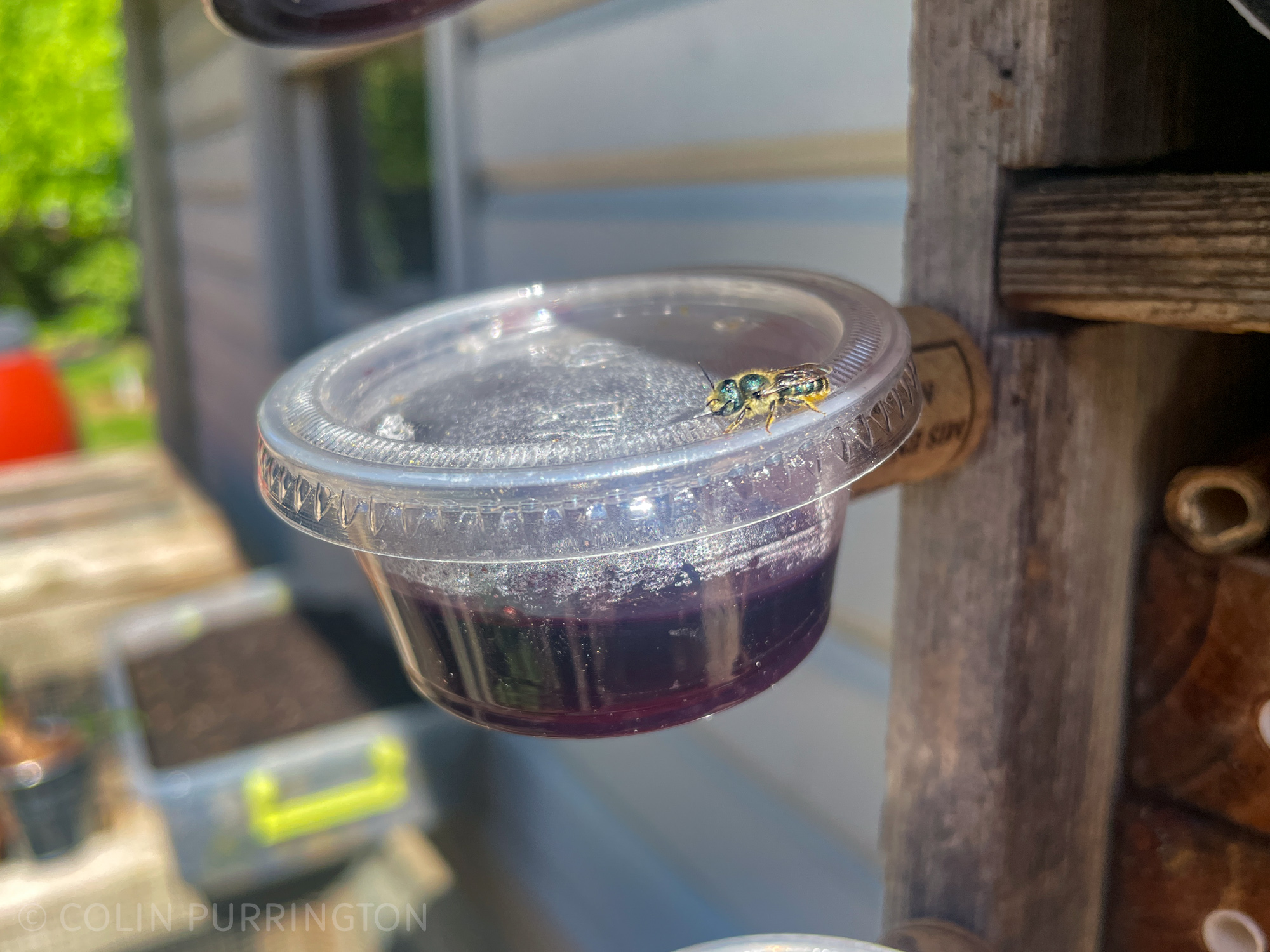
The holes are too small for many mason bee species but there are plenty of solitary bees that could fit into 1/8″ holes if they wanted to try. So far, however, none has become stuck in any of my nine traps. Some of the bees even use them as landing platforms because the sun hits them in the afternoon.
Design tips

Some thoughts that I’ll update as I continue with testing.

  • Opt for clear-sided containers so you have a better view of what is inside.
  • I’m now using a slightly smaller drill bit because 1/8″ allows rather big flies to enter.
  • Reddit user atrailofdisasters uses a red-pepper shaker, a solution that might work well for those who don’t have a drill and collection of small bits.

What wines work best?

Per reddit, the person who came up with the trap idea, Nicole Kenney, of Portland, Oregon, tested different wines for several years and decided that red wine, especially Argentinian malbec, is best. I have no idea how she did the tests but I’ll link to more information when I can find it. I’ve only tried malbec in mine but will do some comparisons next year during peak Houdini-fly season. Malbec is an old grape grown around the world but apparently thrives in Argentina and much of the acreage is in the mountains. It would be very interesting to know exactly which component is attracting the Houdini flies, of course.

Why does it work?

Houdini flies are members of the vinegar fly family (Drosophilidae) and are known to like fermenting fruit juice (source) so it’s not a surprise they are attracted to wine. And all animals are lazy so if there is food near where females are busy ovipositing, they will happily take a break to a have a drink.

More information

If you’d like to see photographs of Houdini flies I have about 20 on iNaturalist.

Please also see my blog post, “Houdini fly alert for owners of insect hotels.”

Annual cleaning of the insect hotels

The cold and snow this winter have prevented me from taking many nature photographs, so it was a treat to have a look inside my two insect hotels. The one below is in the front yard. As you can see, it has a mix of hollow stems and wood blocks that have holes lined with paper straws. I split open the stems and unravel the straws to see who is inside, a process that is interesting but also allows me to kill any non-native, invasive parasites I find. I.e., I don’t want my hotels to be a breeding facility for pests and pathogens that might spread out and harm populations of local bees and wasps.

Bees

The most common mason bee this year was Osmia georgica, a native that can be recognized by its bright orange frass and circular, green, felt-like plugs that separate the cocoons inside the nesting tunnel. Here’s an adult if you’re curious what they look like.

There was also a mystery bee that is currently in a vial and will hopefully emerge sometime this spring. It’s unlike anything I’ve found before but somewhat resembles the cocoon of a resin bee. But much smaller than the cocoon of a sculptured resin bee (pic) that I often find in my hotels; this species is non-native and kind of a bully toward native species so they are unwelcome visitors.

Wasps

These are cocoons of Trypoxylon collinum, a spider-provisioning wasp (pic of adults) that I also get every year, especially in the front yard (maybe they like morning sun?).

I also got a few grass-carrying wasp pupae but I forgot to take any closeups (here’s one from past). For some reason the females prefer to nest in observational panel. The tunnels are full of grass and dead crickets but the larvae are there.

As always, some of the mason bee cells were filled with adult, dead Monodontomerus sp., a parasitoid. I can easily tell they are inside because they have partially chewed exit holes through the straw. When you unwrap the straw the adults are still inside the bee cocoon, apparently unable to exit because the straw is wedged into the drilled hole tightly. In the real world the wasps would chew through the stem and be able to escape. I have pics of larvae, trapped adults, and a female).

Flies

I’m not sure of the ID, but I found small dipterous (I think) pupae scattered around the observation window. Given their small size and the fact that grass-carrying wasps were the only residents, I’m wondering whether they might be scuttle flies, which are known to be parasites. E.g., Megaselia aletia (Medler 1965). I’ve saved the pupae and will attempt to get photographs of the adults.

Several of the mason bee cells were infested with the kleptoparasitic, non-native Houdini flies (Cacoxenus indagator, adult). I usually kill them but this batch is bound for a researcher who needs them.

Bugs

As in most years, the observation panel had several Dufouriellus ater individuals, members of the minute pirate bug family (Anthocoridae). I can confirm that they are minute but also that they rarely sit still and are thus a royal pain to photograph. The nymphs are bright red and even smaller.

Beetles

These two larvae are dermestids and were found inside mason bee nests where they had eaten several of the pupae. They are unwelcome residents and are an important reason why it’s important to clean insect hotels.

Spiders

There was a nest of spiderling jumping spiders in the observation window and they were unspeakably cute, with a thorax that looked liked hammered copper. Note that I typically relocate spiders when I find them on the hotel grounds during the season. For reasons.

Cleaning and restocking

In case of interest, all the pupae go into containers and placed in protected locations outside so that when they emerge in late March they can go on to live their lives. If I’m outside I’ll stop by the location multiple times per day to look for emergers to photograph.

I then bake the wood blocks to kill any remnant dermestid larvae, pollen mites, and pathogens that might be lurking inside. I also sweep out the house structure and drench it with a bleach solution. After everything is dry I’ll restock the house with blocks and stems.

Here’s an action shot of me making new stems sections with a cut-off blade attached to a Dremel.

If you’re envious, here’s where to buy an insect hotel. Or you can build your own. For help identifying a resident, please browse the “Bee and Wasp Hotels” project on iNaturalist. Send me a message if you have questions.

Sorting through guests at my insect hotels

When the weather is cold and rainy in winter, I entertain myself by bringing the nests from my bee and wasp hotels inside for photo ops and cleaning. With a hot cup of tea (I’m in a cold basement), I carefully open up all the occupied nesting tunnels, then put the cocoons and larvae into vials so I can see who eventually hatches out in the spring. Here’s my set-up before I made a complete mess:

Removing the paper liners (here, straws from a local supermarket) from the nesting blocks is much easier with a pair of forceps. The blocks are necessary because if I just crammed paper straws into my bee hotel, every single nest would be parasitized by wasps that could easily get access to the larvae along the length of every straw.

Below are the cocoons of a mason bee, separated by mud plugs and covered with frass. They are probably Osmia cornifrons (pic of adult) or Osmia taurus (pic of adult), both introduced species that are frequent visitors at my hotels. Unwrapping the straws is usually pretty easy, but sometimes you need to use the forceps to grab onto the edges to complete the job.

I also had two stems filled with Georgia mason bees (Osmia georgica), a native species that has a beautiful blue body (pic of adult). It has smaller, bright orange frass and uses chewed plants to seal partitions. It also smells different.

Below is a visual reminder of why I need to sort through my nests each year: Houdini flies (Cacoxenus indagator). These kleptoparasitic dipterans eat the pollen balls that mason bees feed on, resulting in the death of the bee. So when I find them send them along to fly heaven. The common name is from their ability to bust open the mud plugs (they have inflatable heads for the job). Here’s a pic of an adult.

I also had grass-carrying wasps move into the observation panel, below, that I built a few years ago. There’s one nest near the top, and one at the very bottom, possibly provisioned by the same female. Because this panel slides in and out of the hotel easily, I was able to get a photographs of the adult, an egg, and a larva last year.

Here’s a close-up of the cocoon from the panel. It’s quite large. A photograph of a cleaned-up cocoon from a previous year is on my iNaturalist account if you want a better view. If you have a good eye, you might be able to make out a book louse (Liposcelis sp.) on the left-hand side of the cocoon. Here’s a close-up from a previous season if you’re curious.

One of my bee hotels is packed full of hollow stems, so for these I use a knife to split them open. Here’s a brood of potter wasps inside one of them. I’m not sure what species they are (or even genus) but I’ll know in several months when they hatch and I can get an identification on iNaturalist. And there’s a possibility that one or more of the larvae is harboring an internal parasite, too. Or at least that’s what happened in a previous year, when a beetle appeared (see my post about it). A beetle parasitizing one of my wasps was not on my Bingo card that year. I love surprises like that.

In the smaller stems I get lots of these cocoons, likely Trypoxylon collinum (pic of adult), a charming little wasp that feeds very small spiders to its young.

Although I enjoy looking through the nesting tubes, the main reason I do it is to make sure I’m not just breeding Houdini flies, pollen mites (pic), and pathogens that could easily spill out into bee and wasp populations near my house. I.e., if during my cleanings I felt that I was doing more harm than good to local native species, I’d shutter my hotels and find alternate entertainment.

As you may have noticed during the above, I love wasps. So if you have a bee hotel and get wasps, that’s a bonus, not a problem. And thus I implore everyone to not kill the larvae and the pupae simply because they are not mason bees. They both pollinate plants, plus wasps are fantastic at patrolling your vegetable gardens for pests, which they take back to their nests to feed to their young. If you’re on the fence about wasps, consider treating yourself to book on their biology and identification. I have Heather Holm’s fantastic Wasps: A Guide for Eastern North America. I’ve also heard great things about Eric Eaton’s Wasps: The Astonishing Diversity of a Misunderstood Insect and Seirian Sumner’s Endless Forms: The Secret World of Wasps.

More information

Below are my other posts about insect hotels if you want to learn more. If you have a question, send me an email via my Contact page.