
Tag Archives: Osmia

Red wine trap for controlling Houdini flies at bee hotels

Per posts on Reddit and Facebook, jars baited with malbec can trap Houdini flies (Cacoxenus indagator), an invasive kleptoparasite of solitary bees in the genus Osmia. The species was first reported in New York in 2011 and has since appeared in Maryland, Massachusetts, New Jersey, Oregon, Pennsylvania, Virginia, Washington, and British Columbia. For anyone with an insect hotel in an affected area, brood losses can be considerable so the news of a control method is welcome news. Currently hotel owners deal with the parasites by squishing them one by one, vacuuming them up, or trapping them on sticky cards situated in the eaves. All of these techniques seem futile given that a single Houdini fly can leave hundreds of eggs.

The trap

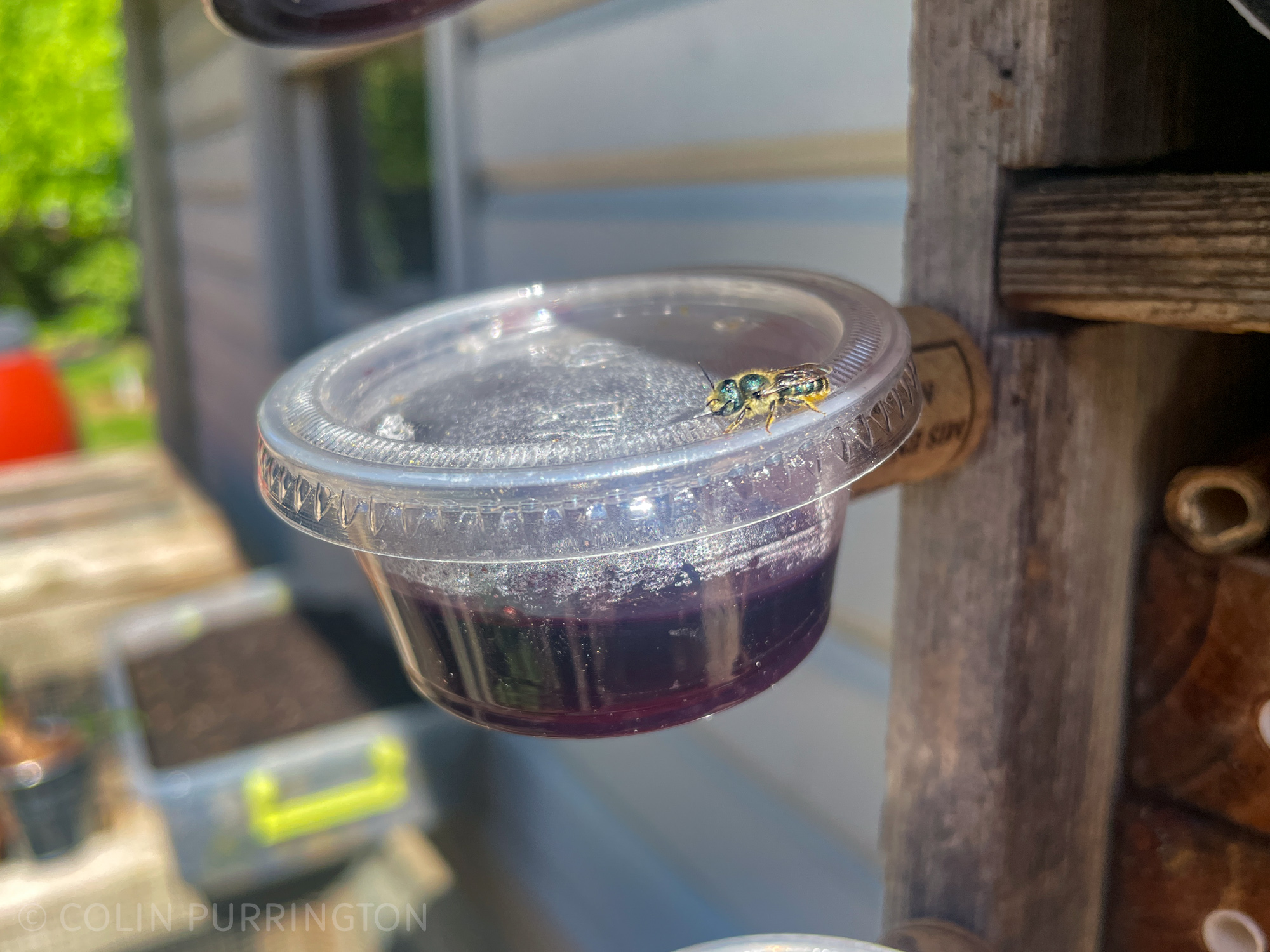
The general idea is to put the wine into a container that has small, fly-sized holes, then situate in a nook in your insect hotel. I opted to use 2-oz containers that I had sitting around but several posters on reddit use small mason jars. I then drilled four, 1/8″ holes in the lids, attached segments of cork with a 1 5/8″ screw to either the side of the container or the lid, and then screwed it to the hotel.
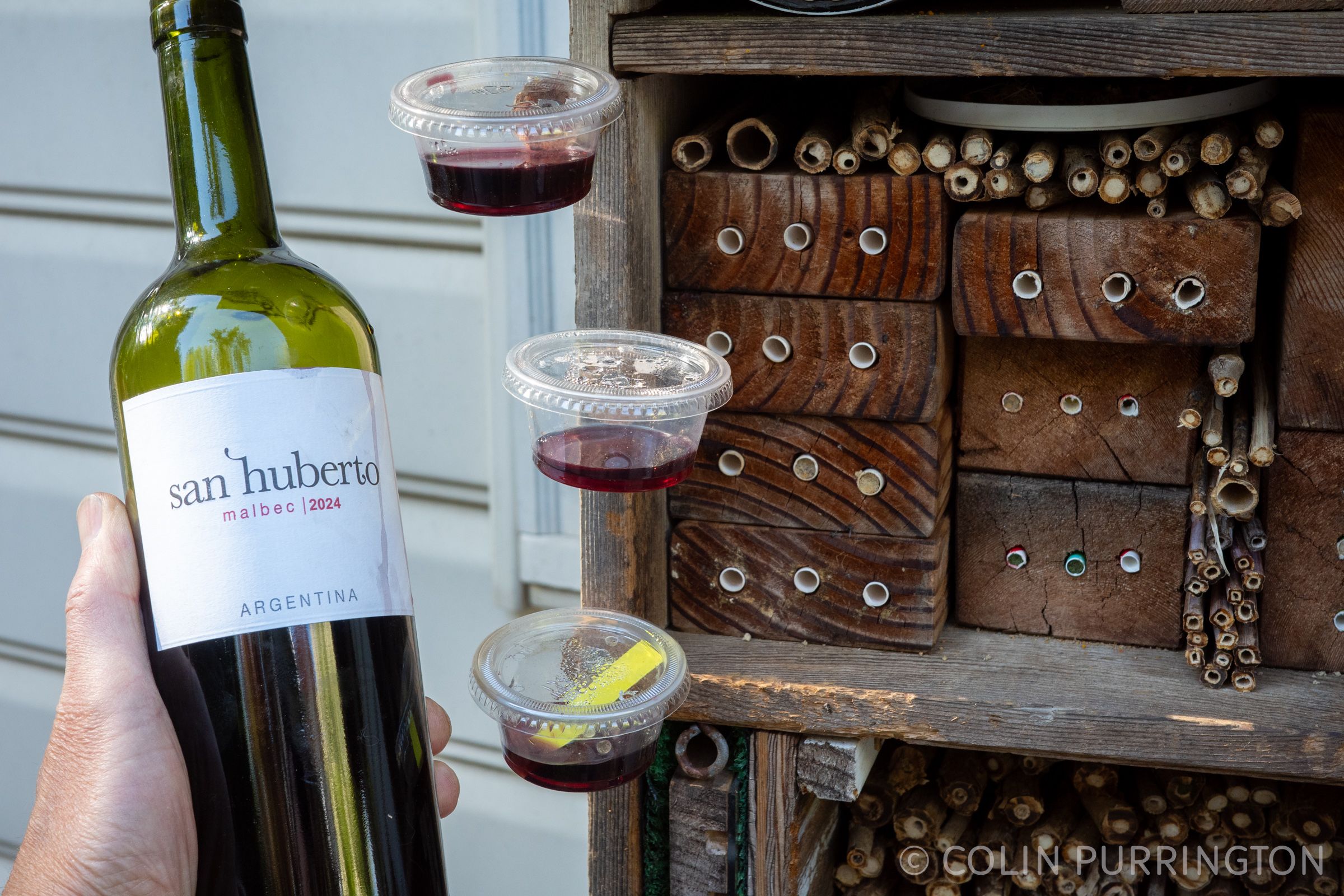
Evidence that it works

I set mine up too late in the season to estimate how many Houdini flies can be trapped per day, but I can confirm that some did go inside the traps and drown. Here are two:
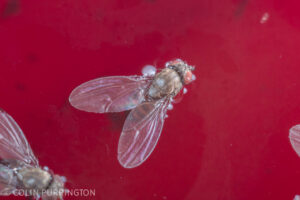
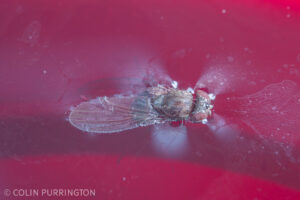
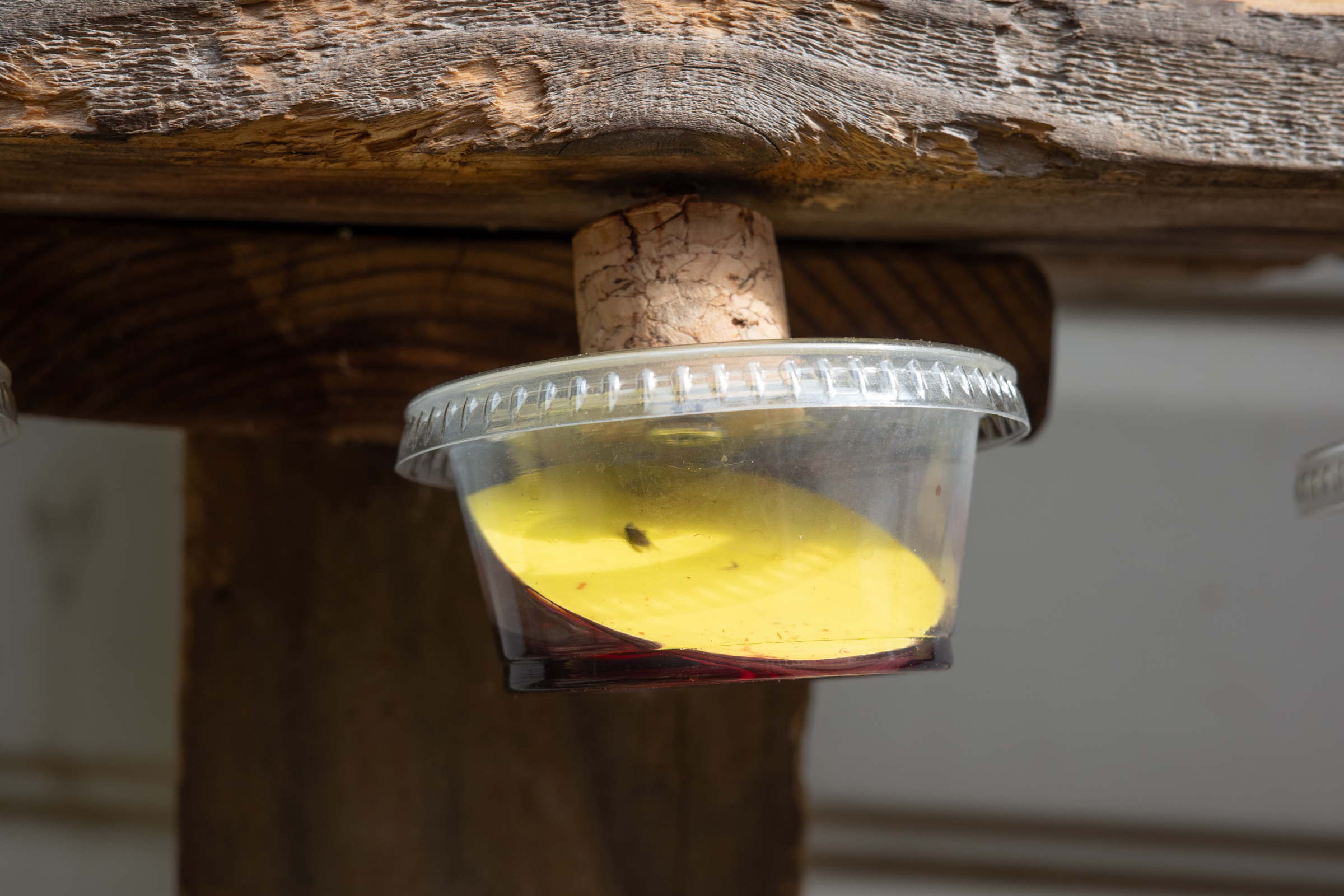
Small waterlogged flies are difficult to identify even when you have decent photographs, so I eventually fitted the containers with sticky cards that would immobilize insects before they drowned. Here’s a trap attached via the lid and a Houdini fly that got stuck:
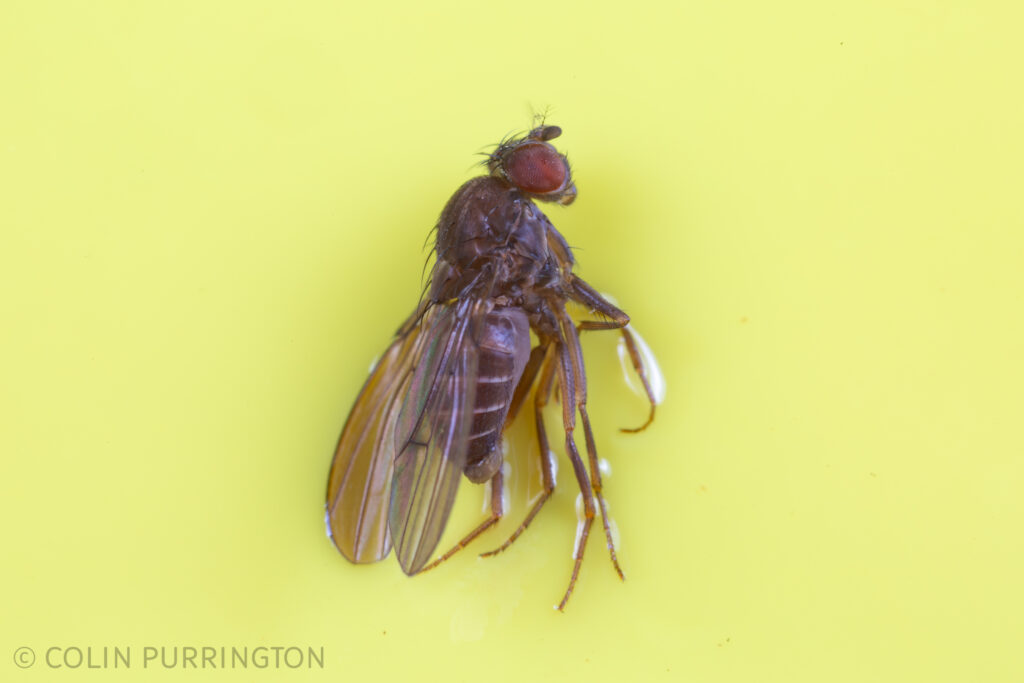
I should emphasize that my traps also caught dozens of small fruit flies that were not Houdini flies. So if you are trying this trap method be cautious in deciding whether it’s actually working or whether it’s just attracting small flies that happen to like red wine. I encourage everyone to use sticky cards and to submit photographs for ID confirmation to either BugGuide (North America only) or iNaturalist. If you opt for the latter you’ll likely get input from me within 24 hours (I’ve ID’d 200 Houdini flies already).

Is it safe for bees?

The holes are too small for many mason bee species but there are plenty of solitary bees that could fit into 1/8″ holes if they wanted to try. So far, however, none has become stuck in any of my nine traps. Some of the bees even use them as landing platforms because the sun hits them in the afternoon.
Design tips

Some thoughts that I’ll update as I continue with testing.

  • Opt for clear-sided containers so you have a better view of what is inside.
  • I’m now using a slightly smaller drill bit because 1/8″ allows rather big flies to enter.
  • Reddit user atrailofdisasters uses a red-pepper shaker, a solution that might work well for those who don’t have a drill and collection of small bits.

What wines work best?

Per reddit, the person who came up with the trap idea, Nicole Kenney, of Portland, Oregon, tested different wines for several years and decided that red wine, especially Argentinian malbec, is best. I have no idea how she did the tests but I’ll link to more information when I can find it. I’ve only tried malbec in mine but will do some comparisons next year during peak Houdini-fly season. Malbec is an old grape grown around the world but apparently thrives in Argentina and much of the acreage is in the mountains. It would be very interesting to know exactly which component is attracting the Houdini flies, of course.

Why does it work?

Houdini flies are members of the vinegar fly family (Drosophilidae) and are known to like fermenting fruit juice (source) so it’s not a surprise they are attracted to wine. And all animals are lazy so if there is food near where females are busy ovipositing, they will happily take a break to a have a drink.

More information

If you’d like to see photographs of Houdini flies I have about 20 on iNaturalist.

Please also see my blog post, “Houdini fly alert for owners of insect hotels.”

Guide to building and managing a mason bee hotel

In nature, tunnel-nesting bees are perfectly happy to use logs riddled by boring beetles or piles of dead plants that have hollow stems. That habitat is often in short supply in many yards, however, so it’s necessary to provide hotels if you want to attract them. These hotels can be as simple as a large coffee can filled with hollow reeds … or as elaborate as the three-level one I built. The bees really don’t care.

Types of nesting material

DIY bee hotels can be filled with routered nesting trays (you can buy these or make your own, if you’re handy), wood blocks with paper inserts (these inserts can be purchased), wood blocks or logs with drilled holes (unlined), or just sections of hollow stems (by far the easiest). Or, like house in the photo below, a mix. A hotel should have a roof to keep the tunnel entrances relatively dry, should be situated to get morning sun, and be approximately 5 feet off the ground (so you can enjoy watching them).

Below is a photograph of my other hotel. It’s smaller and is set up in my front yard to entertain people who walk by. Tunnels are all unlined drilled holes, plus milkweed stems. Holes in the blocks are varied because I want to attract a variety of solitary bees.

Swap nesting materials regularly

The ideal bee hotel is one that allows all the nesting material to be removed each year (or so). By installing fresh nesting material, new tenants each spring will get to move into tunnels free of kleptoparasitic pollen mites and pathogenic fungi. Another benefit of removable nests is that you can remove sections as they get filled, allowing you to replace the spot with the same type of tunnels or with tunnels that have different diameter to cater to a different bee species (there are hundreds). Below are examples of my hotel with different configurations (my 2020 version, on right, is a bit boring).

Protect nests from birds

Woodpeckers are very fond of stem-nesting insects so attach screening to the hotel in such a way that even with their long beaks they can’t get access. Below is example (credit: @BlueEmu on reddit). If you want to see a woodpecker try, see this video.

Emergence boxes

What do you do with the nesting material after you remove it from the hotel? I put mine into a large cardboard box that has holes in the sides and at the top, then store in my unheated garage for the winter. In mid March (before bees in my area start to wake up) I put the box outside in a spot that is dry and gets good morning sun. Then when bees emerge from their cocoons they can escape from the box but are disinclined to re-inhabit the nesting tunnels they emerged from. Here’s a view of the nesting material inside my emergence box.

After several months outside (e.g., in August, long after the last resident has emerged) I take everything back into my shop and redrill holes and sterilize the wood. Then I can reuse blocks in future years.

Cleaning pupae

Lately, I’ve been thinking that I should move entirely to a system where I can sort through pupae at the end of the season. E.g., as summarized here. The reason for this is that I’d like to remove (kill) the kleptoparasitic mites (pic) and Houdini flies (pic) that are likely destroying many of my solitary bees. To enable this process I am going to start using paper straws to line all the tunnels. These straws can then be removed and unwrapped and the contents examined. Below is a photograph showing how drilled holes can be lined with paper straws — just fold over the back overhang and seal with foil tape.

Several companies sell sturdy (and easy to unwrap) paper straws as well as cardboard tubes that can easily accommodate the straws (i.e., you don’t need to drill holes in wood).

Another way to sort through pupae is to use routered wood trays, which you can buy or make (with a router or a table saw). Although some types of trays are better used with straws (to prevent mites from moving from tunnel to tunnel), others fit snuggly enough to be used without them. On my list of things to do is to make some routered nests that are sealed on one side with Plexiglas so that I can observe the bees within (such hotels can be purchased, and are beautiful).

Design tips

  • To keep everything dry on something this tall you need a generous roof overhang. Mine extends 5 inches beyond the front of the shelf, plus the wood sections and reeds are set back from that by another inch or so. If you have a shorter house you can have a smaller roof.
  • For larger hole sizes you want, ideally, 6 inches of depth. Shorter (4″) tunnels are fine but can result in a male-biased brood sex ratios. If you want to encourage population growth, encouraging the production of females is important. So buy long bits (I really like my 5/16″ auger bit, shown in drill below).
Drilling holes for mason bee inserts
  • Burning the front of the wood allows bees to more easily find their holes, plus the darker surface causes the wood to heat up faster in the morning sun.
  • Avoid treated lumber or fresh cedar. Per rumors on the internet, those types of wood can result in the death of the larvae. Pine is fine but I think harder wood is preferable because the drilled holes tend to be smoother.
  • For cutting reeds to size, I highly recommend using a cutoff disc on a Dremel tool instead of pruners. You can get a really smooth surface with a Dremel.

Examples of nice DIY solitary bee hotels

Additional resources

If you’re lazy and just want to buy a mason bee house, here’s my draft listing of companies that seem to make good ones. Please also see my guide to bee houses you should avoid.

Where to buy mason bee houses

A good bee hotel will have tunnels that are approximately 6″ (152 mm) long and have disposable or cleanable components. The latter can be achieved through the use of (1) disposable paper liners, (2) reeds that can be easily split open, then thrown away, or (3) routered wood trays that come apart for cleaning. Avoid bee hotels that use bamboo or have unlined holes drilled in wood (neither can be cleaned) and thus become Mite Hotels. Below are ones that seem OK to me. Note that pine and other cheap wood will warp with humidity and age, so opt for hardwoods when possible.

Standard hotels

Hotels with observation windows

If you’d like to make your own, Native Bee Hives has an excellent page with details on different ways to construct them. I also recommend reading through Nurturing Nature’s pages and videos.

Here’s my guide to avoiding low-quality bee houses that are for sale at most garden centers. If you’re handy, you can also make your own.