
Tag Archives: diptera

Red wine trap for controlling Houdini flies at bee hotels

Per posts on Reddit and Facebook, jars baited with malbec can trap Houdini flies (Cacoxenus indagator), an invasive kleptoparasite of solitary bees in the genus Osmia. The species was first reported in New York in 2011 and has since appeared in Maryland, Massachusetts, New Jersey, Oregon, Pennsylvania, Virginia, Washington, and British Columbia. For anyone with an insect hotel in an affected area, brood losses can be considerable so the news of a control method is welcome news. Currently hotel owners deal with the parasites by squishing them one by one, vacuuming them up, or trapping them on sticky cards situated in the eaves. All of these techniques seem futile given that a single Houdini fly can leave hundreds of eggs.

The trap

The general idea is to put the wine into a container that has small, fly-sized holes, then situate in a nook in your insect hotel. I opted to use 2-oz containers that I had sitting around but several posters on reddit use small mason jars. I then drilled four, 1/8″ holes in the lids, attached segments of cork with a 1 5/8″ screw to either the side of the container or the lid, and then screwed it to the hotel.
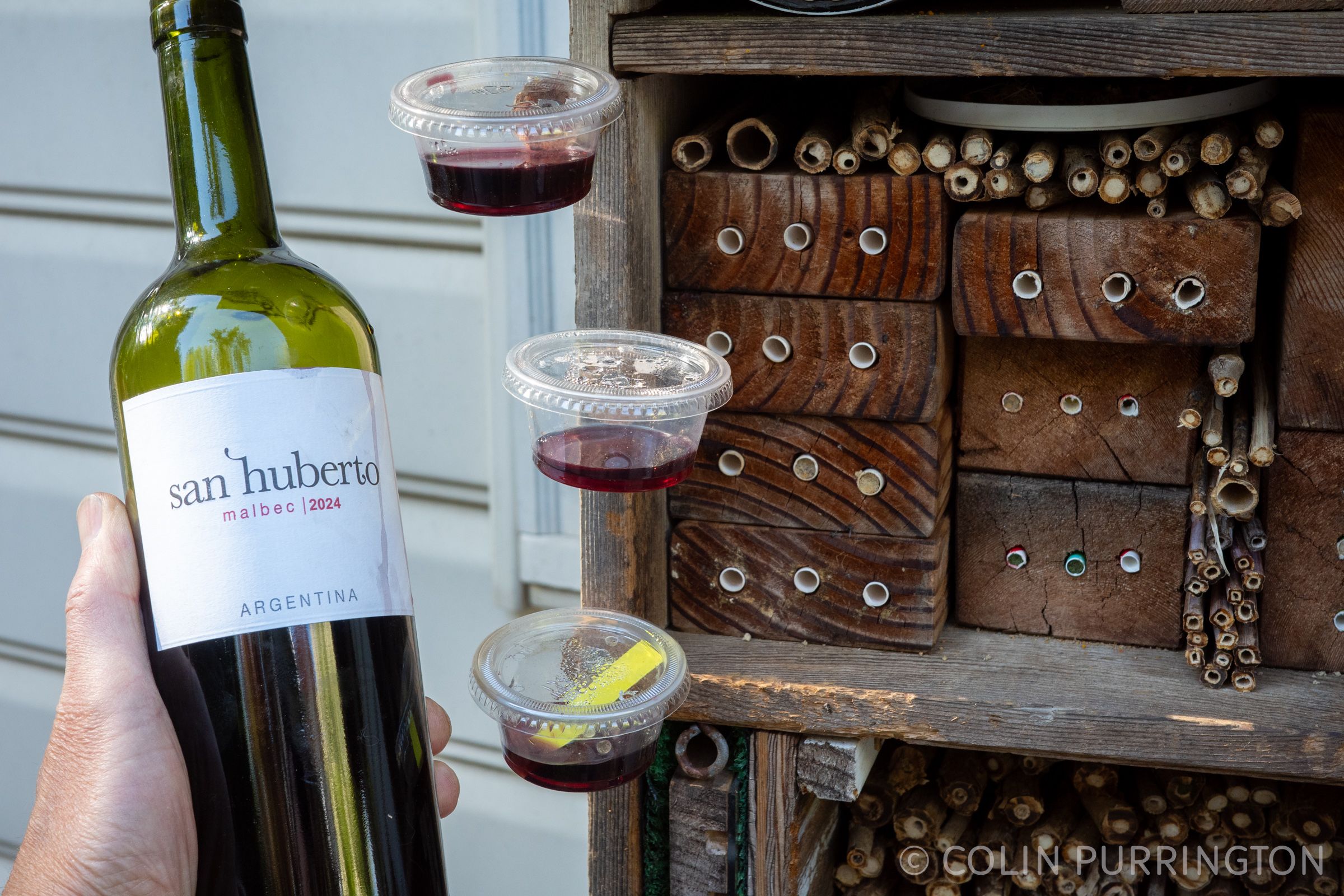
Evidence that it works

I set mine up too late in the season to estimate how many Houdini flies can be trapped per day, but I can confirm that some did go inside the traps and drown. Here are two:
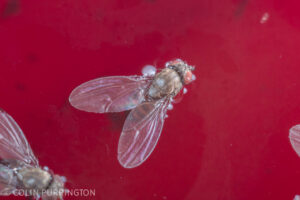
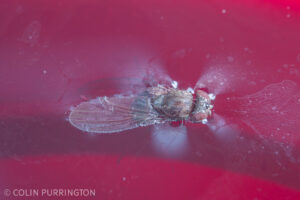
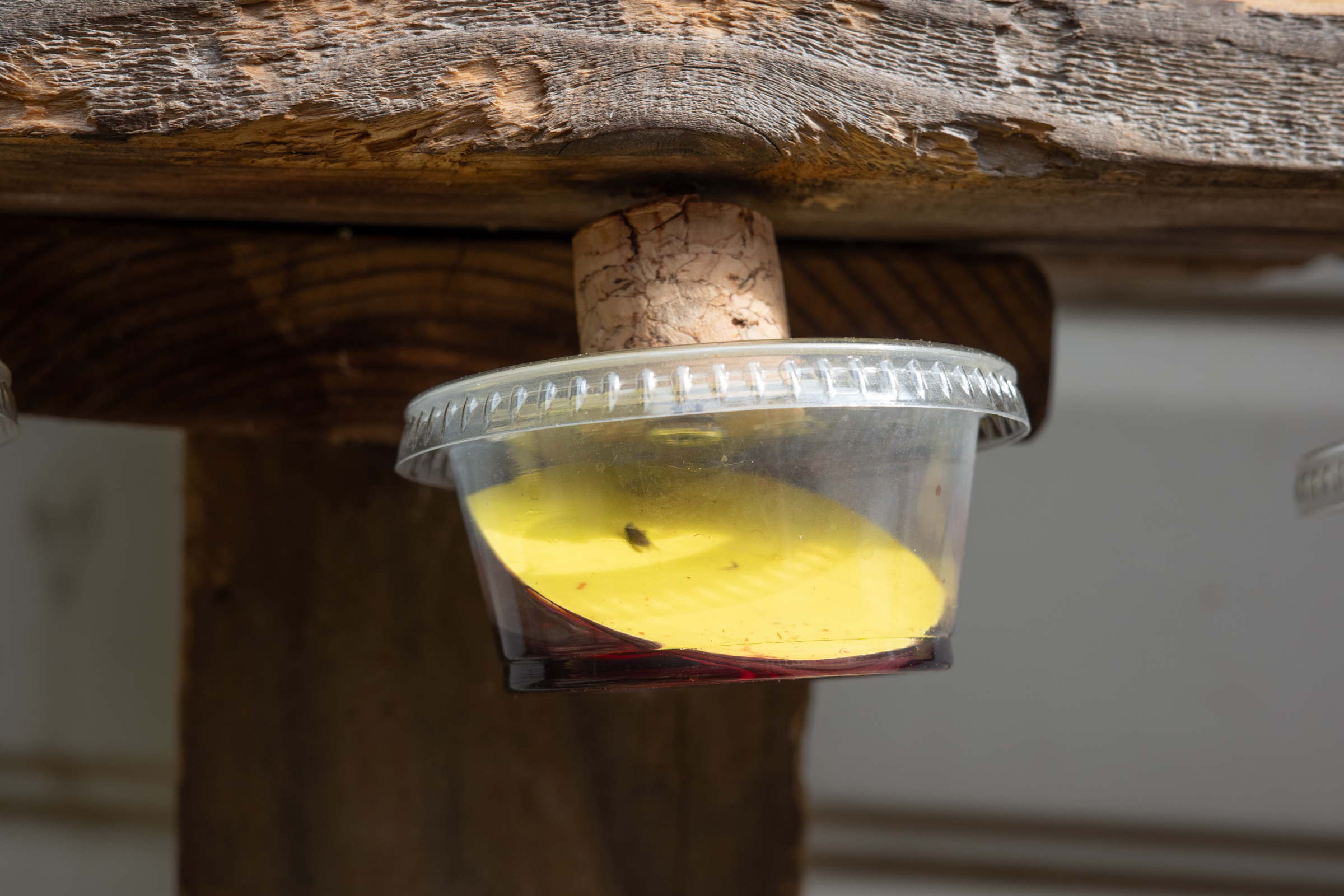
Small waterlogged flies are difficult to identify even when you have decent photographs, so I eventually fitted the containers with sticky cards that would immobilize insects before they drowned. Here’s a trap attached via the lid and a Houdini fly that got stuck:
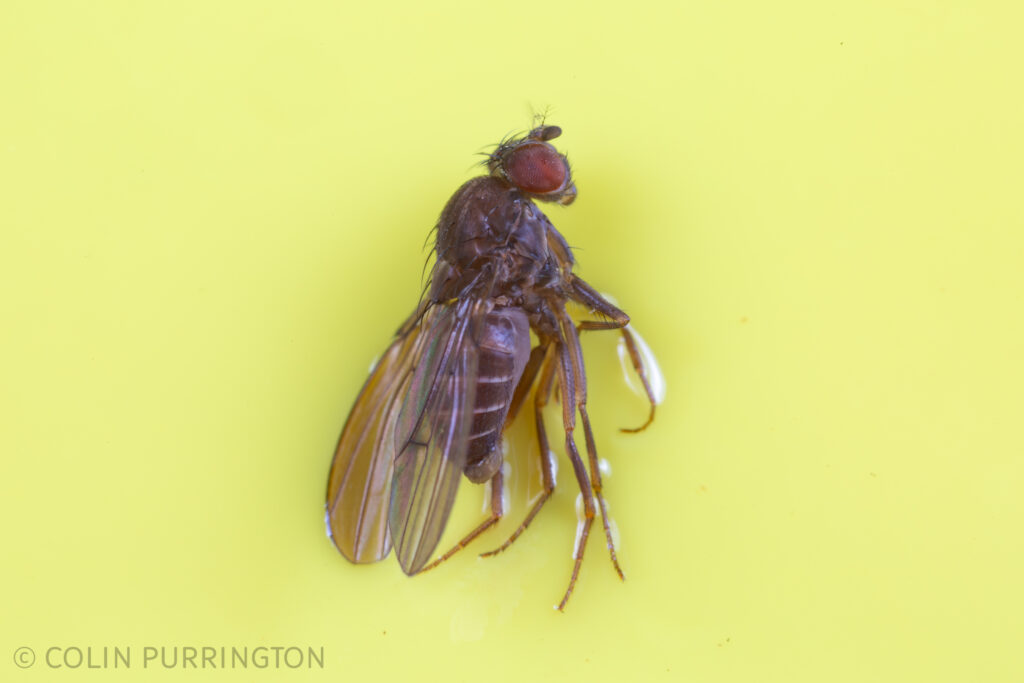
I should emphasize that my traps also caught dozens of small fruit flies that were not Houdini flies. So if you are trying this trap method be cautious in deciding whether it’s actually working or whether it’s just attracting small flies that happen to like red wine. I encourage everyone to use sticky cards and to submit photographs for ID confirmation to either BugGuide (North America only) or iNaturalist. If you opt for the latter you’ll likely get input from me within 24 hours (I’ve ID’d 200 Houdini flies already).

Is it safe for bees?

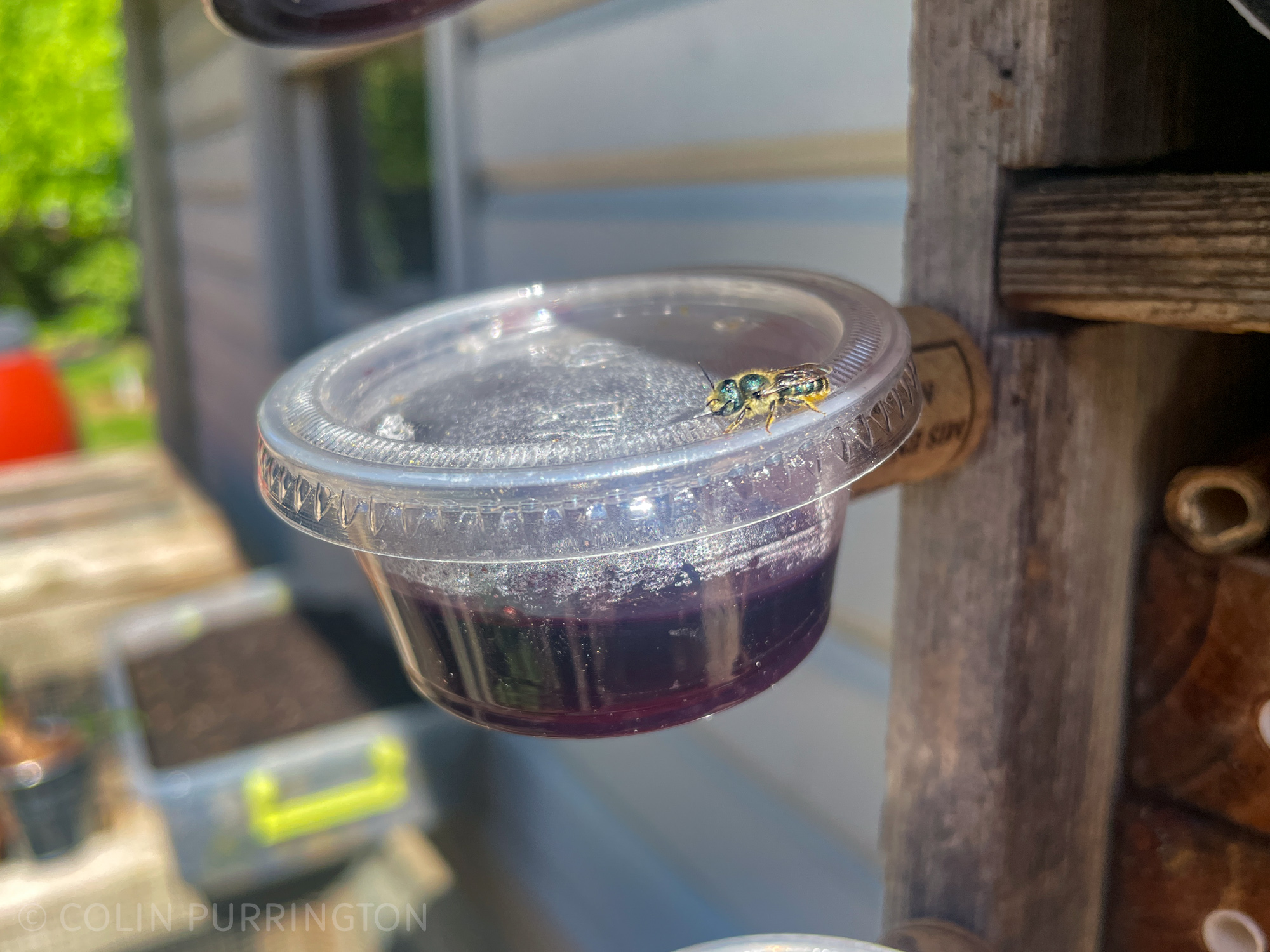
The holes are too small for many mason bee species but there are plenty of solitary bees that could fit into 1/8″ holes if they wanted to try. So far, however, none has become stuck in any of my nine traps. Some of the bees even use them as landing platforms because the sun hits them in the afternoon.
Design tips

Some thoughts that I’ll update as I continue with testing.

  • Opt for clear-sided containers so you have a better view of what is inside.
  • I’m now using a slightly smaller drill bit because 1/8″ allows rather big flies to enter.
  • Reddit user atrailofdisasters uses a red-pepper shaker, a solution that might work well for those who don’t have a drill and collection of small bits.

What wines work best?

Per reddit, the person who came up with the trap idea, Nicole Kenney, of Portland, Oregon, tested different wines for several years and decided that red wine, especially Argentinian malbec, is best. I have no idea how she did the tests but I’ll link to more information when I can find it. I’ve only tried malbec in mine but will do some comparisons next year during peak Houdini-fly season. Malbec is an old grape grown around the world but apparently thrives in Argentina and much of the acreage is in the mountains. It would be very interesting to know exactly which component is attracting the Houdini flies, of course.

Why does it work?

Houdini flies are members of the vinegar fly family (Drosophilidae) and are known to like fermenting fruit juice (source) so it’s not a surprise they are attracted to wine. And all animals are lazy so if there is food near where females are busy ovipositing, they will happily take a break to a have a drink.

More information

If you’d like to see photographs of Houdini flies I have about 20 on iNaturalist.

Please also see my blog post, “Houdini fly alert for owners of insect hotels.”

Annual cleaning of the insect hotels

The cold and snow this winter have prevented me from taking many nature photographs, so it was a treat to have a look inside my two insect hotels. The one below is in the front yard. As you can see, it has a mix of hollow stems and wood blocks that have holes lined with paper straws. I split open the stems and unravel the straws to see who is inside, a process that is interesting but also allows me to kill any non-native, invasive parasites I find. I.e., I don’t want my hotels to be a breeding facility for pests and pathogens that might spread out and harm populations of local bees and wasps.

Bees

The most common mason bee this year was Osmia georgica, a native that can be recognized by its bright orange frass and circular, green, felt-like plugs that separate the cocoons inside the nesting tunnel. Here’s an adult if you’re curious what they look like.

There was also a mystery bee that is currently in a vial and will hopefully emerge sometime this spring. It’s unlike anything I’ve found before but somewhat resembles the cocoon of a resin bee. But much smaller than the cocoon of a sculptured resin bee (pic) that I often find in my hotels; this species is non-native and kind of a bully toward native species so they are unwelcome visitors.

Wasps

These are cocoons of Trypoxylon collinum, a spider-provisioning wasp (pic of adults) that I also get every year, especially in the front yard (maybe they like morning sun?).

I also got a few grass-carrying wasp pupae but I forgot to take any closeups (here’s one from past). For some reason the females prefer to nest in observational panel. The tunnels are full of grass and dead crickets but the larvae are there.

As always, some of the mason bee cells were filled with adult, dead Monodontomerus sp., a parasitoid. I can easily tell they are inside because they have partially chewed exit holes through the straw. When you unwrap the straw the adults are still inside the bee cocoon, apparently unable to exit because the straw is wedged into the drilled hole tightly. In the real world the wasps would chew through the stem and be able to escape. I have pics of larvae, trapped adults, and a female).

Flies

I’m not sure of the ID, but I found small dipterous (I think) pupae scattered around the observation window. Given their small size and the fact that grass-carrying wasps were the only residents, I’m wondering whether they might be scuttle flies, which are known to be parasites. E.g., Megaselia aletia (Medler 1965). I’ve saved the pupae and will attempt to get photographs of the adults.

Several of the mason bee cells were infested with the kleptoparasitic, non-native Houdini flies (Cacoxenus indagator, adult). I usually kill them but this batch is bound for a researcher who needs them.

Bugs

As in most years, the observation panel had several Dufouriellus ater individuals, members of the minute pirate bug family (Anthocoridae). I can confirm that they are minute but also that they rarely sit still and are thus a royal pain to photograph. The nymphs are bright red and even smaller.

Beetles

These two larvae are dermestids and were found inside mason bee nests where they had eaten several of the pupae. They are unwelcome residents and are an important reason why it’s important to clean insect hotels.

Spiders

There was a nest of spiderling jumping spiders in the observation window and they were unspeakably cute, with a thorax that looked liked hammered copper. Note that I typically relocate spiders when I find them on the hotel grounds during the season. For reasons.

Cleaning and restocking

In case of interest, all the pupae go into containers and placed in protected locations outside so that when they emerge in late March they can go on to live their lives. If I’m outside I’ll stop by the location multiple times per day to look for emergers to photograph.

I then bake the wood blocks to kill any remnant dermestid larvae, pollen mites, and pathogens that might be lurking inside. I also sweep out the house structure and drench it with a bleach solution. After everything is dry I’ll restock the house with blocks and stems.

Here’s an action shot of me making new stems sections with a cut-off blade attached to a Dremel.

If you’re envious, here’s where to buy an insect hotel. Or you can build your own. For help identifying a resident, please browse the “Bee and Wasp Hotels” project on iNaturalist. Send me a message if you have questions.

Life inside rotting walnut husks

There’s an eastern black walnut (Juglans nigra) on my neighbor’s property that rains down fruit every fall, and I finally got curious about what species might be inside. So far I’ve found four flies, five beetles, two mites, and a parasitic wasp. I’m a little disappointed with the number of wasps but am hopeful that over time I can find more. There are almost always more wasps.

Walnut husk maggots

Almost all of them were filled with fly larvae that are most likely Rhagoletis suavis (Tephritidae). If you collect walnuts for their nutmeat, these are unwanted residents because their activity can make the husks difficult to remove, stain the shell, and even cause the kernel to discolor, become bitter, and shrivel. Commercial walnut groves Juglans regia will even treat spray insecticide to minimize their presence. Below is a typical scene showing a healthy population of the larvae:

And here’s a close-up. It’s interesting that the larvae seem to accumulate dark pigment in each segment. I’m assuming it’s juglone, also known as Natural Brown 7. The presence is probably unavoidable given what it is eating but I wonder whether it confers any protection against predators. It’s certainly allelopathic, antifungal, and can kill fish.

Here’s an adult that I found a few years ago.

There are several species of tephritids that utilize walnuts. Rhagoletis suavis is restricted to the eastern half of North America (iNaturalist distribution map), with the western-most observation being in Colorado. The western species, Rhagoletis completa (BugGuide pics; iNaturalist map), seems to be expanding its range, arriving in Jonesboro, Arkansas in 2007. Another western species, Rhagoletis juglandis (BugGuide pics; iNaturalist map), occurs in Arizona, Utah, New Mexico, Mexico, and apparently British Columbia. If you live in an area with more than one of these species, you’d need to rear larvae to adulthood to get an identification (see fig. 8 here for wing pattern differences). Alternatively, you can try to use the key to larvae in Steyskal 1973.

Fungus gnat

This fly emerged from a pile of rotting walnuts that I’d covered with fine netting to catch whatever hatched when I wasn’t looking. I think it is Leia bivittata (Mycetophilidae). Per Weiss 1919 the larvae move around in a bag of mucous. It’s the only one that appeared. There is nothing in the literature that suggests they eat the fungi in rotting walnuts, so I don’t know how common they are in the fruit.

Vinegar flies

I found two species of vinegar flies (Drosophilidae) hanging out on rotting husks, Drosophila repleta and Drosophila tripunctata, the latter in large numbers. Per Buchner and Symmes 2014, Drosophila are attracted to the rotting flesh caused by Rhagoletis infestation. What’s notable to me is that larvae can tolerate the juglone and related compounds.

Beetles

This scooped scarab (Onthophagus hecate) was wedged inside a crevice in a walnut husk. They eat fungi but will also show up to eat dead animals.

I also found four different kinds of staphylinids. I’ve only been able to identify one, Belonuchus rufipennis, but will update this post if and when an expert on iNaturalist sees them (so probably at least a decade). I would love to know what they are eating. There are certainly plenty of fly larvae present but I don’t have any confirmation that those are their targets.

Mites

The rotting walnuts were crawling with mites, often numbering in the dozens. These are extremely small and fast moving so I’m not sure how many different kinds are present. I think there are at least two species, both in the order Mesostigmata. The first image might be in the suborder Gamasina, and possibly in the genus Lasioseius. I have no idea what they are eating but some mesostigs are omnivorous.

Parasitic wasps

Although I didn’t find them inside the walnuts, this wasp in the genus Coptera (Diapriidae) ended up in a yellow pan trap set up near a tray of Rhagoletis suava puparia that I situated atop a bin of several dozen walnuts. Here’s a really low-res video of it walking around on the tray after I rescued it from the pan trap. There was a second individual walking on the tray at the same time, so I don’t think the pan-trap individual was just a rando Coptera attracted to yellow. These wasps apparently dig down into the soil to find pupae. Some articles say they’ll drag the pupae to the surface prior to ovipositing into them.

Members of this genus are rarely observed and are difficult to tell apart, but based on proximity to walnuts it is likely Coptera pomonellae, the only species that arrived at pan traps set up under walnut trees in Iowa (two locations) and Indiana in Forbes et al. 2012.

Because I have trays of bait pupae, I’m also monitoring for but haven’t yet seen:

  1. Diachasmimorpha mellea (Braconidae), a wasp that is reported to parasitize Rhagoletis suavis (Krombein and Burks 1967, Wharton and Marsh 1978).
  2. Aphaereta pallipes (Braconidae), a pupal parasite of Rhagoletis suavis that was documented in Amherst, MA (Babb 1902). Per Joseph Fortier, it’s been reared from 15 dipteran families. The two observations on iNaturalist emerged from Chirosia gleniensis and Fannia canicularis.
  3. Phygadeuon sp. (Ichneumonidae), a species that attacks pupae of (the closely-related) Rhagoletis juglandis (Andrew Forbes, pers. comm.). I’m not sure whether Phygadeuon attacks Rhagoletis suavis, but there are observations in the eastern USA.
  4. Aganaspis alujai (Figitidae), a parthenogenic wasp that attacks Rhagoletis completa in Mexico (Ovruski et al. 2007, Takata et al. 2025). I have no idea whether there’s a member of the genus in Pennsylvania, so this is another unlikely arrival.
  5. Tetrastichus giffardianus (Eulophidae) “may parasitize Rhagoletis suavis completa CRESSON” (Narayanan and Chawla 1962, citing Marlatt 1933, which I cannot locate). Marlatt was writing in a USDA publication so this relates to the United States. But host species is now Rhagoletis completa, so this is probably a western wasp (confirmed: just California).

Absent from the list are hyperparasitoids, which is kind of annoying because I really like them. I will certainly be on the lookout for them, of course. I’ve also read that a fairy wasp attacks the Rhagoletis eggs, and that would also be fun to find.

I’ll post an update in August 2026 with details on what emerges from the several hundred Rhagoletis suava pupae I have. Hopefully there will be at least some Coptera in the mix, and with some luck I’ll get photographs of both sexes. I’m also very curious what types of wasps might seek out Rhagoletis completa that are on eastern black walnuts planted in the western USA, but that hinges on my sister reading this post and setting up some trays in a similar way (simple instructions are in next section). The first record of Rhagoletis completa in Oregon was in 1963 (Berlocher 1984).

Below is a photograph of the trays of pupae. The chair is so I can drink my coffee while scanning for wasps.

Collecting fly puparia

If anyone is curious how I’m getting puparia, I placed infested walnuts in trays filled with sand and vermiculate, and the larvae tunnel down into the medium to pupate. The plexiglass is to keep the rain from flooding the containers, and the whole operation is conducted inside a screened enclosure that keeps the squirrels from pilfering the walnuts. This is making the squirrels angry.

The larvae eventually burrow into the medium to form puparia, but sometimes they simply pupated underneath a walnut (e.g., as in photo below). At some point I’ll sift the media to collect puparia so that I can more closely monitor them. I’m curious whether they can be candled under a microscope to spy on the residents.

Here’s a sampling of the puparia along with some third-instar larvae. I suspect I have 500 or so puparia in the trays. Some pupae apparently stay dormant for two years (Stirret 1936).

Next year I’ll likely repeat all of the above but start monitoring for Coptera much earlier.