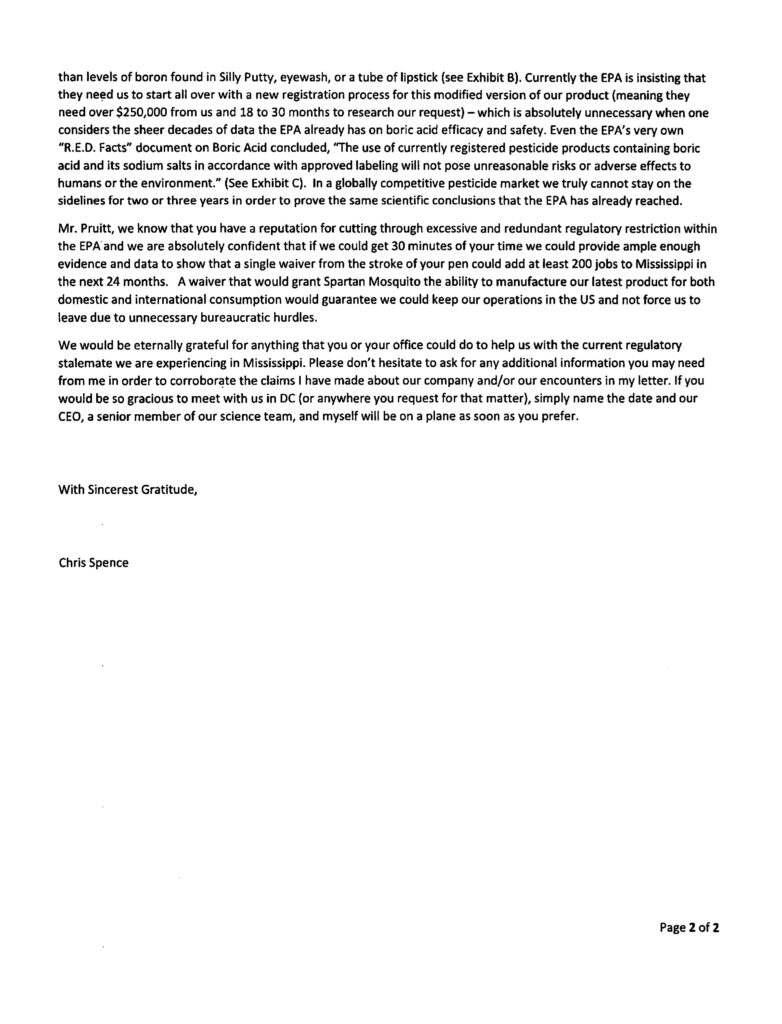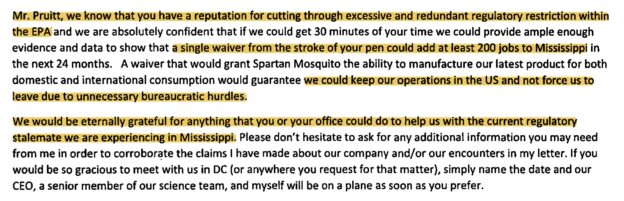
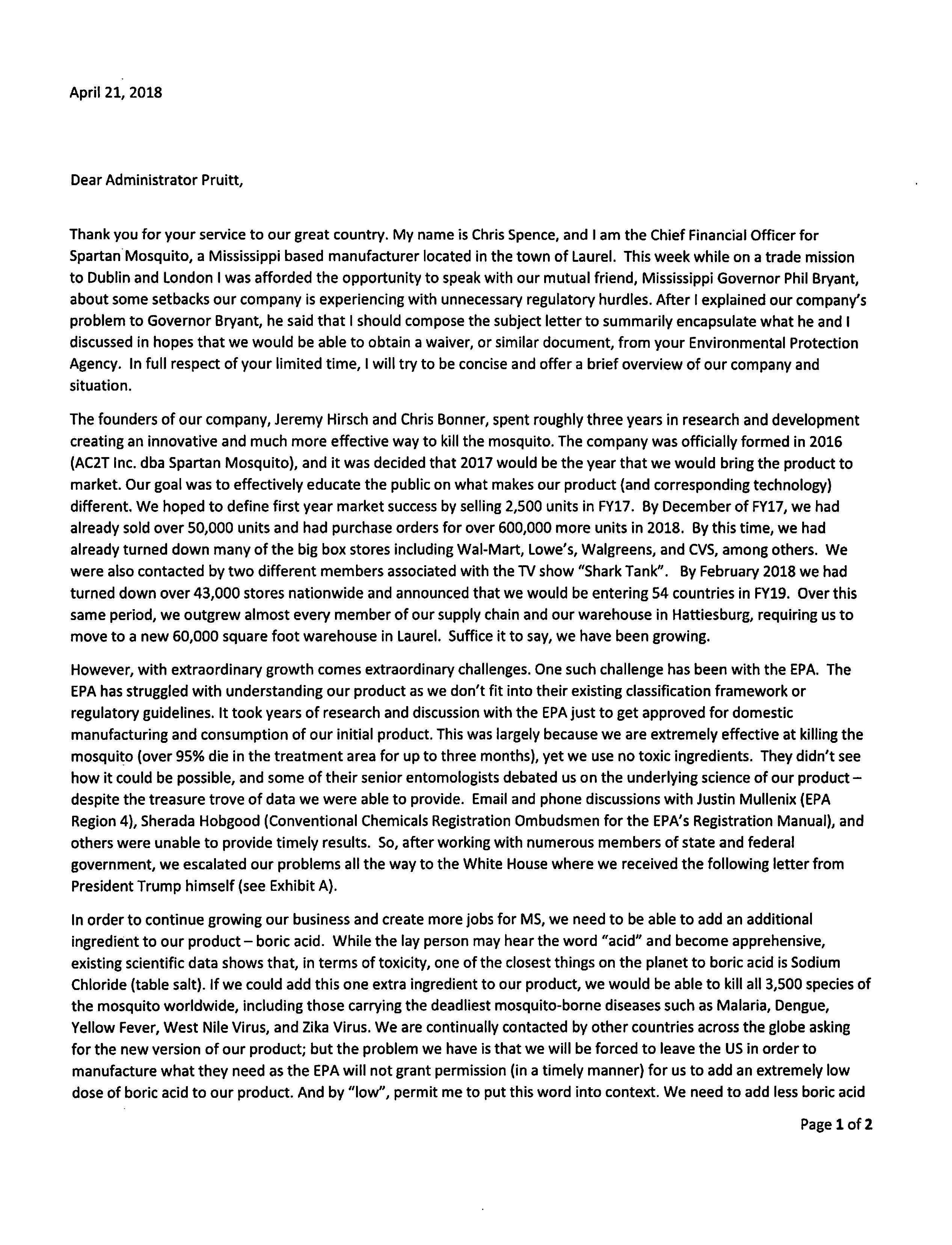
In a prior post I detailed Spartan Mosquito’s secret efforts to secure an EPA registration for the Spartan Mosquito Pro Tech, a plastic tube filled with sugar, yeast, boric acid, and water that the company claims, “kills mosquitoes.” Below is an early part of that successful campaign, a letter sent by Spartan Mosquito’s Chris Spence (CFO/CEO) to EPA’s then-administrator, Scott Pruitt, in April of 2018. In it, the company asks to bypass the normal pesticide-approval process. In particular, it didn’t want to have to prove that the pesticide killed mosquitoes. I obtained the letter through a FOIA request.
Notes and additional files
Given the style of writing and word choice, I’m 99% sure the letter was written by Spartan Mosquito’s Jeremy Hirsch, one of the company’s cofounders and current chairman of the board.
I have asked the EPA for Mr. Trump’s letter (“Exhibit A”) but they have refused to give it to me.
Here is “Exhibit B” referenced in the letter. It’s a graphic that shows the boric acid concentration of the Spartan Mosquito Pro Tech relative to other objects such as Silly Putty.
Here is “Exhibit C” referenced in the letter. It’s a collection of facts pulled from papers on toxicity of boric acid to mosquitoes. NB: the toxicity of boric acid to insects is well known, but Spartan Mosquito likes to focus on the ingredient to distract from the real issue of whether mosquitoes would go inside the tubes and drink the fluid that has the boric acid. Research (by me) shows that mosquitoes do not.
Mr. Spence sent a similar letter to Senator Cindy Hyde-Smith, who sits on several important committees that regularly touch on the EPA. The ask in that letter, dated April 24, 2018, was for Hyde-Smith to get Pruitt to agree to a meeting. Spartan Mosquito employees gave at least $8,100 to her 24 hours later, on April 25, 2018.
Mr. Spence left Spartan Mosquito in November of 2023 and deleted all references to his affiliation with the company from his LinkedIn profile after three years as CEO. I don’t think people normally erase their CEO positions. Journalists should definitely give him a ring.
If you’d like to see the data that Spartan Mosquito eventually submitted to the EPA on July 29, 2019, see this page. In particular, look at the file named “Spartan Mosquito Eradicator Pro Tech EPA Reg. No. 93813-R Field Efficacy Evaluation Against Mosquitoes” (PDF). In this document, Spartan Mosquito summarizes four “experiments” conducted at various locations in Mississippi by Jeremy Hirsch, Chris Bonner, or Michael Bonner.
To the best of my knowledge, California is the only state to request the efficacy data for the Spartan Mosquito Pro Tech from the company. After reviewing the files the state banned all sales of the pesticide product.
Spartan Mosquito says it is has had meetings with multiple countries interested in hosting production facilities for the tubes. It is testing the tubes in Togo and plans to sell in areas with high rates of malaria.
Further evidence of the special consideration the EPA granted Spartan Mosquito is the letter below, sent by Jeremy Hirsch (Spartan Mosquito’s founder and chairman) to Andrew Wheeler (EPA Administrator) on 11 November 2020, almost eight months after the Spartan Mosquito Pro Tech obtained a registration:
The letter references a meeting Mr. Hirsch had with with EPA staff, likely including Susan Bodine (then Assistant Administrator of EPA’s Office of Enforcement and Compliance Assurance) and Alexandra Dunn (then Assistant Administrator for EPA’s Office of Chemical Safety and Pollution Prevention). The obsequious tone of the letter suggests that Spartan Mosquito had been in trouble for some reason. Because the EPA still allows sales of the Spartan Mosquito Pro Tech I assume the meeting diffused whatever concerns the EPA had uncovered. I obtained the letter via a FOIA request. The EPA will not give me any information on what the problem was.
That said, I do know that the pesticide-approval staff at the EPA met in September of 2020 to discuss the Spartan Mosquito Pro Tech after I shared my concerns about the quality and trustworthiness of the data. Erik Kraft (Branch Chief, Regulatory Management and Science Branch) sent an email to me after the meeting: “I’ve discussed your email about the performance of the product with my senior staff and we’ve determined to not take any further action…” It could be the case that the letter from Mr. Hirsch, above, is related somehow to the concerns that I shared. All of my concerns are listed in my review and in my analysis of the Spartan Mosquito’s efficacy tests. In summary, I am sure that Spartan Mosquito misled the EPA. And I’m pretty sure that the EPA now knows it was misled.
The other explanation for the meeting might have been that the EPA became concerned about the claims the company was making about efficacy on its website and Facebook page. Although “kills mosquitoes” was permitted, the EPA eventually asked, in February of 2021, for the addition of qualifying language to the label: “Product has not demonstrated complete kill of mosquito populations.” I don’t know what prompted that letter, but the meeting in November of the previous year could have been related. Spartan Mosquito has not made the requested change.
Why is the Spartan Mosquito Pro Tech still on the market?
The EPA can issue a “stop sale” order on a registered pesticide if it learns that the pesticide violates any provision of FIFRA (i.e., is “misbranded”). Here’s EPA’s language: “As defined in FIFRA Section 2(q)(1)(A) a pesticide is misbranded if its labeling bears any statement, design or graphic representation which is false or misleading.” Accordingly, the EPA could simply say, “the label falsely claims that mosquitoes gather around the tubes.” Similarly, the company’s patent highlights the role of CO2 in attracting mosquitoes, so listing the yeast and sugar as “inactive” ingredients is deceptive. Finally, the EPA could object to the “kills mosquitoes” claim because the tubes clearly do not kill mosquitoes (because they don’t attract them in the first place). In regard to the latter, the EPA might act on the misleading data the company submitted. I’m assuming somebody powerful is holding the EPA back from issuing a stop-sale order, or that the EPA is embarrassed to admit it erred in granting a registration (probably more likely). Only media exposure will change this strategy.
Below are some PDFs that Spartan Mosquito of Hattiesburg, Mississippi, shared with state pesticide officials and the Environmental Protection Agency to get registrations for its two products, the Spartan Mosquito Eradicator and the Spartan Mosquito Pro Tech (EPA #93813-1). I am sharing the files here so that regulatory officials who have not seen the data can better evaluate whether the company’s claims are supported. Additionally, I am hoping that mosquito biologists might read the documents and leave comments on whether the experimental protocols are scientifically sound. To facilitate these goals I’ve listed some draft notes under each file.
The efficacy claims made by Spartan Mosquito
The Spartan Mosquito Eradicator (ingredients: sugar, yeast, and sodium chloride) is advertised to eliminate up to 95% of mosquitoes for up to 90 days. The Spartan Mosquito Pro Tech (ingredients: sugar, yeast, boric acid), registered by the EPA in 2020, is advertised to “kill mosquitoes” for up to 30 days. The company also claims that both of the devices are so attractive to mosquitoes that they will “gather” around the tubes, crawl through small holes (11/64″, 4.4 mm) in the caps, then ingest the fluid inside.
Graph on box of Spartan Mosquito Eradicators showing percentage of mosquito population eliminated over time. It is unclear whether actual data are represented.
Spartan Mosquito Eradicator field efficacy data
The PDF below contains mosquito count data (number landing on forearm in 1-min interval) at two locations (New Augusta and Hattiesburg) in Mississippi during 2016. These data were sent to states that required efficacy data prior to the registration of the Spartan Mosquito Eradicator.
“Control” sites did not have tubes filled with water, sugar, and yeast and thus were not true controls.
In at least one of the two studies the “test” area was situated at a residence while the “control” area was set up in a wooded area. That could bias the results. Here are details:
The coordinates given for the “test” and “control” sites for New Augusta studies are identical (31°16’39.04″N 89° 3’37.88″W). The study street address is listed as 458 Buck Creek Road, New Augusta, MS but that does not exist; it could be 458 Buck Creek Road, Richton, MS, about 1.5 miles away. It is thus unclear where the “test” and “control” sites are actually located.
All data collection, analysis, and writing was done by Jeremy Hirsch, a co-founder of Spartan Mosquito, so potential conflict of interest (COI).
The regulatory consultant, Micah T. Reynolds (Technology Sciences Group, Inc.), states in the document, “This study was not conducted in full compliance with Good Laboratory Practices as outlined in 40 CFR 160.”
Spartan Mosquito Pro Tech data
The subheadings below all relate to the Spartan Mosquito Pro Tech, the version that contains sugar, yeast, boric acid. The PDFs contain efficacy data from mosquitoes inside cages, efficacy data from field trials, and a document (a “bridging rationale”) that argues Anopheles mosquitoes will be killed by the tubes as well.
Laboratory efficacy
This PDF describes mortality experiments using mosquitoes inside cages.
According to the procedure described, the tubes with boric acid seem to lack the yeast that is present in the version on the market.
It is unclear whether the “control” tubes (sugar water only) had caps (like the “test” tubes did). If they did not they cannot be viewed as controls.
There was no replication.
Michael S. Bonner is the father of Chris Bonner, the Vice-President of Spartan Mosquito (potential COI).
Bonner Analytical Testing Company is where Chris Bonner works (potential COI).
There is no mention of who collected the data and whether they were qualified or employed by Spartan Mosquito (potential COI).
The regulatory consultant, Micah T. Reynolds (Technology Sciences Group, Inc.), states in the document, “This study was not conducted in full compliance with Good Laboratory Practices as outlined in 40 CFR 160.”
The PDF below contains additional mortality experiments using mosquitoes inside aquariums and BugDorms.
There’s no mention of yeast being used in either test or control tubes so the conclusions would not apply to the commercial version that includes sugar, boric acid, and yeast.
Control tubes lack caps so they cannot be viewed as acceptable controls.
Michael S. Bonner is the father of Spartan Mosquito’s Vice President (potential COI).
Chris Bonner works at Bonner Analytical Testing Company (potential COI).
There is no mention of who collected the data and whether they were qualified or employed by Spartan Mosquito (potential COI).
The regulatory consultant, Micah T. Reynolds (Technology Sciences Group, Inc.), states in the document, “This study was not conducted in full compliance with Good Laboratory Practices as outlined in 40 CFR 160.”
Field efficacy
This file includes mosquito count data collected at four test locations (and controls) in Mississippi using CDC Light Traps baited with Spartan Mosquito tubes filled with sugar, yeast, and water (for CO2 production, apparently). The PDF also contains information on the company’s standard operating procedures for field trials.
It is unclear whether control control tubes were used at control sites and also what ingredients they contained.
In the Standard Operating Procedures, mosquito counts were determined using a CDC Light Trap equipped with a Spartan Mosquito tube as source of carbon dioxide. This is unusual. Most mosquito biologists would use dry ice or compressed CO2. Per the Office of the Indiana State Chemist, Jeremy Hirsch said that the Spartan Mosquito tubes do not generate enough CO2 to attract mosquitoes.
The selection of sites to use for “test” and “control” treatments does not appear to be random. In general, it appears that control sites were situated in wooded areas and the test sites in residential areas. These decisions might influence whether sites were sprayed during town and county mosquito-abatement activities. Sites might also differ in mosquito density and species composition. The location details are presented below:
In project BA041317, test site 1 is at edge of plowed field and near paved road, test site 2 (28 Country Rd) is at a home, and the control is in woods near a pond.
In project BA071917, the test site was at 33 Franklin Place, a home in suburban development (across the street from Maxwell Bonner, relative of Michael and Chris Bonner and also employed by Bonner Analytical Testing Company). The control site was situated at the edge of a cemetery near a wooded area, far from the road. I.e., non-random site choice.
In project BA072017, test site was 2711 Oak Grove Road, a residence next to Bonner Analytical Testing Company, on a busy road. It was/is owned by the Bonners. The control site was the same as in above (cemetery near woods). I.e., non-random site choice.
In project BT0813018-03, test site given as 207 LaSalle Court but no such address exists. The true location is likely 307 LaSalle Court, a home owned by a J. Tatum, a relative of Josephine Tatum Hood-Hirsch (Spartan Mosquito’s treasurer and wife of Jeremy Hirsch). The control site was situated in “vacant wooded parcel“. I.e., non-random site choice.
Studies were conducted by Jeremy Hirsch (then the President of Spartan Mosquito), Chris Bonner (Vice President), or Michael S. Bonner. I believe they collected data alone. Potential COIs.
The regulatory consultant, Micah T. Reynolds (Technology Sciences Group, Inc.), states in the document, “This study was not conducted in full compliance with Good Laboratory Practices as outlined in 40 CFR 160.”
If Standard Operating Procedures were followed to obtain counts, company used Spartan Mosquito tubes to generate carbon dioxide for the CDC Light Traps. There is no evidence that Spartan Mosquito’s tubes generate sufficient CO2 to attract mosquitoes.
Jeremy Hirsch and Chris Bonner are co-founders (potential COI), and Michael S. Bonner is the father of Chris Bonner (potential COI).
There is no mention of who collected the data and whether they were qualified or employed by Spartan Mosquito.
The regulatory consultant, Micah T. Reynolds (Technology Sciences Group, Inc.), states in the document, “This study was not conducted in full compliance with Good Laboratory Practices as outlined in 40 CFR 160.”
Literature on attractive toxic sugar baits
The PDF below is a summary of select scientific articles that Spartan Mosquito believes are supportive of the ability of the Spartan Mosquito Pro Tech to kill mosquitoes. In particular, the document argues that Anopheles species would be susceptible to attractive toxic sugar baits that contain boric acid.
The literature appended in the original document can be downloaded in this PDF (56MB).
In the “Product Background” (page 5), it is stated that the inert ingredients (plural) attract the mosquitoes. There is literature cited that supports sugar being an attractant, but not yeast (the other inactive ingredient). Yeast is not mentioned anywhere in the document, including in all the appended scientific articles.
The “Product Background” states that cap has openings that allow mosquitoes to enter but there is no cited literature on how many mosquitoes will enter holes that size when they are in search of sugar and/or yeast. Document does not mention the grid size of the Westham ATSB registered by the EPA (Micah T. Reynolds was involved in that product’s registration, too).
“Carbon dioxide” appears 27 times and “CO2” appears 35 times in the appended articles but is not mentioned in the text of “bridging rational” authored by the regulatory consultant. It is unclear why the articles on carbon dioxide are appended. Perhaps to imply that the tubes emit sufficient quantities of carbon dioxide to entice mosquitoes inside?
There is no literature cited that relates to whether mosquitoes enter small holes that are emitting carbon dioxide. There are several articles on holes in mosquito netting that could have been cited but they do not deal with holes this small.
There is no literature presented that discuss whether Anopheles mosquitoes respond to sugar, yeast, and carbon dioxide differently than Aedes and Culex.
There is no literature presented that discusses whether Anopheles will enter small holes.
Third party efficacy data
In addition to the in-house data, Spartan Mosquito also payed scientists to evaluate the tubes in their respective research laboratories at universities. It’s my understanding that these data showed the tubes were not effective, but I haven’t been able to see the data and I don’t know which versions (the Eradicator or the Pro Tech) were tested. I suspect the data have not been seen by state and federal pesticide regulators. I’ve been told that the scientists were required to sign non-disclosure agreements so the data will likely only be released if a criminal investigation somehow removes the NDAs.
There are, however, two peer-reviewed journal articles that directly relate to Spartan Mosquito’s tubes. The first (Aryaprema et al. 2020) was a direct test of Spartan Mosquito Eradicators worked (they did not) and the second (Yee et al. 2020) evaluated whether ingestion of salt water kills adult mosquitoes (it does not).
The only third-party test of the Spartan Mosquito Pro Tech was one that I conducted. There have been no peer-reviewed studies, however.
Who regulates the Spartan Mosquito Eradicator?
Because the scientific publications above reveal that the efficacy claims for the Spartan Mosquito Eradicator are false and misleading, the device does not qualify for exemption under FIFRA 25(b), the category that includes pesticides with “low risk” active ingredients such as table salt. Therefore, the Spartan Mosquito Eradicator cannot legally be sold unless it gets a registration from the EPA. Some states have already denied registrations for this very reason, but the majority seem to be allowing the illegal sales to continue. As just one example, Florida still allows sales even though state law prohibits any false or misleading claims to be made on pesticide packaging, plus prohibits sale of pesticides that have been shown under laboratory conditions to be ineffective. The latter legislation is particularly relevant given that the laboratory publishing the journal article above (Aryaprema et al. 2020) is based in Florida.
The EPA, similarly, seems to be allowing sales of the Spartan Mosquito Eradicator to continue even though the device does not have an EPA registration number. I’m not aware of other pesticides that have enjoyed immunity from both state and federal regulatory authority. It will be interesting to see how long this immunity lasts.
This post is a review of the Spartan Mosquito Pro Tech, a tube containing sugar, yeast, and boric acid that you fill with warm water and position around the perimeter of your property. The cap has a series of small holes (approximately 5/32″) that are supposed to allow the release of carbon dioxide (a mosquito attractant) and also accommodate the passage of mosquitoes. Per the company, the tubes allow you to “take back your outdoor space”.
Here is how a mosquito is supposed to be killed by a Spartan Mosquito Pro Tech:
mosquito is attracted to the tube by CO2
mosquito lands on the tube
mosquito crawls around until it finds a hole in the cap
mosquito squeezes though a hole
mosquito walks down side of tube toward liquid
mosquito ingests some of the liquid (which contains boric acid)
mosquito walks back up walls of tube
mosquito finds hole
mosquito squeezes through hole
mosquito flies away
mosquito dies from boric acid ingested in step 6
Do they work?
No. I tested four tubes in my yard in Pennsylvania and there was no noticeable drop in the numbers of mosquitoes biting me. I never observed a mosquito near any of the tubes. I looked inside all of the tubes and never found a mosquito.
In addition to the above observations I used a home security camera to spy on one tube continuously for over a week, to see whether mosquitoes might be showing up when I’m not watching (e.g., at night). Here are the details of what I did (photographs of setup are below). The camera didn’t record the presence of a single mosquito. I concluded that the Spartan Mosquito Pro Tech is not capable of killing mosquitoes outdoors because mosquitoes are not even attracted to it. I.e., it fails at step 1, above.
Why doesn’t the Pro Tech attract mosquitoes?
Based on what the inventors have said publicly, the carbon dioxide produced by the yeast is supposed to fool mosquitoes into believing there’s an animal inside the tube. I think this scenario is implausible. Although it is certainly true that mosquitoes use carbon dioxide to find hosts, I doubt the yeast is making enough carbon dioxide to attract mosquitos. And certainly not for an entire month. I think it is unlikely that Spartan Mosquito even believes this actually happens. I.e., the company has decided to claim the tubes attract mosquitoes because saying that is likely to convince some consumers it actually happens.
How did the Pro Tech get an EPA registration?
The EPA is famously strict about approving pesticide registrations, so it is unclear how this product managed to slip through. One explanation might be that Spartan Mosquito supplied data from experiments using caged mosquitoes. In this scenario, a known number of mosquitoes would be released inside a cage that contained a Spartan Mosquito Pro Tech, and their survival over time would be compared to that inside a control cage. There are some obvious problems with testing attractive toxic sugar baits (ATSBs) in cages. The most glaring is that there are no alternative sugar or water sources for mosquitoes and thus the test doesn’t measure, at all, how attractive the device might be in the real world (consumers’ yards).
Another major problem is that Spartan Mosquito seems to set up experiments in a way that biases the outcomes. This can be illustrated by evaluating an experiment involving the Spartan Mosquito Eradicator they posted about on Facebook:
On the bottom left of the video there’s a view of the “Product” treatment — this tube is presumably filled with sugar, yeast, water, and salt (the listed active ingredient). The tube on the right shows the “Control” treatment, presumably filled with only sugar, yeast, and water (but no salt). However, the Eradicator in the “Control” cage doesn’t have a cap. The absence of a cap means that mosquitoes in search of water and sugar can easily get both simply by crawling into the tube. I.e., the experiment was designed in a way that ensures mosquitoes in the “Control” tank lived longer than those in the “Product” tank.
But because we have no idea how Spartan Mosquito set up the “control” tubes, the bias could be even more dramatic. If, for example, the control tubes had only water or were empty, they would not be producing any carbon dioxide at all. In contrast, the experimental tubes would be generating enough of the gas to potentially asphyxiate the mosquitoes inside the aquariums. Carbon dioxide is heavier than air so you’d expect higher mortality in cages with the “product” treatment; but the deaths would have nothing to do with the active ingredient (salt).
The video also reveals another strategy of Spartan Mosquito, that of implying that all 378 mosquitoes that died in the “Product” cage died because they entered the tube, ingested some fluid, then died. You can see part of this pile of dead mosquitoes at the bottom of the screen grab below (left).
There’s zero evidence in the video that any of those mosquitoes ingested the fluid inside the tube. All that’s presented in the video is a compilation of 3 or 4 clips showing individual mosquitoes entering or exiting the tubes. The screen grab below shows one of these instances along with the suggestive phrase, “Mosquitoes enter Spartan Mosquito Eradicators to feed on the solution inside.”
What’s important to notice here is that the company did not include a compilation of hundreds of clips showing mosquitoes going into the tube. If Spartan Mosquito had these clips I’m positive they would have used them. Plus the video doesn’t show a single mosquito exiting with a distended abdomen, which would be evidence that a mosquito had ingested fluid. My conclusion is that all the mosquitoes piled up on the bottom of the “Product” cage died from some other cause. The most likely explanations are that they died of dehydration or CO2 poisoning. Regardless, it certainly had nothing to do with mosquitoes going inside and drinking saltwater, because scientists have showedthat the saltwater in Spartan Mosquito Eradicators is not lethal to mosquitoes.
The experiment I’ve critiqued above concerns a “minimum risk” pesticide, of course, and I acknowledge that Spartan Mosquito may not have needed to be particularly careful in how it set up and analyzed experiments (many states don’t even require proof that such devices work). However, it seems possible that the company adopted some of the same strategies when designing experiments for the Spartan Mosquito Pro Tech. And it seems possible the company might represent the outcomes to the EPA in the same way, persuading regulators that the deaths in the “Product” treatment were from mosquitoes going inside the tubes and then drinking the toxic fluid, when in reality there’s no real evidence of that happening.
The backstory
Given all of the above, I was not surprised to eventually discover that the EPA registration decision was not just based on efficacy data. Instead, Spartan Mosquito apparently convinced the EPA that the device should be fast-tracked. I first learned of this from a radio segment featuring Jeremy Hirsch (the inventor, founder, and current chairman of the board). During the interview the host said, “Hirsch is attempting to get an early green-light because mosquitoes are so dangerous”.
How, exactly, does one persuade the EPA that a pesticide should be rushed through the registration process? It turns out that Spartan Mosquito hired a lobbying firm (Gunster Strategies Worldwide) to get this done. Below is a document (now deleted) that I found posted on Gunster Strategies’ website. The scheme is spelled out in astonishing detail:
In regard to the op-eds mentioned in the document, it appears that an influential health official in Togo (Dr. Dr. Atcha-Oubou Tinah) was one of the writers, though it came in the form of a press release. I’m not convinced, however, that he actually wrote it.
I’m still trying to figure out who the firm payed to write letters to EPA officials. I would also like to know which administrators at the EPA were targeted.
Although not mentioned in the strategy document, Spartan Mosquito and one of its founders (Jeremy Hirsch) gave approximately $10,000 to the Cindy Hyde-Smith, the senator who chairs the committee with EPA oversight. I don’t think they donated to any other senator. It would be interesting to know whether Senator Hyde-Smith was one of the persons who called or wrote EPA officials about the Pro Tech.
I’m not sure how it fits into categories listed above, but it’s possible that two companies (see below) were created for the sole purpose of influencing the Pro Tech’s registration process at the EPA. Both companies claimed to be non-profits, but they were both singularly interested in promoting Spartan Mosquito. So my guess is they were involved in the scheme.
1. Innovative Mosquito Control, Inc
Innovative Mosquito Control (INMOCO) purports to be a public benefit corporation devoted to fighting malaria in Africa. As part of this effort it claims to have partnered with Spartan Mosquito to promote/supply the company’s tubes to the region. Its CEO and President is Omar Arouna (2nd from left in photograph below), a lobbyist based in D.C. who typically charges $1,500/hr for consulting and social media campaigns. There’s no further information on who works at the company or whether it even has employees. Contributing to the lack of information is that fact that the business was set up in Delaware, a state popular among companies that want to keep the true owner secret. And the company’s website was housed on a server in the U.S. Virgin Islands, also famous for companies that want to obscure their operations. It all seems needlessly secretive for a company that is ostensibly fighting malaria. But here’s the interesting part: Mr. Arouna has worked with Gunster Strategies on several occasions. And as a minor fact, both INMOCO and Gunster Strategies use Wix for websites. So I’m guessing that INMOCO was dreamed up by Gunster, which also hired the frontman. (UPDATE: Gunster has officially hired Arouna.)
Dr. Atcha-Oubou Tinah, MD-MPH (Coordinator of the Togolese National Malaria Control Program), Omar Arouna (President and CEO Innovative Mosquito Control Incorporated, Dr Moustafa Mijiyawa (Togolese Minister of Health and Public Hygiene, Chair of the Africa CDC Governing Board), & Jeremy Hirsch (Founder and Chairman of the Board, Spartan Mosquito).
What’s also interesting is that soon after the Pro Tech got its registration from the EPA, INMOCO’s website was taken down and its Facebook page has had no further posts. And Mr Arouna’s LinkedIn profile is devoid of any mention of this endeavor. It’s as if the whole operation was created just to give the illusion that Spartan Mosquito was going to rid the world of malaria, a fact that could be used to manipulate reviewers at the EPA.
2. West Nile Education, Eradication & Prevention
WEEP & Recover, a Mississippi non-profit, was also set up two days before the EPA’s consideration of the Pro Tech. It’s run by James Hendry, probably most famous for his other non-profit, Mississippi for Family Values. The WEEP & Recover website and Facebook page are full of slick graphics and videos, most of which feature Spartan Mosquito and, notably, never mention any other mosquito-control company.
Functionally, WEEP & Recover is an advertising arm of Spartan Mosquito. The videos, graphics, and website design are all provided by the branding firm, Unify by Bread. Unify by Bread also produced a heartwarming video about hardware store staff that used Spartan Mosquito products as backdrops. My guess is that all of this was funded by Spartan Mosquito, perhaps channeled through Gunster Strategies. Regardless, somebody gave the nonprofit checks of $5,000 in 2020 and 2021, then stopped. That fits with the brief role the non-profit played for Spartan Mosquito.
In summary, it seems very likely that the EPA was played. And they likely know it.
Require Spartan Mosquito to add wording to packaging and website to clarify that the Pro Tech will not completely eliminate mosquitoes. The change is needed because its previous product, the Spartan Mosquito Eradicator, is advertised to kill up to 95% of mosquitoes (a false claim), and consumers who have used Spartan Mosquito Eradicators for years might thus assume that the Pro Tech has the same level of efficacy, if not higher. The EPA has already directed the company to make this change. Spartan Mosquito has so far refused to comply.
Require company to remove the phrase, “slow release device“, from its website and Facebook page. The “slow release” suggests that the boric acid gradually activates over a month, which is a false statement as far as I know (i.e., boric acid just doesn’t do this). Also, the phrase is not mentioned in the EPA registration and is therefore an off-label claim.
Require company to remove the phrase, “attractive toxic sugar bait” from its website and Facebook page. To qualify as an “attractive toxic sugar bait”, the Spartan Mosquito Pro Tech would need to attract mosquitoes when natural sources of sugar (flowers, rotting fruit) are present in a yard. As far as I know, there is no evidence that the Spartan Mosquito Pro Tech attracts mosquitoes when it is deployed outside. I.e., even though the tubes do contain sugar and a toxin, it does not appear to be an attractive toxic sugar bait. Also, the phrase is not mentioned in the EPA registration and is therefore an off-label claim.
Prohibit company from using the device’s alternate brand name, “Spartan Mosquito Eradicator Pro Tech”. The reasoning behind this suggestion is that the EPA specifically prohibits the use of the word “Eradicator” in brand names. The name does not comply with FIFRA.
Require Spartan Mosquito to omit the phrase, “mosquitoes will gather around the tubes”, that is currently printed on the package label. To my knowledge there are no data supporting this claim. I.e., Spartan Mosquito has not demonstrated that mosquitoes are drawn to its tubes when they are deployed outside.
Require company to clarify what the sugar and yeast are for. If the sugar and yeast are active in some way (e.g., to attract mosquitoes to the tube via the CO2 produced) they should be listed as active ingredients. Also, the yeast will produce ethanol vapors and carbon dioxide, both of which can be lethal to mosquitoes, another reason why the ingredients should be in the active-ingredient category. NB: the company has indicated on forms sent to several states that the yeast and sugar in the Spartan Mosquito Eradicator function as attractants.
Require company to remove the testimonials on its website. Currently the company features nine testimonials from people discussing their experiences with the Spartan Mosquito Eradicator, a different pesticide product. I.e., given the date when these testimonials were posted on the company’s Facebook page (I spent hours tracking them down), the people would not yet have had the opportunity to test the Pro Tech for the season. This is deceptive.
States should ask Spartan Mosquito for all the data
It’s my understanding that any state can require a company to provide additional experimental data, even for pesticides that have EPA registrations. As the sole example of how this happens, California requested Spartan Mosquito’s data on the Pro Tech and then rejected the registration, making it the only state to prohibit sales of the tube. I encourage all states to ask for these data. They should ask for data from outdoor efficacy trials, proof that the tubes attract mosquitoes outdoors, and proof that tubes produce levels of carbon dioxide capable of attracting mosquitoes for a full 30 days. And for all data that you receive, pay careful attention to whether the experiments are designed with proper controls, have replication, and are done by third-party researchers who are actually qualified to run experiments. I.e., if data are coming from poorly-designed, in-house tests, be skeptical.
I also encourage SLAs to contact Mr. Ajay Kumar at the California Department of Pesticide Regulation. He has gone through all of Spartan Mosquito’s data on the Pro Tech and personally signed off on the rejection of the company’s application to sell it in the state. I suspect he’d share his findings with state pesticide regulators in other states. It would take all of 60 seconds to send him an email. You should also ask him to send you files for study IDs #327922-327936.