
In the United States, three companies — Spartan Mosquito, Aion Products, and Tougher Than Tom — are selling devices that supposedly kill mosquitoes by luring them inside with carbon dioxide. I tested them in my yard last year and they all killed exactly the same number of mosquitoes: zero. Below are details about how they are marketed, why they don’t work, and why people still buy them.
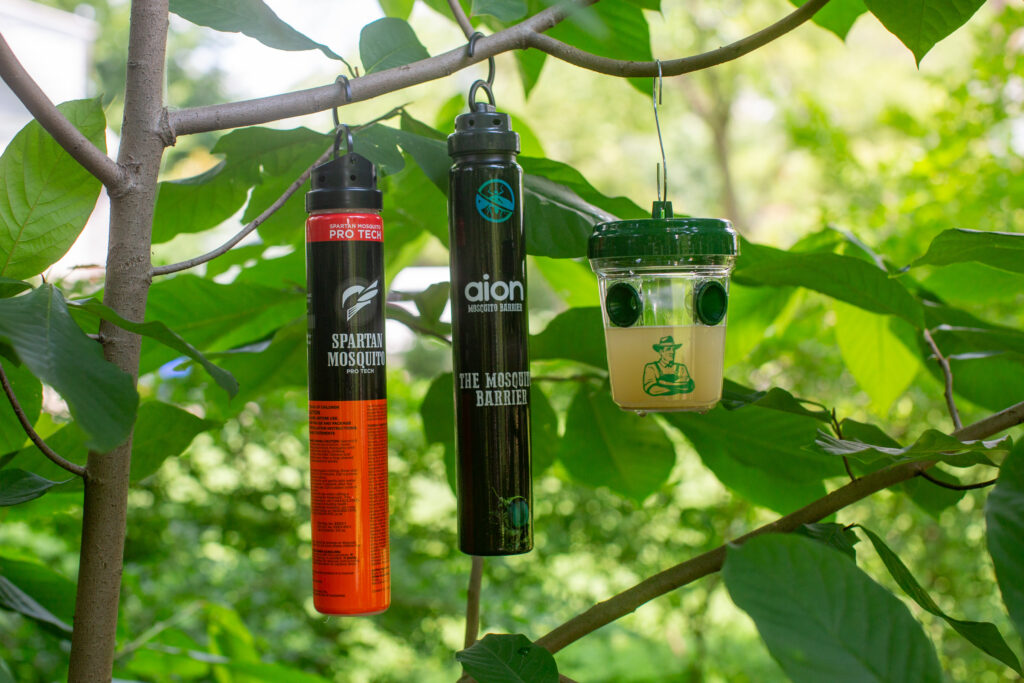
Spartan Mosquito Pro Tech
Company says tubes kill mosquitoes for up to 30 days. Spartan Mosquito (also known as AC2T, Inc.) was the first to commercialize a yeast-and-sugar tube; the other two companies are copying it to some extent. Based in Hattiesburg, Mississippi, and owned by Josephine Tatum Hood. website: spartanmosquito.com
Aion Mosquito Barrier
Company claims device will kill and repel mosquitoes for 90 days. Much of the advertising seems to be AI-generated. The box claims that part of the profits go to saving marine turtles, but I seriously doubt this happens. Based in Memphis, Tennessee, and owned by Wade Whitely. aion-products.com
Tougher Than Tom’s Mosquito TNT
Company claims they work for 30 days. This company spends a lot of money targeting people with cheesy ads on Facebook, Instagram, YouTube, and Tiktok. Based in Austin, Texas, and owned by Zachary Snyder Collins. website: tougherthantom.com
Do they work?
To my knowledge, there’s no evidence that any of these devices kill mosquitoes. I tested all three of them in my yard in Pennsylvania and none was able to even attract mosquitoes. This is not surprising given the small amount of sugar and yeasts that are included. I.e., even though some carbon dioxide will be produced by the yeast, it will never be enough to fool a mosquito. One would likely needs pounds of sugar to produce the necessary volume of carbon dioxide. Moreover, you would need to keep adding sugar daily to maintain the required output. It is pretty obvious, even before testing, that they can’t work as described.
Another reason why mosquitoes are not attracted to these devices is that mosquitoes use more cues than just carbon dioxide to find hosts. For example, most species also use odor, heat, and visual detection.
Although these devices do not control mosquitoes, they do attract and kill other insects such as flies, beetles, wasps, and ants. Many people view these non-target deaths as evidence that the devices are working.
I have full reviews of the Spartan Mosquito Pro Tech and the Tougher Than Tom Mosquito TNT if you need details. For the Aion Mosquito Barrier, please see my review of the device it copies, the Spartan Mosquito Eradicator (per court order it is longer manufactured).
Why are these companies still in business?
Grifters thrive in the United States because state and federal regulators rarely punish businesses that make false claims about pesticides. It’s also sadly true that we have a generally poor level of science education in the country, and that leaves citizens open to being deceived by even obvious scams. And we have a huge population, so there are hundreds of thousands of people each summer who might give one of these products a chance. For a grifter, it doesn’t really matter than 99% of these people will never buy it again — there will always be hundreds of thousands of new (naive) customers next summer.
There are also people who will keep buying a scam year after year. This happens for a variety of reasons:
- Towns, municipalities, and regional health departments often spray insecticides from trucks and airplanes, in the middle of the night, without many residents being aware. And if some of those people have yeast-and-sugar tubes hanging in their yards, they might wrongly assume the lack of mosquitoes is related to the tubes. This scenario is probably common because spraying happens pretty much at the exact time of the year that homeowners place the yeast-and-sugar containers around their yards. For those curious about Mosquito Abatement Districts, this article has a nice summary. You can also ask your local government for details on whether your house is being treated.
- Sometimes due to sudden and extended drought conditions, mosquito populations plummet. Again, people might not appreciate that the lack of water is preventing mosquitoes from completing their life cycle and will mistakenly attribute the drop to yeast-and-sugar devices they have deployed around their yards.
- Many of the companies encourage homeowners to hang the tubes before the start of the mosquito season. It might seem to some that the tubes are keeping the mosquitoes at bay but in reality it’s because the mosquito season hasn’t started.
- Finally, some homeowners spray pyrethroid-based insecticides (like those used by Mosquito Shield and the like) in addition to deploying the yeast-and-sugar contraptions. I’ve seen comments on the internet suggesting that these people believe both are necessary even though in reality the tubes are merely decorative.
Once a person becomes convinced that one of these devices works, they are unlikely to abandon that belief even when presented with clear evidence to the contrary. That’s probably especially true if a person tells multiple friends that a device works. I.e., people can become more and more invested in a false belief over time. Indeed, when the tubes fail in future summers (or during gaps in municipal spraying), true fans of these tubes go to great lengths to blame themselves. For example, they might say, “I don’t think I used the correct temperature of water”, “I may have placed them too close to my house”, or “I should have used a few more tubes.” The companies use the same lines in response to consumer complaints, never acknowledging that the failure is with the tubes themselves.