
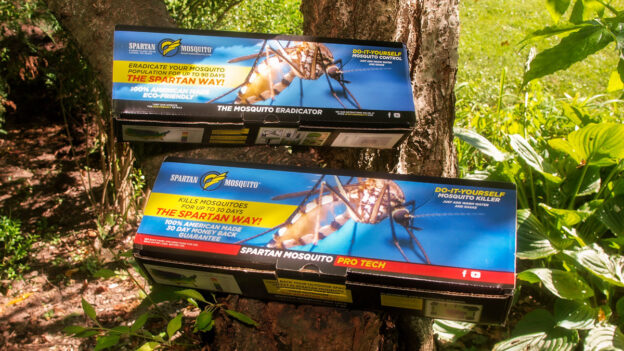
This post evaluates the claim on the label, “mosquitoes will gather near them”. Per the company, it is the first step in how the device kills mosquitoes. I.e., the device needs to attract mosquitoes if it is going to work.
Evaluating the claim
I used a security camera to record activity around the cap area. Here’s a photograph of how I arranged everything:
Below is a 15-second time-lapse to show that small insects such as ants were easily visible, even at night. I think they are Prenolepis imparis, which are 3-4 mm long —mosquitoes are larger and thus would be detectable even in flight.
On the day that began filming (September 2nd, 2020) I counted over a dozen mosquitoes (all Aedes albopictus) landing on my arms and legs within 30 seconds. According to the instruction sheet, the device begins to work instantly, as soon as water is added, so an hour of remote, video observation should be a sufficient amount of time to evaluate the attraction claim.
I collected continuous footage for over a week, ending observations on September 10th. The mosquitoes were still plentiful on that day.
Results
During 183 hours of footage, I couldn’t find a single mosquito on or near the device. Here are the contents. I also posted a photograph to iNaturalist.
Conclusion
Because the Spartan Mosquito Pro Tech did not attract any mosquitoes, it therefore did not kill any mosquitoes. If my results are generalizable to other yards, the device is worthless as mechanism of mosquito control.
It is noteworthy, I think, that Spartan Mosquito has not made public a single video of mosquitoes gathering around a Pro Tech (or an Eradicator) when it is deployed outside. My guess is that the company has tried many times to get such footage but has not succeeded in attracting a mosquito. It will be interesting to know whether they will be compelled to disclose their efforts in a court of law. I.e., because the company has formally claimed to the EPA that “mosquitoes will gather” around the Pro Tech, the company would be in substantial legal jeopardy if that statement turned out to be false. If that’s what is going on then it seems likely that the EPA Enforcement Office might coordinate with the FTC as well.
In case anyone might be skeptical of my results, I decided to upload all 183 hours of footage onto YouTube. I had to break it into 16 segments due to size limits on YouTube.
Research conducted in Florida found no evidence that Spartan Mosquito Eradicatiors are effective mosquito-control devices. Below is my reconstruction of the two experiments they conducted. One was in the laboratory, one was outside.
Laboratory experiment
Below is a rough reconstruction of the laboratory experiment they conducted. In each of the cages (BugDorm-2120), 100 male and 100 female tiger mosquitoes (Aedes albopictus) were released, then monitored for mortality at 24, 48, and 72 hours.
Schematic of laboratory experiment based on description in Aryaprema et al. 2020.
Here is a photograph of one of the choice cages:
Below are the cumulative mortality data for the three cages. The Spartan Mosquito Eradicator filled with the provided packet ingredients (treatment) did not result in higher mortality. I.e., there was no evidence the device killed mosquitoes under laboratory conditions.
Field experiment
The researchers also conducted a field experiment using two sites that had large populations of tiger mosquitoes (because of the presence of tires). At each site they deployed five tubes (separated by 4 m), switching whether the tubes were “treatment” or “control” tubes every 2 weeks. A BG-Sentinel trap (without carbon dioxide) was used to quantify mosquito numbers every week.
Schematic of field experiment based on description in Aryaprema et al. 2020.
Below are the weekly numbers of mosquitoes caught in the BG Sentinel traps. Results: there was no evidence that presence of treatment tubes (filled as per company guidelines) reduced the numbers of mosquitoes at the sites.
Conclusions
The scientists concluded that “Both laboratory and field components of our study show that the Spartan Mosquito Eradicator is not effective in reducing abundance of Ae. albopictus.” They speculate that the contents do not attract mosquitoes and that the holes on the device (~3 mm) are too small for mosquitoes to easily reach the fluid inside. They also highlight the need for an experiment to evaluate whether the active ingredient (1% sodium chloride) kills adult mosquitoes. I.e., even if mosquitoes were attracted to Spartan Mosquito Eradicators and could easily get inside, the salt might not be lethal.
Aryaprema, V.S., E. Zeszutko, C. Cunningham, E.I.M. Khater, and R.-D. Xue. 2020. Efficacy of commercial toxic sugar bait station (ATSB) against Aedes albopictus. J. Florida Mosquito Control Association 67: 80-83. PDF
Here are instructions for building a mosquito trap using a 2-liter plastic soda bottle. All you do is add some bait (honey, fruit, juice, sugar water, or some nectar-containing flowers) and place in a dark corner of the room. It works because mosquitoes seek out sugar, which they require to fuel themselves. Once inside the bottle they can’t get out.
The above instructions are a modification of a Taiwanese science-fair project that eventually went viral. The differences between the original instructions and mine are that (1) I don’t recommend adding dry active yeast, (2) I suggest sugar sources other than granulated sugar, and (3) I don’t wrap trap in black paper. The omission of yeast is because I don’t think the generation of carbon dioxide is necessary to attract mosquitoes to sugar. In fact, adding yeast likely reduces the attractiveness and causes the trap to fail faster.
The critical part of the original instructions is to deploy the device on the floor in a corner of a room. This is because mosquitoes love to hang out in corners — they are dark and relatively free of desiccating drafts.
Why it works
Mosquitoes are famous for sucking blood, but like many insects they spend most of their lives quietly ingesting sugar from flowers and rotting fruit. For example, here are some mosquitoes nectaring in the middle of the day:
Psorophora feroxAedes albopictus
So when mosquitoes find themselves trapped inside, they will zero in on whatever you have on the countertops — fruit, puddles of syrup, cut flowers, or even a dirty sponge. I don’t have photographs of mosquitoes eating fruit inside but Justin Yoshida (Thailand) does: on jackfruit, on apple slices, and on eggplant. Mosquitoes indoors are likely not especially picky about fruit type because the option is starving to death. Mosquitoes even fall into juice containers and die, apparently, as one restaurant discovered. And here’s a mosquito eating brioche goop at my house:
In case you’re skeptical that these traps can actually work, here’s a video by somebody who followed the original (science fair) directions and killed 9-10 mosquitoes in 24 hours:
Tips
The original instructions suggest 50 g (~1/2 cup) sugar and 200 mL (~1 cup) water but the ratio probably doesn’t matter at all. Brown sugar is likely better than granulated (white) sugar because it has more impurities (some of which are volatile). A drop of rose water might make the sugar mixture more attractive.
Make traps with different types of bait to see which ones are most attractive to the species that are local. Anopheles coluzzii, for example, seems to prefer papaya and banana juice over mango juice (Nignan et al. 2020). Other species might prefer oranges. Or, perhaps, durian.
Replace your bait when it stops attracting mosquitoes. Perhaps every four days if you use fruit (Meza et al. 2020).
If you use flowers, opt for ones that have nectar (if you know) and are light-colored. Or stick a small potted orchid inside the bottle — their blooms last for weeks.
If you happen to have a plant with extrafloral nectaries, that’s a great bait that will likely last for a long time (when you’re on vacation, for example). Try a bunch of wild cherry leaves, for example.
Why it won’t work outside
Don’t bother using these traps outside (the recommendation of the viral versions). Mosquitoes prefer natural sources of sugar so they will likely ignore anything inside a container. The traps will also not work in rooms full of flowering plants or decomposing fruit. Similarly, if your kids spill juice and soda everywhere, the traps won’t work.
Adding toxins to the mix
If you have a house free of small kids and meddlesome pets, you can add bit of boric acid to the solution to create an attractive toxic sugar bait (ATSB) station. Then, when mosquitoes ingest the fluid they will die even if they manage to escape the trap (it can happen). In fact, once you have a toxin in the fluid you can and should just get rid of the funnel part of the trap — its presence is likely a barrier to some mosquitoes even though it’s relatively wide (~2 cm). Instead, cut a 3 cm hole in the side and keep the cap on the bottle. Note that because these devices are indoors you don’t need to worry about the boric acid (or whatever) poisoning the pollinators in your yard.
The above is nicely explained by Andy Lee Graham:
Anne Barone writes that blackberry wine pairs well with boric acid.
Note that fermentation will occur even though you haven’t added any yeast. Fungal spores are present everywhere.
Commercial, outdoor versions that contain yeast
In the United States the following “yeast and sugar” products are advertised to kill mosquitoes outside: the Spartan Mosquito Eradicator, the Spartan Mosquito Pro Tech, the Sock-It Skeeter, the Donaldson Farms Mosquito Eliminator, the Mosquito XT, the Aion Mosquito Barrier, the Skeeter Hawk Backyard Bait Station, Grandpa Gus’s Mosquito Dynamiter, Tougher Than Tom’s Mosquito TNT, and the Solution X. I’ve reviewed them all here (they don’t work).