Author Archives: Colin Purrington

Boxes of Spartan Mosquito Eradicators and Spartan Mosquito Pro Techs.

Posts about Spartan Mosquito

Below are my posts that discuss Spartan Mosquito (AC2T, Inc.) of Hattiesburg, Mississippi.

  1. Spartan Mosquito Eradicator review
  2. Spartan Mosquito is suing me
  3. Class action suit over Spartan Mosquito Eradicators
  4. Scientists confirm that Spartan Mosquito Eradicators don’t work
  5. Spartan Mosquito Eradicator updates
  6. Spartan Mosquito Pro Tech review
  7. Does the Spartan Mosquito Pro Tech attract mosquitoes?
  8. Spartan Mosquito Eradicator vs Spartan Mosquito Pro Tech
  9. Yeast-based mosquito control devices
  10. Spartan Mosquito’s efficacy data revealed
  11. Regulatory actions against Spartan Mosquito
  12. A timeline of Spartan Mosquito
  13. Spartan Mosquito settles class-action fraud suit for $3.6 million
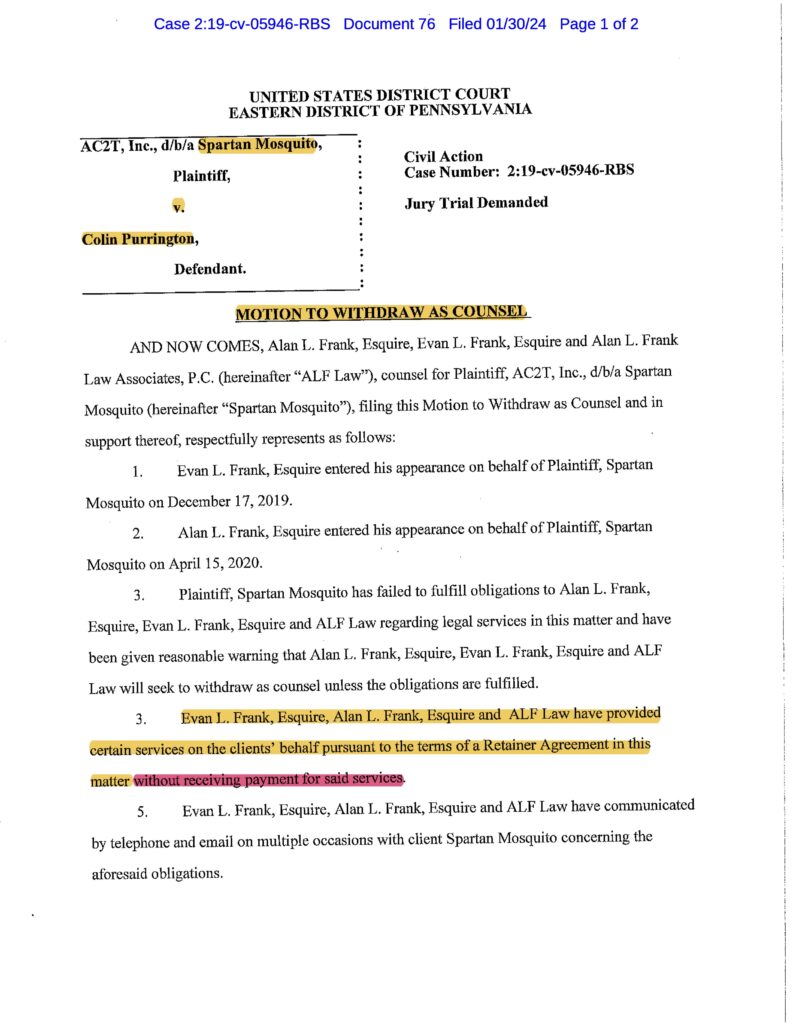
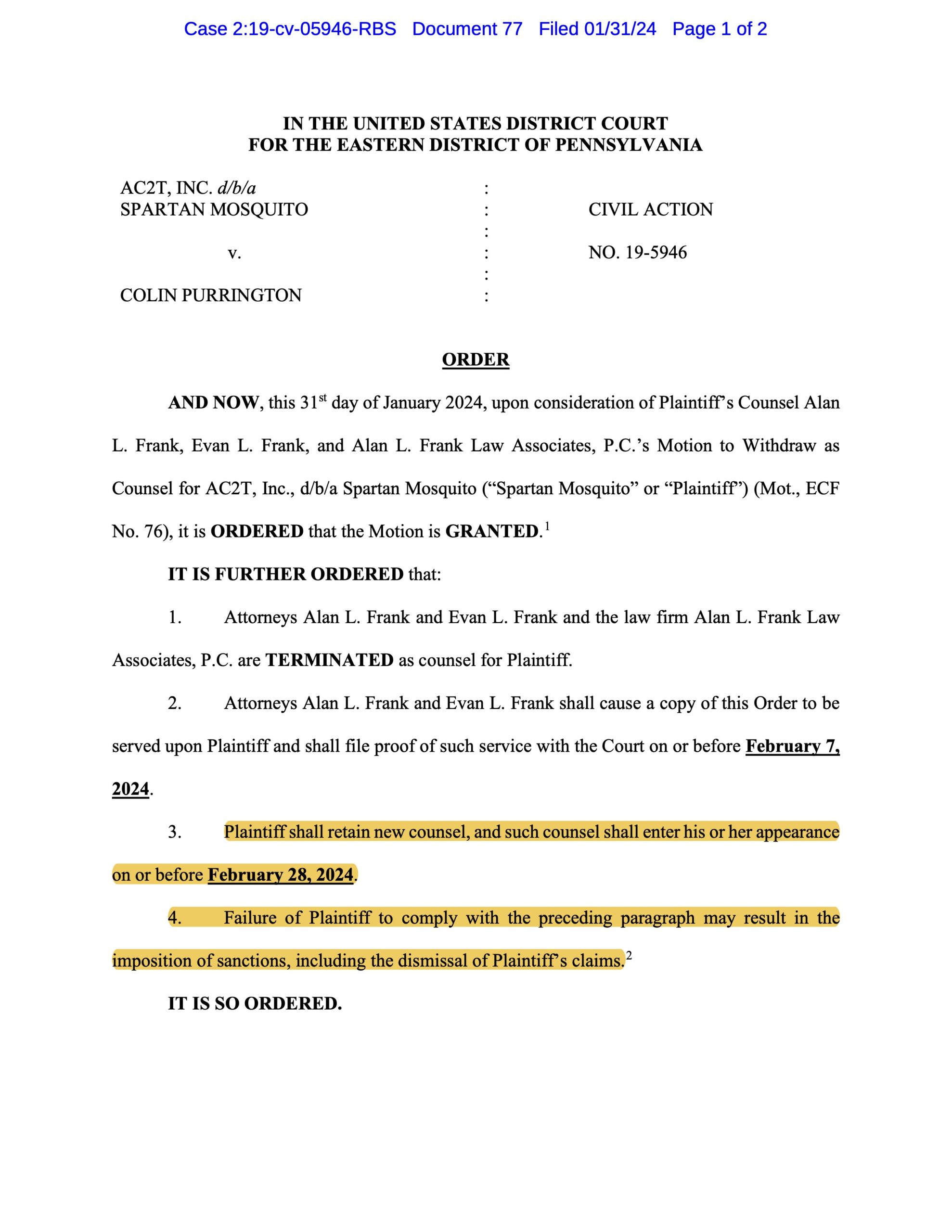
  14. Spartan Mosquito’s attorneys quit over unpaid bills
  15. Spartan Mosquito’s letter to the EPA asking for a testing waiver
  16. Judge dismisses Spartan Mosquito’s SLAPP against me

I never intended to publish more than my original 2019 review, but AC2T’s retaliatory lawsuit against me (#2 on the above list) prevented me from visiting my mom while she was dying and has cost me $90,000 in legal fees (update: I countersued the company, successfully). I will continue to expose this company until it goes out of business.

Background

This television clip is a good introduction to the Spartan Mosquito Eradicator and to the company’s frontman, Jeremy Hirsch:

Are you a journalist?

There’s likely a fun story here. Owner of sandwich franchise becomes head of award-winning, $100 million company that sells tubes of sugar water to kill mosquitoes. Inventor says, “We’ve come up with the most economical, easiest, most effective mosquito-control measure pretty much in the world”.

When I pointed out that device is totally unlikely to work, company lashed out with a SLAPP to bankrupt and silence me. A lawyer in New York read my post and used it as the basis for a $5 million class action suit (but I won’t get a penny). Soon after, separate teams of scientists confirmed that, indeed, Spartan Mosquito Eradicators cannot and do not work. Shockingly, the FTC and EPA have done absolutely nothing, and even the American Mosquito Control Association cowered in silence, fearful of itself being sued. Only a handful of states have banned sales of the tubes.

And in 2020, Spartan Mosquito even managed to get a version of its tube approved by the EPA, a feat engineered by the lobbying firm behind Brexit. Scientists are horrified. You can now buy the tubes on Amazon, where they’re marketed as a beneficial pest-control insects. Only California sees the scam and bans sales.

Will the FTC ever get involved? Does the EPA know that it’s been snookered?

And how on earth did the tube get registered for sale in the first place, in Mississippi? Answer, political pressure (the Branch Director of the Pesticide Program wrote, “I was told from above to approve“).

If that’s not enough drama for a good read, there’s pornography and NASCAR in the mix (racy, eh?). And I’m guessing that Spartan Mosquito hired a private investigator to pry into my personal life (they posted online comments about my wife). I suspect there is also a lot of delicious information on the company’s failed effort to get a foothold in Africa (all that’s left is an archive of the shell company’s website). There’s even talk of a military discharge file with highly pertinent information. And talk of governors in multiple states intervening on behalf of the company, pressuring pesticide regulators.

There’s also plenty of footage of Spartan Mosquito on YouTube. There used to be more but the company has been deleting it. I can’t say I blame them.

Here’s the sole article that’s been written about Spartan Mosquito: “A Biologist, a Blog, and a Mosquito Control Dispute” by Brooke Borel and published in Undark Magazine.

Are you a state pesticide regulator?

Please consider contacting your counterparts in states that have denied registrations to Spartan Mosquito (CA, CT, ID, IN, KS, ME, MT, NE, NM, NY, OK, PA, UT, VA, WA, and DC) and ask for a copy of the letter sent to the company detailing the reason. You can also ask the Region 4 EPA office for the “Letter of Warning” sent to Spartan Mosquito in 2018 that details why the Spartan Mosquito Eradicator does not satisfy the conditions for exemption from registration under Section 25(b) of FIFRA (i.e., the company has falsely claimed it is exempt).

Are you an EPA or FTC enforcement officer?

I would recommend taking a close look at the efficacy data (field trials, case studies, cage experiments, etc.) that the company has been sending to state lead agencies for the Eradicator. Spartan Mosquito is apparently sending data that show a 95% reduction in mosquito populations (to support the claim of 95% efficacy that appears on the box). It would be very interesting, therefore, to know how they managed to get such results. I.e., because salt is not lethal to mosquitoes, the purported 95% reduction must be due to bad experimental design, selective data reporting, or simple fabrication. If it’s the latter (involving lying to the EPA and to state regulators), prison time for some or all AC2T employees is not out of the question.

I’d also recommend scrutinizing the claim on the box (and on instructional brochure inside, and on company’s Facebook page, and on video ads) that mosquitoes will be “drawn” to the tubes. Here’s the issue: Spartan Mosquito admitted to a state regulator (in 2019) that the Spartan Mosquito Eradicator does not emit enough carbon dioxide to attract mosquitoes. Yet the company has continued to make the “draws mosquitoes” claim for years, assuring state regulators that all the claims on the label are true. This seems to be an example of the company, and perhaps its attorneys as well, of knowingly misleading state and federal pesticide authorities. The EPA should also ask the company to provide the CO2 production data for the Spartan Mosquito Pro Tech to see whether the same issue is at play (the company claims the tube attracts mosquitoes).

If you work at the EPA and know details on how the Spartan Mosquito Pro Tech got its registration, please consider reporting your concerns to the Office of the Inspector General. Did the company receive a data waiver? Did efficacy fall below the 95% population reduction required by EPA? Do you have evidence that regulatory shortcomings are being hidden from the public? You can make a tip anonymously.

Are you John Oliver?

This company’s products would make for a fantastic deep-dive into the proliferation of ineffective mosquito control products in the United States and how some states allow these products on shelves even when it’s pretty darn clear they don’t do a thing. Pills, creams, bracelets, zappers, tubes of sugar water. Spartan Mosquito has taken it to the next level and deserves to be exposed for the hive of charlatans it is.

Here’s one of the company’s commercials for the Spartan Mosquito Pro Tech that you can show and say, “coooool.” True fact: the lobbying firm behind Brexit helped to get that tube approved by EPA. Here’s another heartwarming commercial (for its original tube) that involves a guy slapping his kids. For footage of the frontman I recommend this. Or this. Here’s my YouTube playlist with more options.

You could tie segment in with SLAPPs because the company has served me with one. And you could ask your favorite Mosquito Control Board why Spartan Mosquito Eradicators are banned in over a dozen states but not in New Hampshire. You could also ask the American Mosquito Control Association why it hasn’t released its scientific report on Spartan Mosquito.

The company’s Facebook page is also worth a look. They rarely post about their magic tubes, instead opting to rile up the base with, for example, calls for less government interference in business and veiled support for truckers who use their vehicles to protest vaccination requirements. And, more recently, a subtle reference to the Tea Party featuring an Edwardian boy in a dress eating something with a spoon.

Most importantly, Spartan Mosquito owns a rather nice mascot suit and I bet the guy who built it will make one for you. It goes well with attractive models dressed as Spartans, and maybe you could get the whole gang to picket the beautiful Spartan Mosquito production facility in Laurel, Mississippi, for a photo op. For added fun, please give them signs that say, “Release the efficacy data!”, “Please hire a biologist”, and “It’s spelled ENTOMOLOGY no ETYMOLOGY”. I would be entertained.

Consider donating to my GoFundme campaign

My legal battle with Spartan Mosquito is over but I’m still $36,000 in the hole. Donations and/or shares would be hugely appreciated: https://gofund.me/fe59f642.

GoFundMe campaign

I’ve set up a GoFundMe campaign to cover the nearly $90,000 I’ve spent defending myself against Spartan Mosquito’s SLAPP (ACT2, Inc. vs Purrington).

I’d be equally grateful for support on Twitter. E.g., it would be great if influential people would bring this company to the attention of the EPA, FTC, and state pesticide regulators at the respective departments of agriculture. I’m @colinpurrington if you want to tag me.

Here’s a Twitter thread with the current status of the case:

https://twitter.com/colinpurrington/status/1500104801283104773?s=20&t=MUlw3C4yYopIfdjAYCti-A

Ideally, some wealthy donor might give me the funds to countersue these charlatans. That would be really fun.

For more information, please see my other posts about Spartan Mosquito.

Spartan Mosquito v. Colin Purrington

Photo tour of my DIY chicken coop

Pics of my chicken coop in case useful to others who are building their own. It has a sunflower theme because I used an old mural for the exterior.

Sunflower-themed chicken coop built from scrap lumber

The primary feature is a large, south-facing window on the front that provides solar gain during the winter, but hinged to provide ventilation, too. Opening is covered with heavy wire (to exclude raccoons) and screening (to exclude mosquitoes).

Chicken coop window for ventilation

Additional ventilation is provided by a hinged panel at the top. This will be open even during the winter unless temperatures get shockingly low. Opening is covered with hardware cloth and mosquito screening.

Chicken coop ventilation panel

I’ve opted for a platform at the pop door so the chickens can more gracefully go in and out. They really like to just rest on the platform.

Chicken coop pop door

Pop door is opened and closed by an Add-A-Motor controlled with a Wemo smart plug. The Wemo needs to be configured with two separate routines; one to open, and one to close (like this). Here’s a video of the door opening in the morning, followed by a video of chickens using it. The motor is a tad loud but that’s useful in alerting the chickens.

Nesting boxes are accessible on the outside of the coop so that I don’t need to disturb the flock to do an egg check. Lid can be hooked to chain above if there are a lot of eggs to collect. The hinged side is protected from rain with a rubber gasket made out of an old bicycle tire. Lid and nesting boxes are all insulated so that frozen eggs are less of a concern.

Nesting box on exterior of chicken coop

Here’s the view inside the coop. The chickens get to the nesting boxes and perch via a ramp with cleats spaced every 3″. Then there’s a short hop (or optional ramp trip) to the perch. Underneath the perch is a droppings pit that gets filled with granulated clinoptilolite (“PDZ”) to absorb ammonia. Floor of coop is covered in pine shavings. Wood is left unpainted mainly because I’m lazy, but also because if I went with the traditional white it would always look dirty. I did, however, treat the perch with linseed oil, then sprayed it with permethrin (to kill mites).

Layout of walk-in chicken coop

This photograph shows the small ramp that comes up from the nesting box landing. It’s likely unnecessary but the chickens do use it, so it will stay. It’s screwed down but can be easily repositioned if needed.

Ramps inside DIY chicken coop

Next is a close-up of the nesting boxes, positioned below the level of the perch so that they don’t hang out. I have an old pillowcase (see above video) that tacks onto the boards to give them privacy in the nests.

Nesting boxes inside chicken coop

Underneath the ramp is a wood box filled with moss, sand, and dried mint. The chickens will likely never use this but it was fun to provide. It’s large enough for four chickens at once, I think.

Dust bath inside chicken coop

Lighting inside the coop is provided by smartphone-controlled LEDs (Philips hue shape light). Lights come on automatically (but slowly, over 30 minutes) in the morning for several hours, then again in the evening to provide 15-hour days. I’ve set mine to red to minimize aggression among hens and to increase egg production (per research). Red lighting is also less polluting for humans due to our reduced reliance on that part of the spectrum.

The LEDs are a tad bright so I’ve nested the strip inside a piece of white molding attached to the wall at 45°. The resulting illumination is bounced off the ceiling.

LED strip light inside chicken coop

To spy on my chickens I’ve installed a Wyze (v2) video camera equipped with a 64Gb microSD card. Here’s a still showing birds on perch. I have a second cam trained lower level so that I can monitor the pop door and the water status.

Wyze camera inside chicken coop

To monitor the temperature and humidity in the coop I’ve added a SensorPush, configured to send me phone alerts if temperature gets too low or too high. I can also set humidity alarms. I purchased the SensorPush G1 Gateway, too, so that I could access the data even when I’m away from home (normal version is Bluetooth-only). Overkill, surely, but fun.

SensorPush temperature/humidity probe on north wall of chicken coop

I was worried about condensation (from moist air hitting a cold ceiling) so I added reflective bubble insulation. The walls are filled with fiberglass insulation so I don’t think the winter will be a problem, especially in Philadelphia and especially given global warming. Plus the chicken breeds I currently have (Golden Laced Wyandotte, Blue Easter Egger) are large and cold-tolerant. With my current setup I could likely raise Silkies.

Reflective bubble insulation on ceiling of chicken coop

The insulation seems to work. During the December 15-17 nor’easter (pic below), outside temperature fell to 24 °F; inside dipped to only 31.8 °F. It’s not just the insulation, of course — the chickens generate heat (10 W each, I think), plus the thermal gain during the day is retained in the pure mass of the structure (wood, nails, screws, etc.). If I felt the cold would be a problem I’d also attach plastic film to the window.

For all the lights and gadgets, power is delivered via an extension cord fitted with a GFCI splitter. I decided on getting one of these after a near-death experience with a faulty router.

GFCI power supply for chicken coop

The coop is situated inside my former berry garden that featured chicken wire to protect fruit from birds and squirrels. To convert it for chickens I added a layer of 2×3″ fencing to all surfaces, plus buried hardware cloth along the perimeter. I also added approximately 15″ of hardware cloth on the lower part of the structure to prevent raccoons from reaching in and grabbing a chicken, which apparently they like to do. Something could, conceivably, tunnel into the coop from several feet away, avoiding the buried screening, so I still patrol it daily in case a hole has been started. Small birds (wrens) still come in to steal food, though, and if I’d had to build a run from scratch I would have opted for 100% hardware cloth.

Chicken run covered with wire

Construction photographs

Tips for building a chicken coop

  1. Tour local chicken coops for inspiration before you do anything else. You can’t do this online … pinning hundreds of ideas to your Pinterest boards simply poisons the brain and you really need to see actual coops and talk to actual chicken people who, surprise, know things.
  2. Join or create a local Facebook or Nextdoor group that traffics in free things. I got window, door, and almost all the lumber free. People have things sitting around and you really just need to ask. There’s absolutely no reason why chickens will care if things don’t match or are broken in some way.
  3. Start collecting materials months in advance so you can plan your coop before you start building. E.g., don’t finalize your framing plans until you know the dimensions of your windows and doors.
  4. If you can find a cheap or free shed, do it. Moving a shed and converting it to a chicken coop is infinitely easier and cheaper than building your own. I enjoyed building mine from scratch but it took a long time given I didn’t know what I was doing.
  5. Equip the inside with removable ramps and perches so that you can fix your building mistakes. Similarly, opt for screws instead of nails. Then you can watch the chickens on a security camera for a week or so and then reconfigure items. I.e., perhaps your ramp needs more cleats — easier to just pull it out and take it to the shop for that mod.
  6. Finish your coop before ordering chickens. It’s going to take longer to build than you think.