Tag Archives: beetle

Gallery of parasitic wasps from the redbuds in my front yard

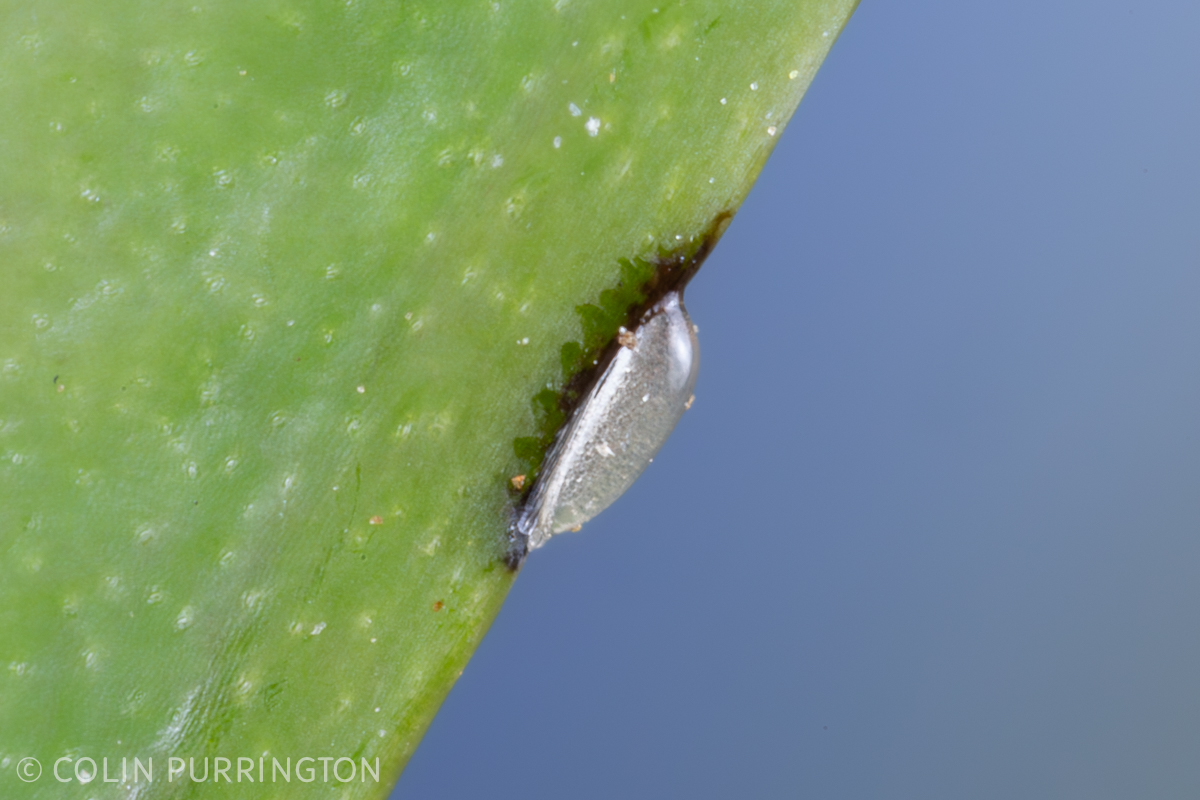
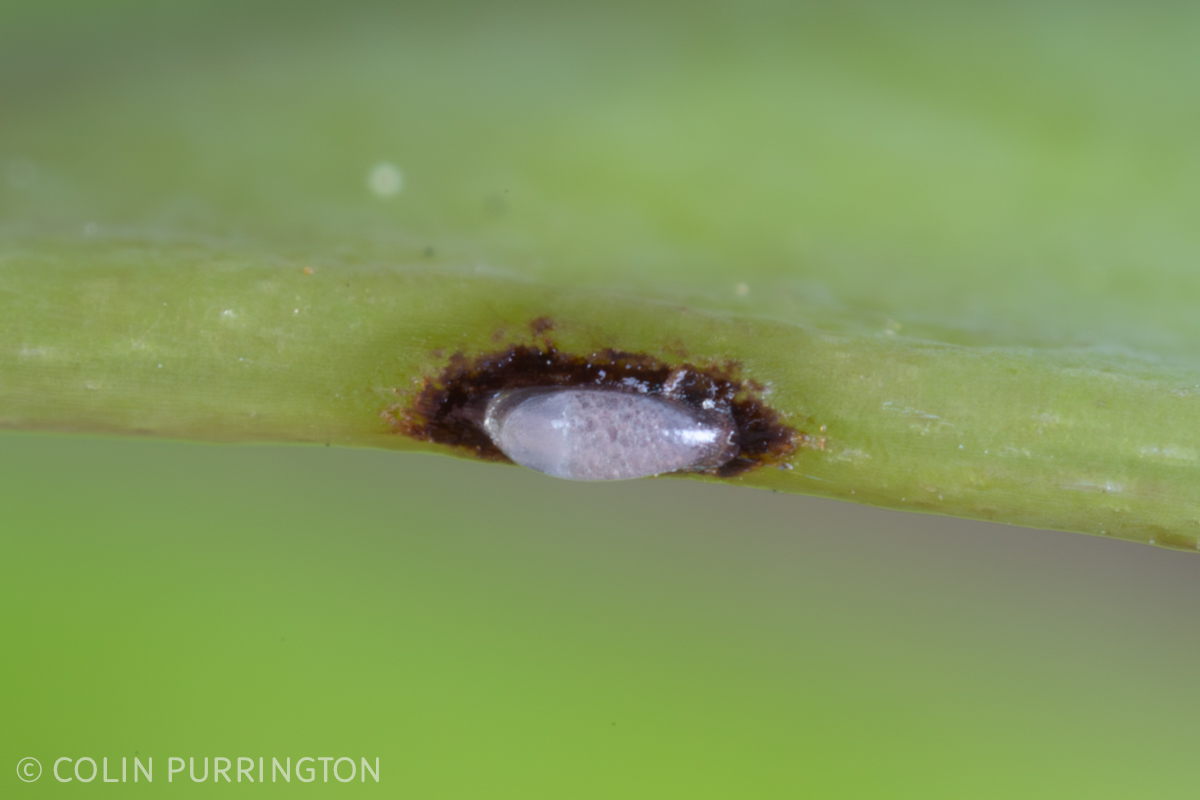
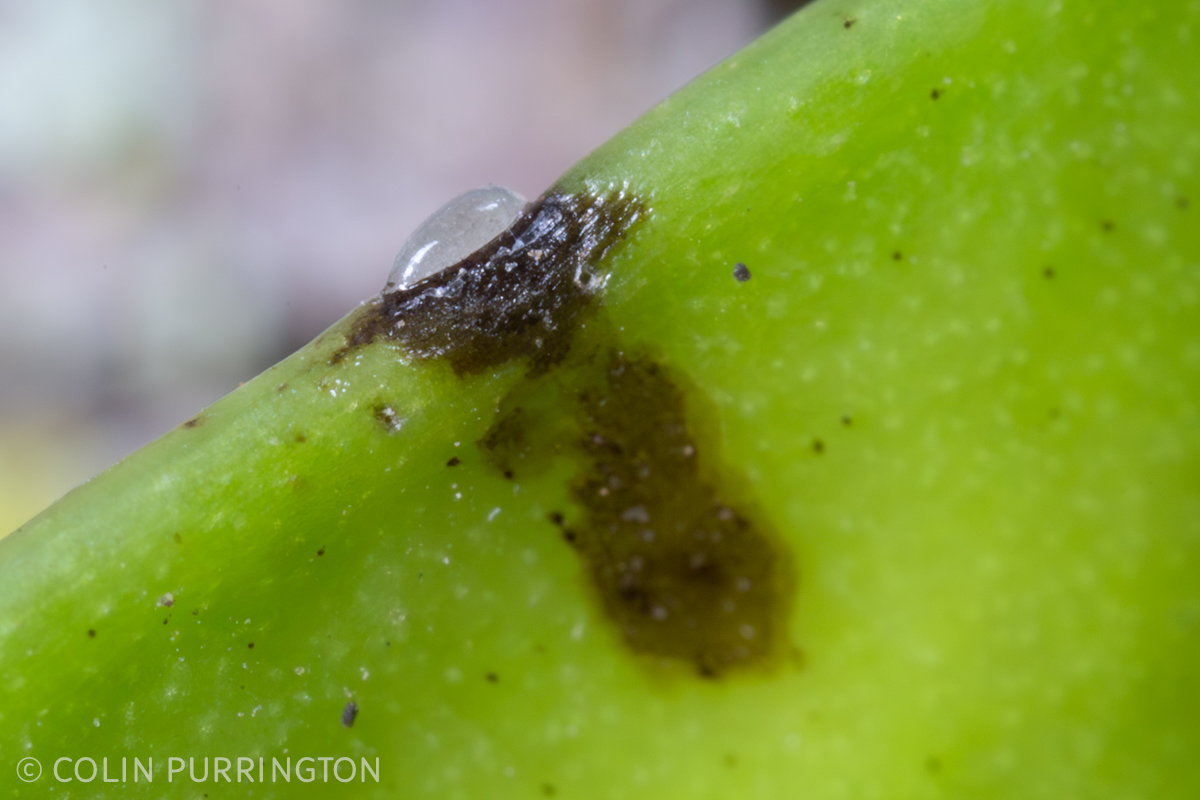
Now that my eastern redbuds (Cercis canadensis) are pumping out thousands of pods each fall, I thought I’d start photographing the wasps that show up to parasitize the redbud bruchids (Gibbobruchus mimus) developing inside the seeds.

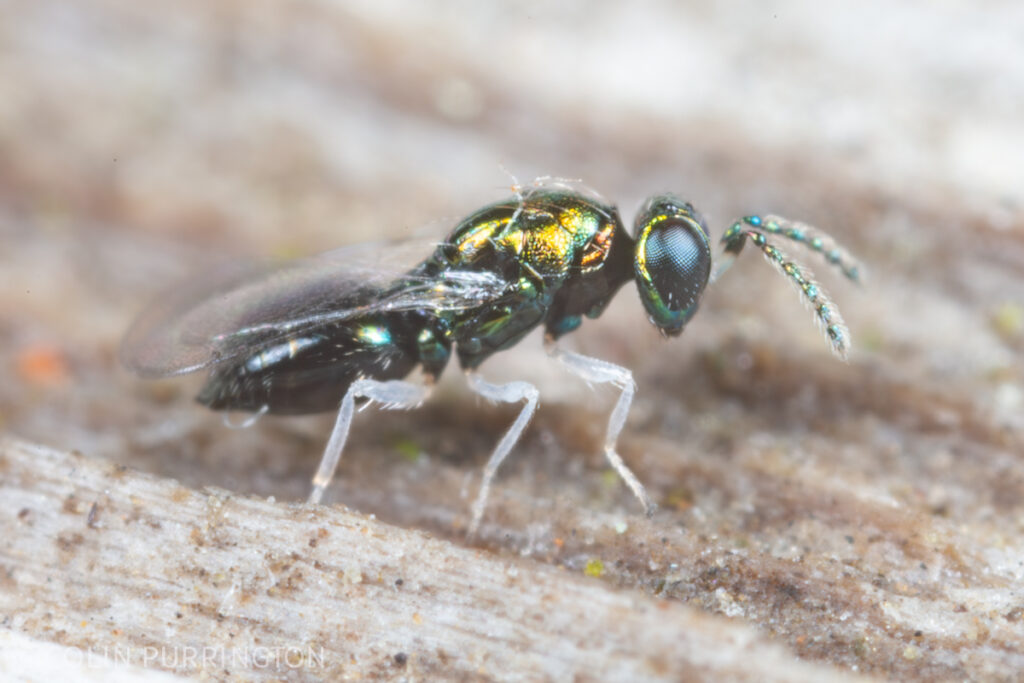
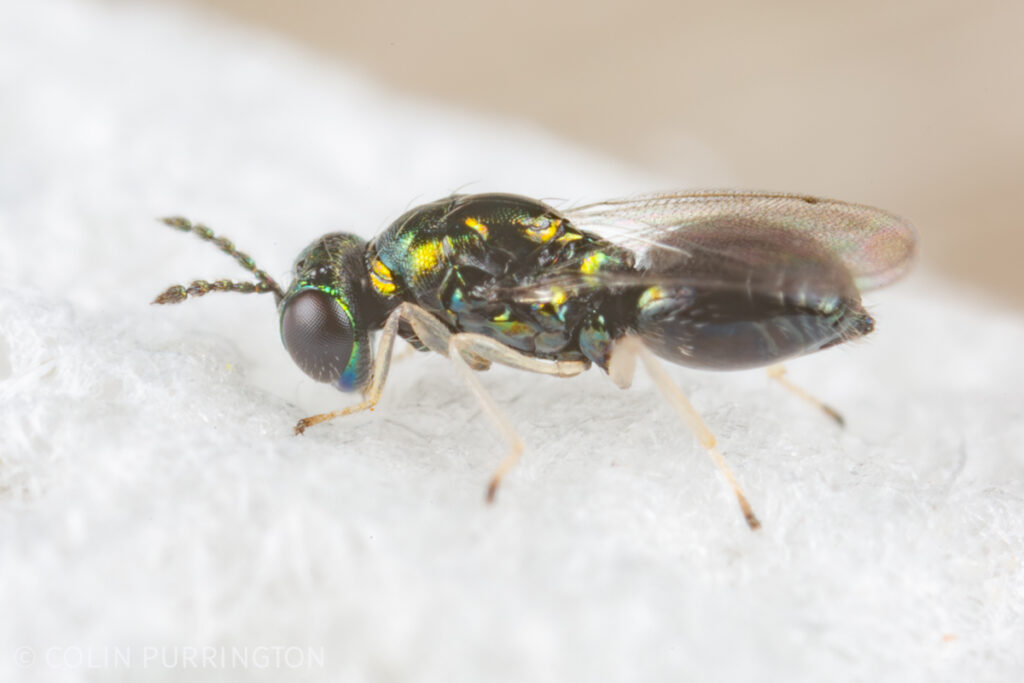
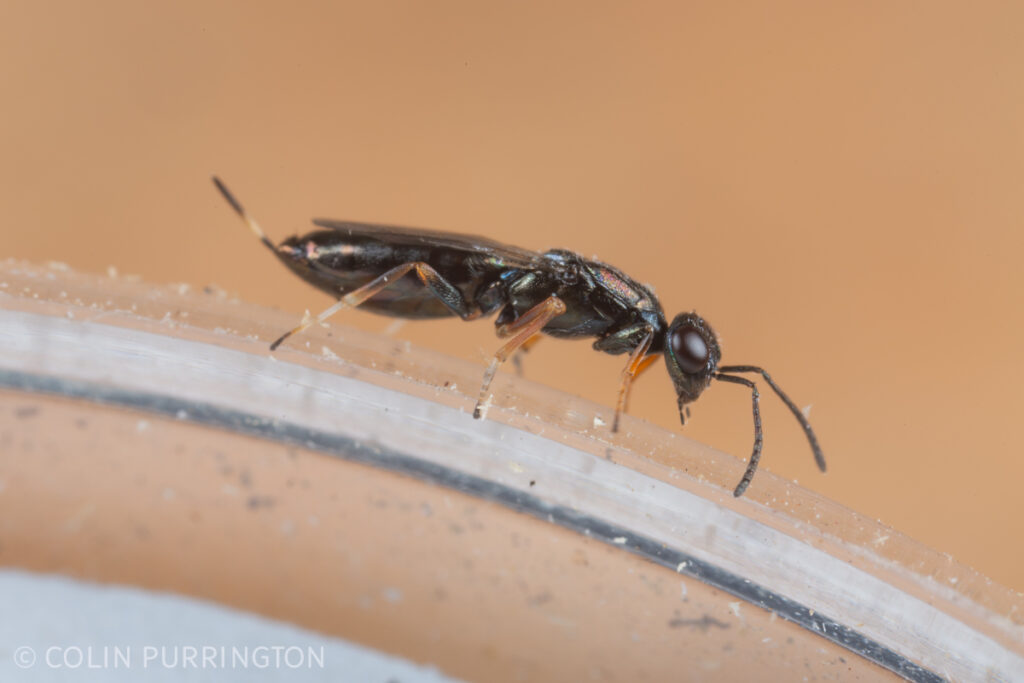
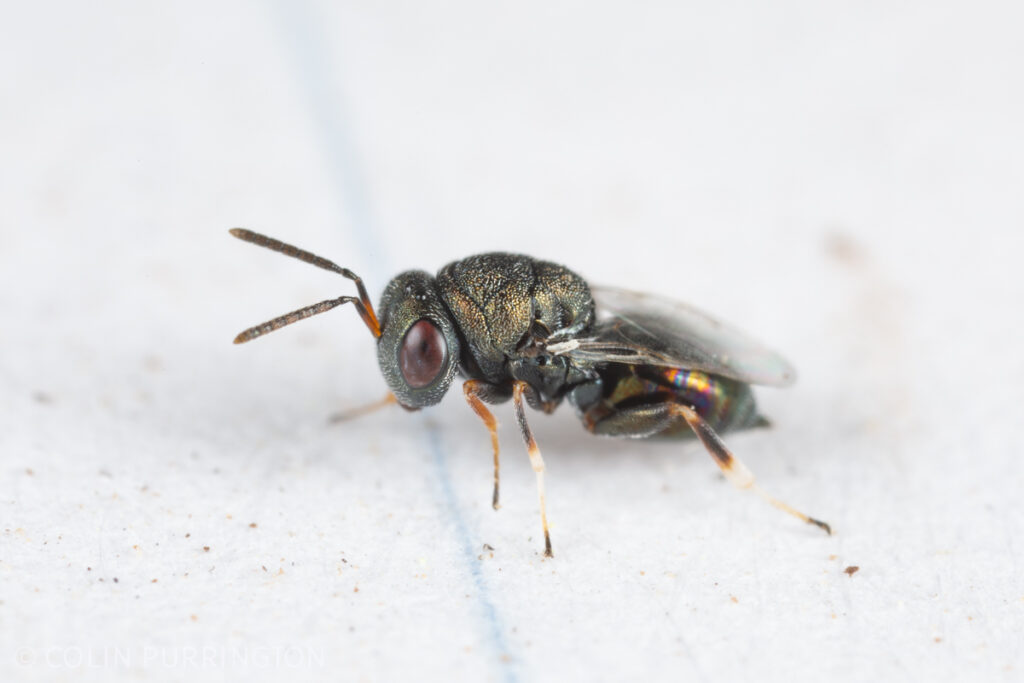
Eupelmus pulchriceps (Eupelmidae)

I’m starting with this species because it’s the only one I’ve photographed that is currently identified beyond genus on iNaturalist. Here’s the female:

And here, possibly, is the male:

I think this a known parasitoid of the redbud bruchid but it took some digging to figure it out. Kingsolver 2004 lists E. cyaniceps as a parasite but Gibson 2001 asserts, “… all literature recording E. cyaniceps from various Bruchidae appear to be misidentifications of E. cushmani.” And per iNaturalists taxonomy page, Eupelmus cushmani is now known as Eupelmus pulchriceps. That said, BugGuide seems to have a listing for Eupelmus cushmanii but not Eupelmus pulchriceps. Additionally, the 2021 “Checklist of Chalcidoidea and Mymarommatoidea (Hymenoptera) of Canada, Alaska and Greenland” (Huber et al. 2021) contains both species, as does the “Bees and wasps of Central America Extended.” I’m a bit confused and thus I likely made a mistake somewhere.

As an aside, the species has recently been found in the Galapagos Islands (Camacho-Erazo et al. 2024, Carmargo-Martinez et al. 2024). Its host range is quite impressive.

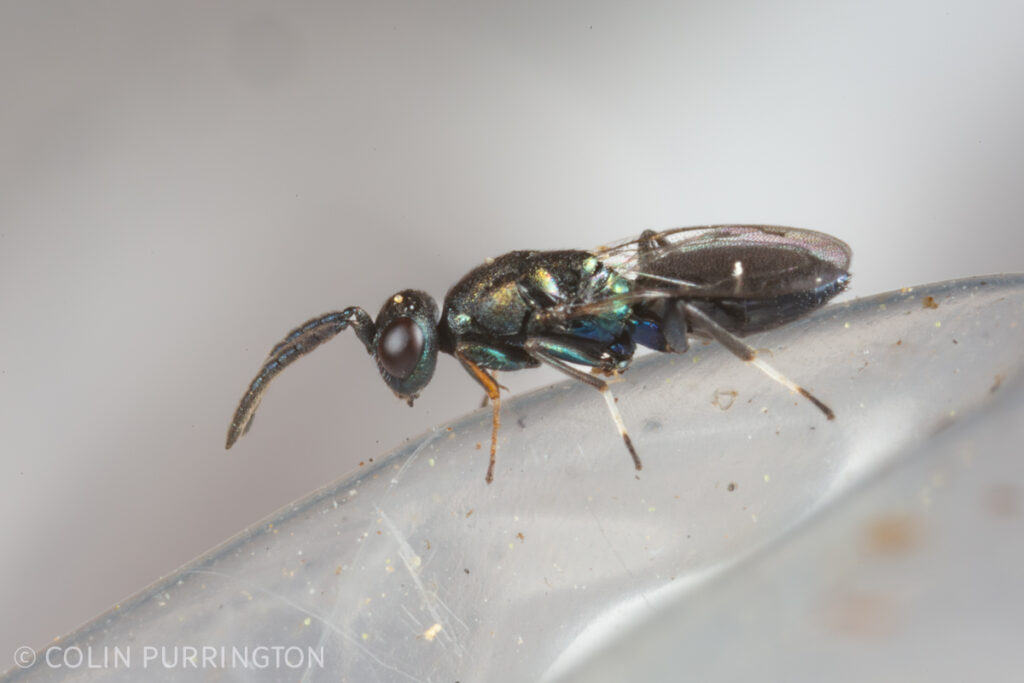
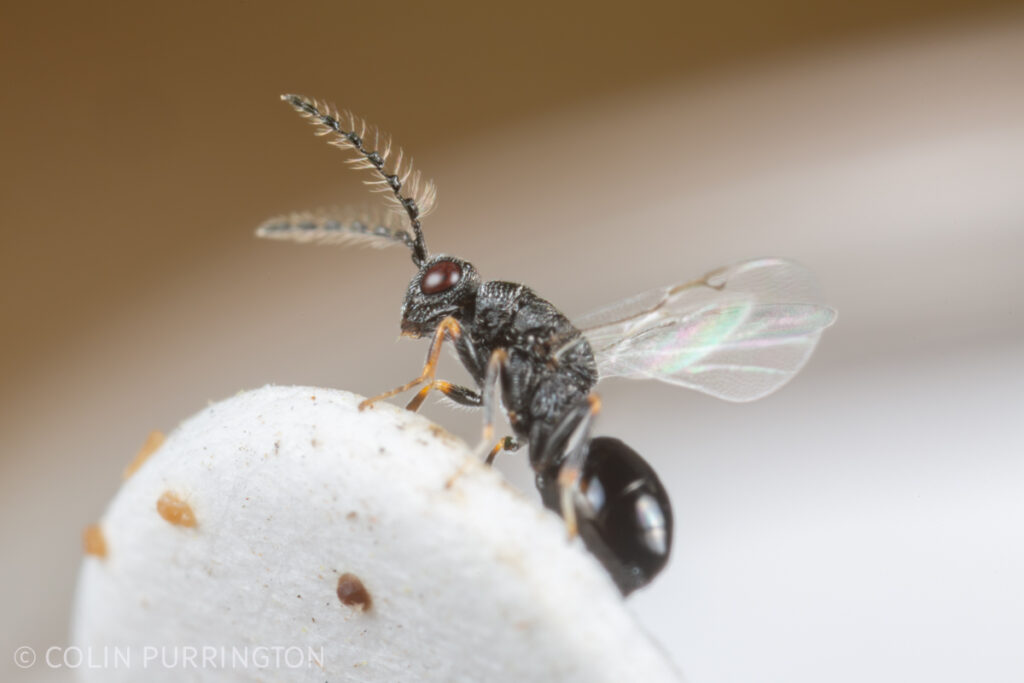
Heterospilus sp.

Kingsolver 2004 mentions that both Heterospilus bruchi and H. prosopidis can be found parasitizing redbud bruchids, so my specimens could one of those (or both), but perhaps even something else in the genus. My ID is because the wasp strongly resembles an observation on BugGuide that is identified as Heterospilus sp.

And here’s the male, which I admit assumes they are the same species. I don’t have any photographs of this species arriving at pods still attached to the tree.

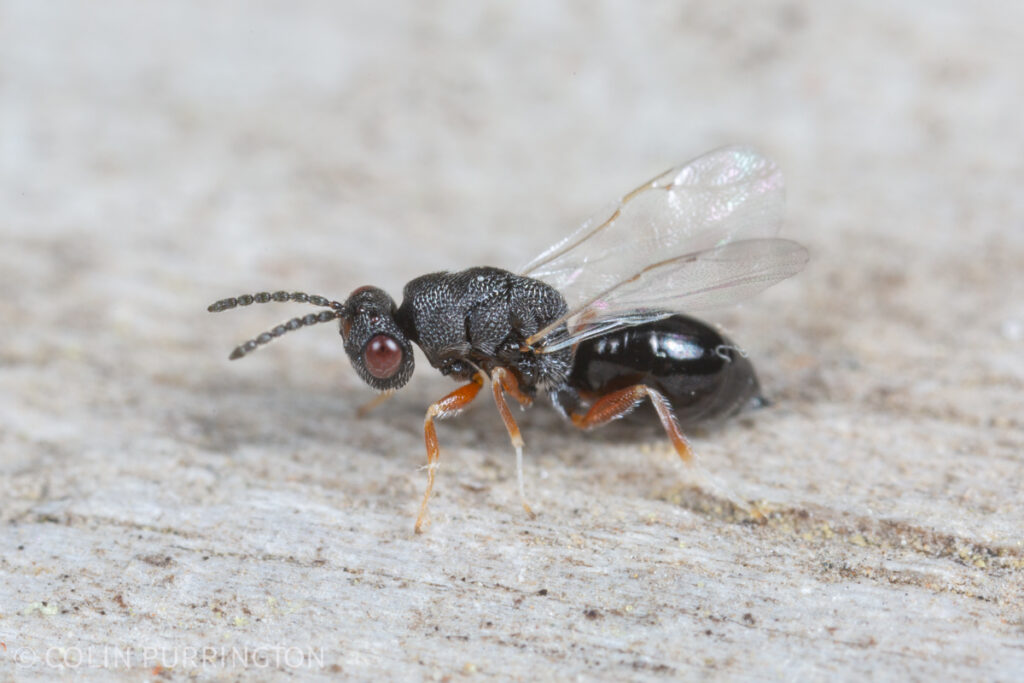
Eurotoma sp.

Klingeman and Carrington 2005 list two unidentified Eurytomidae associated with redbud trees that have bruchid infestations, so this was also not an unexpected find.

A male (below) was one of several that emerged from redbud seed pods. As with the other finds, I’m tentatively assuming that the male/female pairs are the same species.

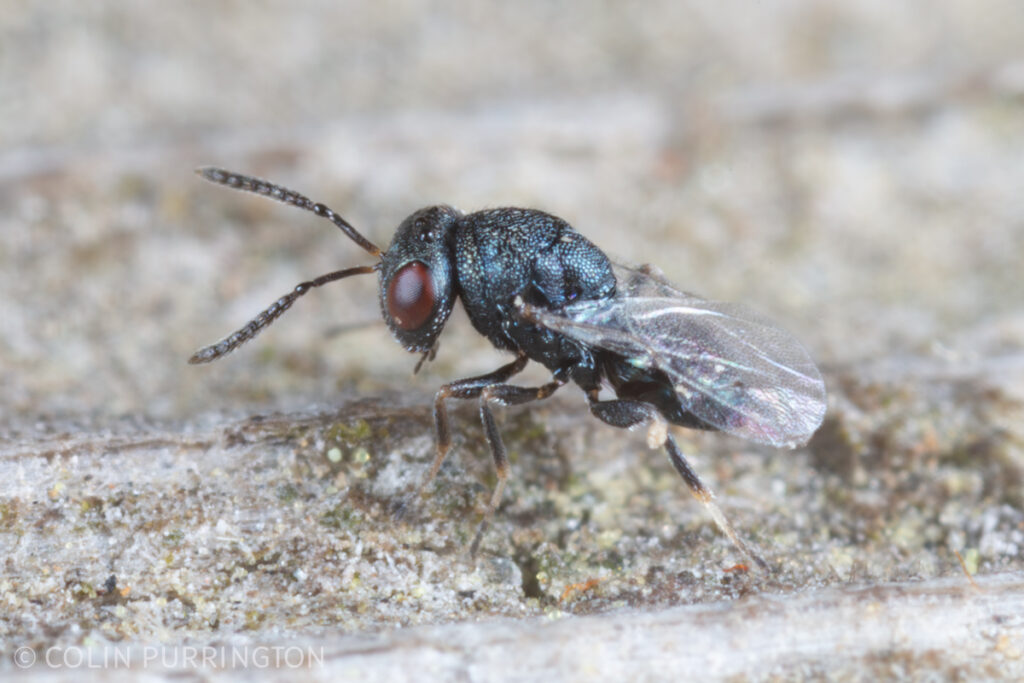
Dinarmus sp. (Pteromalidae)

Per a suggestion on iNaturalist, this might be in the genus Dinarmus. In (weak) support of that, it does appear similar to observations of that genus on BugGuide and iNaturalist. If the genus is correct, it might possibly be Dinarmus basilis, a species that Klingeman and Carrington 2005 found emerging from eastern redbud seeds in Tennessee. There’s an illustration of a female on page 646 of Sureshan and Narendran 2001, however, that doesn’t look like mine in profile, so I’m hesitant. Similarly, figures 2 and 3 of Pimentel et al. 2024 look much bluer than mine. I also think my specimens have too many antennal segments (9?). Dinarmus basilis is apparently introduced in North America and is popular in IPM. The lectotype (a male from Egypt) is in Florence under the basionym of Entedon basalis (Bouček 1974).

More wasps to come?

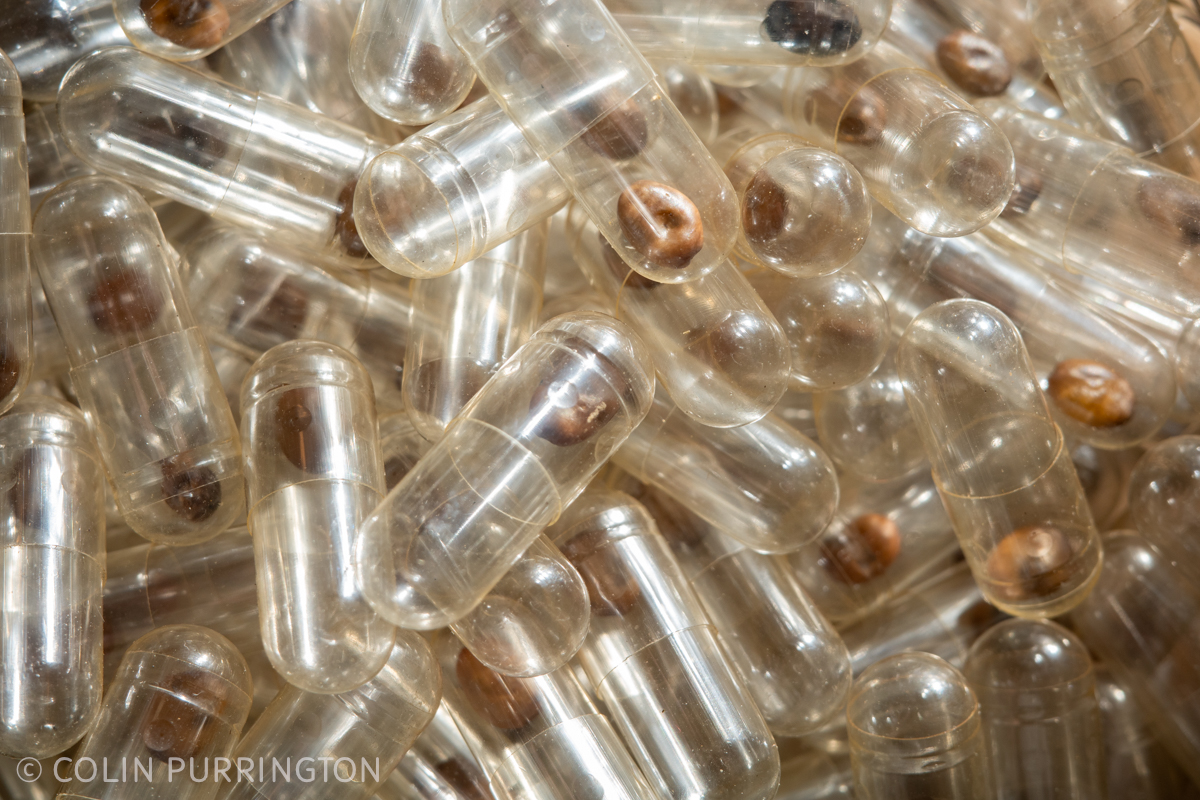
I’d be very surprised if my current gallery of wasps is complete, so I’m monitoring several thousand seed pods (below photograph) to see who else might emerge in the months to come. There are two wasps that are mentioned in the literature and that I’m hoping to find. The first is Horismenus missouriensis (Eulophidae; bright metallic green with a “longitudinal median groove on the scutellum“; see fig. 1), mentioned by Burke 1971. And Stenocorse bruchivora (Doryctinae; fig 9b, fig 7) is mentioned by Cushman 2011. Neither BugGuide nor iNaturalist has photographs of these species.

I’m especially interested in finding hyperparasites of some of the wasps mentioned above. And on my to-do list in 2026 is to collect several hundred redbud pods in the spring to see whether any of the redbud bruchid eggs harbor parasites such as fairy wasps (Mymaridae).

Redbud seed bruchid

In case you want to see what the beetle looks like, here’s an adult:

Macrosiagon cruenta parasitizing potter wasps at insect hotel

Last year I had a little surprise at my bee and wasp hotel. Although I didn’t know it at the time, some of the wasp larvae I found nesting inside the tubes were harboring parasitoids. The story starts in early March, 2021, when I took my hotel apart for its annual cleaning.

Here’s a photograph of one of the wasp larvae I recovered from the hotel. Each larva was in its own cell, and I simply unwrapped the paper straw and then plopped them all into a container.

Potter wasp larva in nesting tube

I got over two dozen of them, and kept them in my unheated garage.

Potter wasp larvae in container

By mid-May, the wasps were starting to look like wasps. But there was variation in how far along they were, which is probably because the eggs were deposited at different times.

Potter wasp pupae

The surprise

But four of the larvae weren’t progressing onto the next stage, and when I looked closer they each had a smaller larvae attached to the ventral region near the head. Here’s one:

Macrosiagon cruenta parasitizing potter wasp

Here’s a closeup:

Macrosiagon cruenta larva attached to Euodynerus sp. larva

The larvae were clearly sucking fluids out of the wasps, but also retarding their development in some way, which is a nice trick. The wasps below were approximately the same age. The ones with parasitoids attached never progressed to the pupal stage, instead just becoming shriveled bags. I was traveling when most of this happened so I don’t have additional photographs of this process.

Macrosiagon cruenta larva attached to Euodynerus sp. larva (right). Unparasitized wasp on left for comparison.

Luckily, one of the parasitoids survived to adulthood (below) and I was able to identify it as Macrosiagon cruenta, a wedge-shaped beetle.

Macrosiagon cruenta

Here’s a side view. The wings didn’t develop properly, probably because the containers I had them in didn’t have the proper humidity or were kept at the wrong temperature. Or, perhaps, their development suffered from all the fussing I did during the earlier photo shoots. If you’re curious what they should look like, here are images on iNaturalist.

Macrosiagon cruenta

Before this, I didn’t realize there were parasitic beetles that might arrive at insect hotels. But now I’m extremely interested in finding the dispersal phase of this insect, a tiny (less than 1-mm long) mobile larva called a triungulin that lurks on flowers visited by wasps, then jumps on, secures itself, and hitches a ride back to the nest the wasp is making. Here’s a photograph (not mine) of Macrosiagon limbata triungulins lurking on a mint inflorescence:

Macrosiagon limbata triungulins
Image by MJ Hatfield (CC BY-ND-NC 1.0)

Once inside the nest, the triungulin burrows into a developing wasp larva to feed internally for months, only later popping out to complete its development while attached externally. This is why I didn’t initially know the wasp larvae had parasites. The adults live only a few days, with females ovipositing onto plants (here’s one doing that) that are visited by wasps.

I’m not positive who the host was. In fact, it could be the case that the four larvae I found parasitized were different species. My confusion is because all of the unparasitized wasp larvae from the 2020 season turned out to be Euodynerus foraminatus. But one of the parasitized larva survived (because the I accidentally disturbed the parasite), and it was a Euodynerus hidalgo boreoorientalis. So I’m fairly confident that hosts were in the genus Euodynerus. I’m going to sort my wasps more carefully next time so that I can keep track of individual nest tubes.

In case of interest, below is a photograph of my bee and wasp hotel. And my guide to building your own.

Insect hotel

End band net-wing beetle (Calopteron terminale)

Identifying End band net-wing (Calopteron terminale)

This week I finally decided to teach myself how to identify Calopteron terminale (end band net-wing beetle), and the characteristics aren’t as bad as I thought. I made a visual to help in case others might find it useful:

The easiest diagnostic feature is the transverse depression (dip), shown with a red line in photograph above. I think when I first noticed this depression in the wild I foolishly assumed it was a deformation that certain beetles got from being wedged into a pupal cases that were a tad too small for their bellies. But no, it’s a real, unique thing for this species. I have no idea why they have it. Below is another of my C. terminale photographs. In this one you can see that there’s a second, slight depression just anterior to the transverse band. For this reason many keys refer to an “undulation” along elytra rather than just a single depression.

End band netwing beetle

Even the distal depression is sometimes hard to see with dorsal photographs, so in those cases use the uniformity in discal costae (ridge, vein) heights to make the ID. Excluding the edge vein there are four (4) ridges that are elevated to the same amount. Both C. reticulatum and C. discrepans (the other two members of the genus in the United States) have alternating ridge heights. Here’s a photograph of C. reticulatum:

Banded net-wing

The ridges are filled with poisonous hemolymph, by the way, so don’t poke them.

In addition to the above diagnostic features, many keys say that C. terminale has a “distinct blue tinge”. Other species in the genus sometimes have a blue tinge but I’ve only noticed a distinct blue tinge on C. terminale.

For more information on identification, here are links to C. terminaleC. reticulatum and C. discrepans on BugGuide. If you’re on iNaturalist, here they are again: C. terminaleC. reticulatum and C. discrepansThere are many more (100+) species in the genus, and most of them are in South America, Central America, and Mexico. I’m not aware of a current guide to these other species but here’s an 1886 one for Central America.

If you encounter a mating pile of any of these insects, please take a lot of photographs and examine the abdomens of females for droplets of hemolymph. There are reports (Burke 1976) that males feed on this hemolymph.

For more natural history, start with these publications:

Burke, H.R. 1976. Observations on the adult behavior of the Lycid beetle Calopteron terminale (Coleoptera: Lycidae). Entomological News 87:229-232.

McCabe, T.L., and L.M. Johnson. 1979. Larva of Calopteron terminale (Say) with additional notes on adult behavior (Coleoptera: Lycidae). Journal of the New York Entomological Society 87:283-288.