Category Archives: Biology

Life inside rotting walnut husks

There’s an eastern black walnut (Juglans nigra) on my neighbor’s property that rains down fruit every fall, and I finally got curious about what species might be inside. So far I’ve found four flies, five beetles, two mites, and a parasitic wasp. I’m a little disappointed with the number of wasps but am hopeful that over time I can find more. There are almost always more wasps.

Walnut husk maggots

Almost all of them were filled with fly larvae that are most likely Rhagoletis suavis (Tephritidae). If you collect walnuts for their nutmeat, these are unwanted residents because their activity can make the husks difficult to remove, stain the shell, and even cause the kernel to discolor, become bitter, and shrivel. Commercial walnut groves Juglans regia will even treat spray insecticide to minimize their presence. Below is a typical scene showing a healthy population of the larvae:

And here’s a close-up. It’s interesting that the larvae seem to accumulate dark pigment in each segment. I’m assuming it’s juglone, also known as Natural Brown 7. The presence is probably unavoidable given what it is eating but I wonder whether it confers any protection against predators. It’s certainly allelopathic, antifungal, and can kill fish.

Here’s an adult that I found a few years ago.

There are several species of tephritids that utilize walnuts. Rhagoletis suavis is restricted to the eastern half of North America (iNaturalist distribution map), with the western-most observation being in Colorado. The western species, Rhagoletis completa (BugGuide pics; iNaturalist map), seems to be expanding its range, arriving in Jonesboro, Arkansas in 2007. Another western species, Rhagoletis juglandis (BugGuide pics; iNaturalist map), occurs in Arizona, Utah, New Mexico, Mexico, and apparently British Columbia. If you live in an area with more than one of these species, you’d need to rear larvae to adulthood to get an identification (see fig. 8 here for wing pattern differences). Alternatively, you can try to use the key to larvae in Steyskal 1973.

Fungus gnat

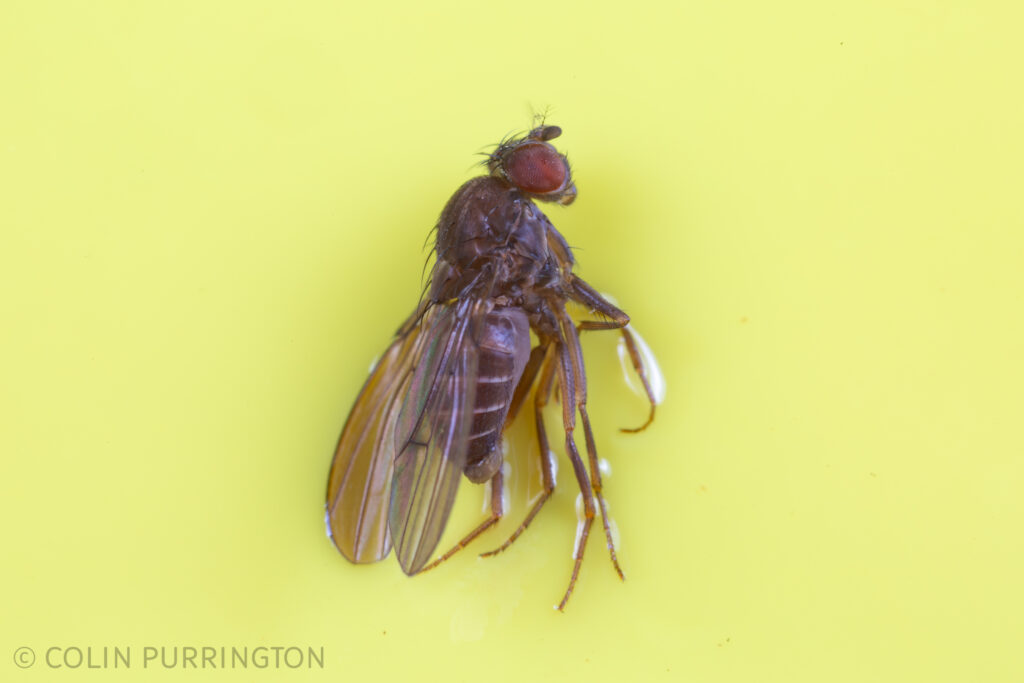
This fly emerged from a pile of rotting walnuts that I’d covered with fine netting to catch whatever hatched when I wasn’t looking. I think it is Leia bivittata (Mycetophilidae). Per Weiss 1919 the larvae move around in a bag of mucous. It’s the only one that appeared. There is nothing in the literature that suggests they eat the fungi in rotting walnuts, so I don’t know how common they are in the fruit.

Vinegar flies

I found two species of vinegar flies (Drosophilidae) hanging out on rotting husks, Drosophila repleta and Drosophila tripunctata, the latter in large numbers. Per Buchner and Symmes 2014, Drosophila are attracted to the rotting flesh caused by Rhagoletis infestation. What’s notable to me is that larvae can tolerate the juglone and related compounds.

Beetles

This scooped scarab (Onthophagus hecate) was wedged inside a crevice in a walnut husk. They eat fungi but will also show up to eat dead animals.

I also found four different kinds of staphylinids. I’ve only been able to identify one, Belonuchus rufipennis, but will update this post if and when an expert on iNaturalist sees them (so probably at least a decade). I would love to know what they are eating. There are certainly plenty of fly larvae present but I don’t have any confirmation that those are their targets.

Mites

The rotting walnuts were crawling with mites, often numbering in the dozens. These are extremely small and fast moving so I’m not sure how many different kinds are present. I think there are at least two species, both in the order Mesostigmata. The first image might be in the suborder Gamasina, and possibly in the genus Lasioseius. I have no idea what they are eating but some mesostigs are omnivorous.

Parasitic wasps

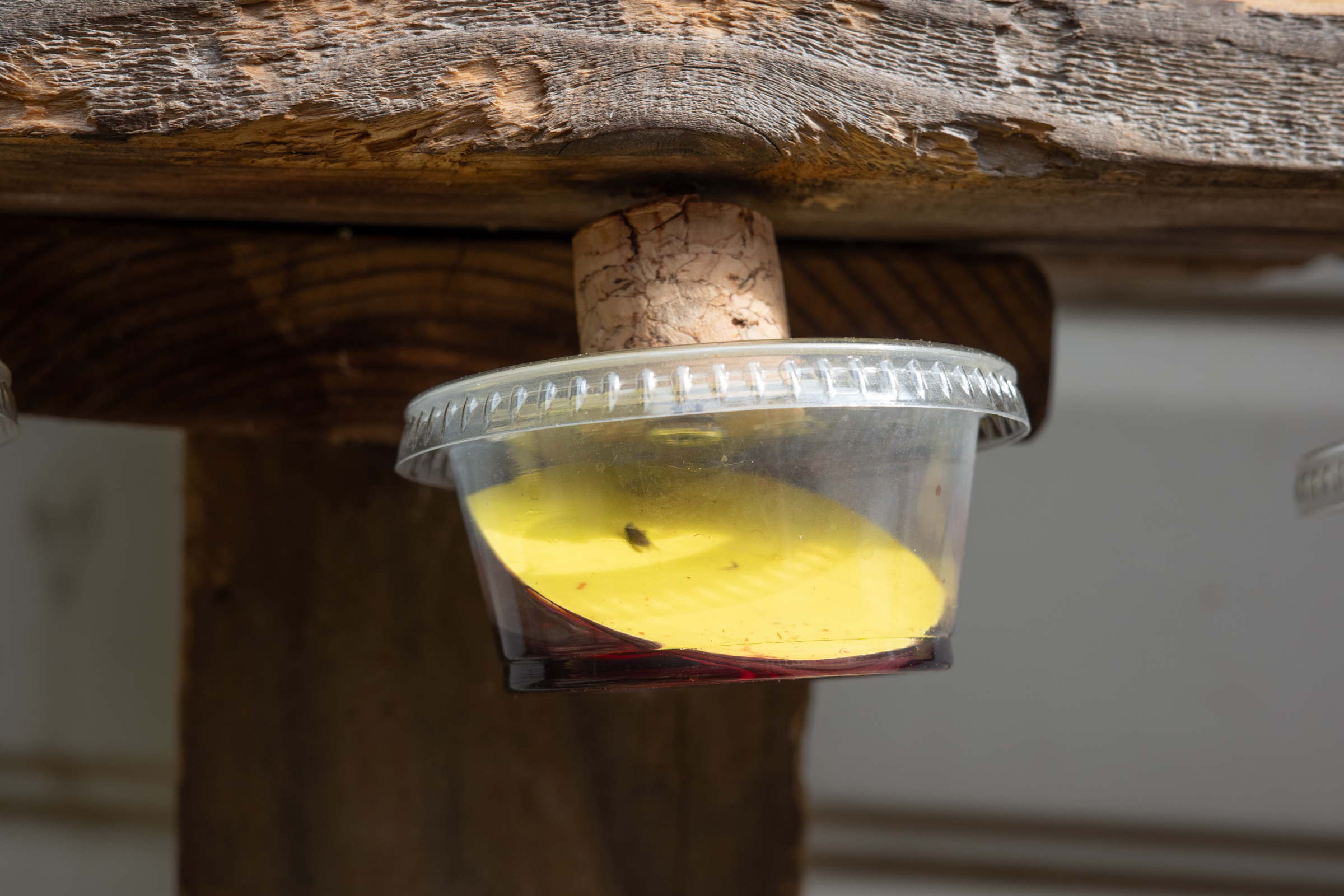
Although I didn’t find them inside the walnuts, this wasp in the genus Coptera (Diapriidae) ended up in a yellow pan trap set up near a tray of Rhagoletis suava puparia that I situated atop a bin of several dozen walnuts. Here’s a really low-res video of it walking around on the tray after I rescued it from the pan trap. There was a second individual walking on the tray at the same time, so I don’t think the pan-trap individual was just a rando Coptera attracted to yellow. These wasps apparently dig down into the soil to find pupae. Some articles say they’ll drag the pupae to the surface prior to ovipositing into them.

Members of this genus are rarely observed and are difficult to tell apart, but based on proximity to walnuts it is likely Coptera pomonellae, the only species that arrived at pan traps set up under walnut trees in Iowa (two locations) and Indiana in Forbes et al. 2012.

Because I have trays of bait pupae, I’m also monitoring for but haven’t yet seen:

  1. Diachasmimorpha mellea (Braconidae), a wasp that is reported to parasitize Rhagoletis suavis (Krombein and Burks 1967, Wharton and Marsh 1978).
  2. Aphaereta pallipes (Braconidae), a pupal parasite of Rhagoletis suavis that was documented in Amherst, MA (Babb 1902). Per Joseph Fortier, it’s been reared from 15 dipteran families. The two observations on iNaturalist emerged from Chirosia gleniensis and Fannia canicularis.
  3. Phygadeuon sp. (Ichneumonidae), a species that attacks pupae of (the closely-related) Rhagoletis juglandis (Andrew Forbes, pers. comm.). I’m not sure whether Phygadeuon attacks Rhagoletis suavis, but there are observations in the eastern USA.
  4. Aganaspis alujai (Figitidae), a parthenogenic wasp that attacks Rhagoletis completa in Mexico (Ovruski et al. 2007, Takata et al. 2025). I have no idea whether there’s a member of the genus in Pennsylvania, so this is another unlikely arrival.
  5. Tetrastichus giffardianus (Eulophidae) “may parasitize Rhagoletis suavis completa CRESSON” (Narayanan and Chawla 1962, citing Marlatt 1933, which I cannot locate). Marlatt was writing in a USDA publication so this relates to the United States. But host species is now Rhagoletis completa, so this is probably a western wasp (confirmed: just California).

Absent from the list are hyperparasitoids, which is kind of annoying because I really like them. I will certainly be on the lookout for them, of course. I’ve also read that a fairy wasp attacks the Rhagoletis eggs, and that would also be fun to find.

I’ll post an update in August 2026 with details on what emerges from the several hundred Rhagoletis suava pupae I have. Hopefully there will be at least some Coptera in the mix, and with some luck I’ll get photographs of both sexes. I’m also very curious what types of wasps might seek out Rhagoletis completa that are on eastern black walnuts planted in the western USA, but that hinges on my sister reading this post and setting up some trays in a similar way (simple instructions are in next section). The first record of Rhagoletis completa in Oregon was in 1963 (Berlocher 1984).

Below is a photograph of the trays of pupae. The chair is so I can drink my coffee while scanning for wasps.

Collecting fly puparia

If anyone is curious how I’m getting puparia, I placed infested walnuts in trays filled with sand and vermiculate, and the larvae tunnel down into the medium to pupate. The plexiglass is to keep the rain from flooding the containers, and the whole operation is conducted inside a screened enclosure that keeps the squirrels from pilfering the walnuts. This is making the squirrels angry.

The larvae eventually burrow into the medium to form puparia, but sometimes they simply pupated underneath a walnut (e.g., as in photo below). At some point I’ll sift the media to collect puparia so that I can more closely monitor them. I’m curious whether they can be candled under a microscope to spy on the residents.

Here’s a sampling of the puparia along with some third-instar larvae. I suspect I have 500 or so puparia in the trays. Some pupae apparently stay dormant for two years (Stirret 1936).

Next year I’ll likely repeat all of the above but start monitoring for Coptera much earlier.

Gallery of dead potatoes in silk-lined coffins

In case you never get to visit The Canadian Potato Museum on Prince Edward Island, here are photographs from the excellent exhibit on diseases and pests of potatoes. I’ve included all the accompanying interpretive signs in case you want the gruesome details but it’s really all about the adorable coffins. Poor little spuds. RIP.

Bacterial soft rot is primarily caused by Pectobacterium carotovorum (aka Erwinia carotovora).

Bacterial ring rot is caused by Clavibacter sepedonicus (formerly called Clavibacter michiganensis subsp. sepedonicus). Note that the potato has fallen off its attachment point higher up in the coffin.

Blackleg is caused by Pectobacterium atrosepticum.

Fusarium dry rot is caused by several species of Fusarium, of course. But also by Gibberella pulicaris, which was formerly in the genus, I gather).

Skin spot is caused by the fungus, Polyscytalum pustulans.

Potato wart is caused by the chytrid fungus, Synchytrium endobioticum. Lesions make the potatoes unmarketable, which is bad, but also result in fields being quarantined and potentially never farmed again.

Many types of slugs eat potatoes.

The potato-rot nematode is Ditylenchus destructor. As in several other coffins, the potato seems to have become unglued.

White grubs are the larvae of scarab beetles (Scarabidae) in the genus Phyllophaga (May beetles, June bugs, … and sometimes even July beetles). Fun fact: they crawl on their backs.

Wireworms are the larvae of click beetles (Elateridae).

Potato scab is caused by the potato scab gnat (Pnyxia scabiei), a member of the Sciaridae. Fun fact: the females are wingless (and have no halteres!)

The flea beetle most associated with potato is Epitrix cucumeris.

The most common millipede in potato fields is the spotted snake millipede (Blaniulus guttulatus).

Blackheart is not a disease but rather a physiological response to low oxygen during growth or storage. High temperatures during transport and storage are the main culprits. Blossom-end rot is caused by the same conditions.

In case you are curious, the coffins were designed by Meredith and Tom Hughes for the “The Amazing Potato” exhibit (1991-1994) at Canada’s Museum of Science and Technology in Ottawa. There are, apparently, undisplayed coffins because the O’Leary building was too small to house them all.


But you should definitely visit. You can pose in front of the 14-foot potato out front, stroll through the world’s largest exhibit of potato-related farm machinery, shop for trinkets such as squishy stress potatoes, and dine in the Potato Country Kitchen (don’t skip the seaweed pie made with Chondrus crispus, a red alga; it’s a recipe from Ireland). It’s open from May 12 to October 10.

Beach finds on Prince Edward Island

Here are some photographs from a 2024 trip to Prince Edward Island. Plus assorted blurbs because I try to learn something about the species I come across. At the very end are three mystery organisms that have stumped me.

Crustaceans

Atlantic rock crab (Cancer irroratus). It looked sad. Also of minor note: all the tiny little shells in the sand.

Northern acorn barnacles (Semibalanus balanoides) growing on a snail. I wonder how they fare compared to ones that develop on rocks.

Mollusks

As a segue, here are some common periwinkles (Littorina littorea) inside empty barnacle shells. I wonder how often the snails become trapped inside after they add whorls to their shells.

PEI is famous for its Eastern oysters (Crassostrea virginica) so it was no surprise they were growing everywhere. That said, I was surprised. Trillions of them, I suspect, if you count all the babies (spats). Females are said to produce 100 million eggs when they spawn, which is rather impressive.

Blue mussels (Mytilus edulis) were also present in uncountable numbers. This patch seemed to have very prominent growth rings and I wonder whether the farmed ones are smoother. Could just be my imagination, of course.

Northern horse mussel (Modiolus modiolus). These are very large but the word on the street is that they are not good for eating. The alga is Fucus serratus (saw wrack).

Common Atlantic slippersnails (Crepidula fornicata) on the inside of some shell. Unfortunately there’s nothing for scale so you can’t tell how tiny and adorable these are. Approximately the size of a corn kernel.

Three-lined mudsnail (Ilyanassa trivittata). A scavenger, but apparently has a taste for the egg-case of northern moonsnails (below).

Northern moonsnail (Euspira heros). This is a snail of unusual size (SOUS) and uses a mechanical drill and acid to bore into clams and other snails, including other moonsnails. But they also eat algae, as shown by carbon isotope analysis (source). This video is a short and entertaining primer on how they do it. The resulting hole is always countersunk.

Atlantic jacknife (Ensis leei). Despite persistent effort I could not locate a restaurant on Prince Edward Island that served razor clams. Likely because I went in October. I will need to go back.

Tunicates

Chain (or violet) tunicate (Botrylloides violaceus). This invasive is loathed by oyster and mussels farmers on the island because it fouls cages, ropes, boats, etc., all of which need to be blasted clean with high-pressure hoses. And if you don’t, the combined weight of the tunicate is enough to break the mussels’ attachments to the rope that suspends them in the water. They also compete for food. And it gets worse because this is just one of four invasive tunicates in the area. But they are pretty!

Plants

Gutweed (Ulva intestinalis). I didn’t take a close-up but I read that the fronds have hollow parts that trap oxygen and allow it to float when the tide comes back in. Although it’s very green, the reddish rock and combover reminded me of somebody. That’s why I took this photo.

Mermaid’s tresses (Chorda filum) attached to a rock. Fronds can get as long as a school bus. It’s a brown alga.

Furcellaria lumbricalis. This is a red alga and the only member of the genus. Apparently loaded with carrageenan. But apparently not as easy to harvest as giant Irish moss (an asexual, hexaploid variant of Chondrus crispus), a red alga that used to be harvested with horses on Prince Edward Island before the population crashed (invasive green crabs and potatoes are on shortlist of culprits). Even the Irish Moss Interpretative Centre has closed.

Sea wrack (Fucus serratus). Apparently quite tasty, and it’s an invasive so you should.

Dead man’s fingers (Codium fragile), another invasive. Often called oyster thief because it attaches to farmed bivalves, which then get washed away by strong waves. Per one source it causes millions of (CAD) dollars of losses every year.

New York aster (Symphyotrichum novi-belgii). This wasn’t in the intertidal but it was close enough so I wanted to include. I’m a sucker for compact plants that are just barely hanging on.

Insects

Black kelp fly (Coelopa frigida). There were millions of these but it still took probably 100 tries before I could get a decent image. Small, frenetic, and easily spooked. And only 126 observations on iNaturalist for North America, as a likely result. I would like to go back with my real camera and flash setup. Larvae are said to eat the bacteria that grow on decomposing seaweed.

Telmatogeton japonicus. These were even harder than kelp flies to photograph, and that’s my excuse for it being out of focus. And for the sake of full disclosure I’m not positive about the identification. If confirmed, my iNaturalist observation would be the first for Prince Edward Island.

Peryphus sp. This is a subgenus of Bembidion, my father’s favorite carabid. As he often complained, they are really fast and hard to capture. And hard to identify which is probably why my dad liked them.

Black vine weevil (Otiorhynchus sulcatus). This is an invasive agricultural pest and I was surprised to see it on the beach. But it turns out that it has a rather wide host range so I guess not unusual.

For such a beautiful and large wasp I thought somebody on iNaturalist would offer up an identification. After almost a year, nothing. I’m guessing that it was going after some sort of cavity-nesting bee that uses beetle bore holes in driftwood as nests. All the logs had plugs like this so some bee is really utilizing the wood.

Spiders

Thin-legged wolf spider (Pardosa sp.) that was under a rock. I’d wager that it was mainly eating kelp flies. Species identification is only possible with dissection.

Trochosa sp. that has recently molted. This also can’t be taken to species level because the patterns aren’t visible until after the new exoskeleton ages a bit.

Mysteries

I’m assuming this is some sort of venting product made by a sand-dwelling organism such as a clam, worm, or crab. Here’s the iNaturalist observation if you’d like to weigh in.

This sort of looks like a sponge (e.g., Clionaidae, Halichondriidae) but I truly have no idea. Definitely creepy, and I wonder whether those barnacles were victims of something slow moving. Here’s my iNaturalist observation if you can help.

I think this might be some sort of fungus (e.g., Collemopsidium halodytes) or a lichen. It was especially common in depressions in rocks where water might pool. More ideas are on my iNaturalist observation. I would be grateful for suggestions.

As always, if you see a mistake please let me know.

In case you’re a camera nerd, all photographs were taken with an OM TG-7 that I purchased for the trip. It’s waterproof, shoots RAW, does focus-stacking (poorly), and weighs a lot less than the Canon DSLR that I usually lug around with me.