Tag Archives: hymenoptera

Sorting through guests at my insect hotels

When the weather is cold and rainy in winter, I entertain myself by bringing the nests from my bee and wasp hotels inside for photo ops and cleaning. With a hot cup of tea (I’m in a cold basement), I carefully open up all the occupied nesting tunnels, then put the cocoons and larvae into vials so I can see who eventually hatches out in the spring. Here’s my set-up before I made a complete mess:

Removing the paper liners (here, straws from a local supermarket) from the nesting blocks is much easier with a pair of forceps. The blocks are necessary because if I just crammed paper straws into my bee hotel, every single nest would be parasitized by wasps that could easily get access to the larvae along the length of every straw.

Below are the cocoons of a mason bee, separated by mud plugs and covered with frass. They are probably Osmia cornifrons (pic of adult) or Osmia taurus (pic of adult), both introduced species that are frequent visitors at my hotels. Unwrapping the straws is usually pretty easy, but sometimes you need to use the forceps to grab onto the edges to complete the job.

I also had two stems filled with Georgia mason bees (Osmia georgica), a native species that has a beautiful blue body (pic of adult). It has smaller, bright orange frass and uses chewed plants to seal partitions. It also smells different.

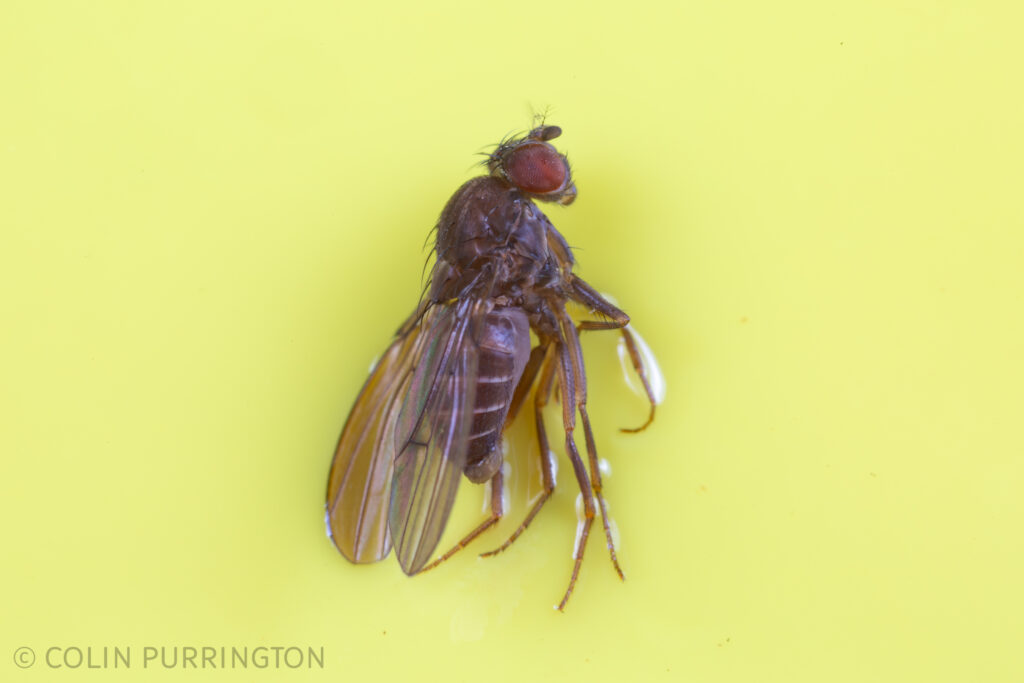
Below is a visual reminder of why I need to sort through my nests each year: Houdini flies (Cacoxenus indagator). These kleptoparasitic dipterans eat the pollen balls that mason bees feed on, resulting in the death of the bee. So when I find them send them along to fly heaven. The common name is from their ability to bust open the mud plugs (they have inflatable heads for the job). Here’s a pic of an adult.

I also had grass-carrying wasps move into the observation panel, below, that I built a few years ago. There’s one nest near the top, and one at the very bottom, possibly provisioned by the same female. Because this panel slides in and out of the hotel easily, I was able to get a photographs of the adult, an egg, and a larva last year.

Here’s a close-up of the cocoon from the panel. It’s quite large. A photograph of a cleaned-up cocoon from a previous year is on my iNaturalist account if you want a better view. If you have a good eye, you might be able to make out a book louse (Liposcelis sp.) on the left-hand side of the cocoon. Here’s a close-up from a previous season if you’re curious.

One of my bee hotels is packed full of hollow stems, so for these I use a knife to split them open. Here’s a brood of potter wasps inside one of them. I’m not sure what species they are (or even genus) but I’ll know in several months when they hatch and I can get an identification on iNaturalist. And there’s a possibility that one or more of the larvae is harboring an internal parasite, too. Or at least that’s what happened in a previous year, when a beetle appeared (see my post about it). A beetle parasitizing one of my wasps was not on my Bingo card that year. I love surprises like that.

In the smaller stems I get lots of these cocoons, likely Trypoxylon collinum (pic of adult), a charming little wasp that feeds very small spiders to its young.

Although I enjoy looking through the nesting tubes, the main reason I do it is to make sure I’m not just breeding Houdini flies, pollen mites (pic), and pathogens that could easily spill out into bee and wasp populations near my house. I.e., if during my cleanings I felt that I was doing more harm than good to local native species, I’d shutter my hotels and find alternate entertainment.

As you may have noticed during the above, I love wasps. So if you have a bee hotel and get wasps, that’s a bonus, not a problem. And thus I implore everyone to not kill the larvae and the pupae simply because they are not mason bees. They both pollinate plants, plus wasps are fantastic at patrolling your vegetable gardens for pests, which they take back to their nests to feed to their young. If you’re on the fence about wasps, consider treating yourself to book on their biology and identification. I have Heather Holm’s fantastic Wasps: A Guide for Eastern North America. I’ve also heard great things about Eric Eaton’s Wasps: The Astonishing Diversity of a Misunderstood Insect and Seirian Sumner’s Endless Forms: The Secret World of Wasps.

More information

Below are my other posts about insect hotels if you want to learn more. If you have a question, send me an email via my Contact page.

Mock-orange scissor bee (Chelostoma philadelphi)

Some photographs of Chelostoma philadelphi, the most common guest at my mason bee hotel in past years. Approximately 7 mm in length and all black unless covered in pollen. Seems to prefer nest holes that are 1/8″ in diameter. In looking at photographs online they seem to show up on a variety of flowers (perhaps with preference for asters), but females are reported (Sedivy et al. 2008) to collect only Philadelphus pollen for use in nest provisions for her brood.  

Chelostoma philadelphi in flight
Chelostoma philadelphi with pollen load
Chelostoma philadelphi
Chelostoma philadelphi covered with pollen

Guide to building and managing a mason bee hotel

In nature, tunnel-nesting bees are perfectly happy to use logs riddled by boring beetles or piles of dead plants that have hollow stems. That habitat is often in short supply in many yards, however, so it’s necessary to provide hotels if you want to attract them. These hotels can be as simple as a large coffee can filled with hollow reeds … or as elaborate as the three-level one I built. The bees really don’t care.

Types of nesting material

DIY bee hotels can be filled with routered nesting trays (you can buy these or make your own, if you’re handy), wood blocks with paper inserts (these inserts can be purchased), wood blocks or logs with drilled holes (unlined), or just sections of hollow stems (by far the easiest). Or, like house in the photo below, a mix. A hotel should have a roof to keep the tunnel entrances relatively dry, should be situated to get morning sun, and be approximately 5 feet off the ground (so you can enjoy watching them).

Below is a photograph of my other hotel. It’s smaller and is set up in my front yard to entertain people who walk by. Tunnels are all unlined drilled holes, plus milkweed stems. Holes in the blocks are varied because I want to attract a variety of solitary bees.

Swap nesting materials regularly

The ideal bee hotel is one that allows all the nesting material to be removed each year (or so). By installing fresh nesting material, new tenants each spring will get to move into tunnels free of kleptoparasitic pollen mites and pathogenic fungi. Another benefit of removable nests is that you can remove sections as they get filled, allowing you to replace the spot with the same type of tunnels or with tunnels that have different diameter to cater to a different bee species (there are hundreds). Below are examples of my hotel with different configurations (my 2020 version, on right, is a bit boring).

Emergence boxes

What do you do with the nesting material after you remove it from the hotel? I put mine into a large cardboard box that has holes in the sides and at the top, then store in my unheated garage for the winter. In mid March (before bees in my area start to wake up) I put the box outside in a spot that is dry and gets good morning sun. Then when bees emerge from their cocoons they can escape from the box but are disinclined to re-inhabit the nesting tunnels they emerged from. Here’s a view of the nesting material inside my emergence box.

After several months outside (e.g., in August, long after the last resident has emerged) I take everything back into my shop and redrill holes and sterilize the wood. Then I can reuse blocks in future years.

Cleaning pupae

Lately, I’ve been thinking that I should move entirely to a system where I can sort through pupae at the end of the season. E.g., as summarized here. The reason for this is that I’d like to remove (kill) the kleptoparasitic mites (pic) and Houdini flies (pic) that are likely destroying many of my solitary bees. To enable this process I am going to start using paper straws to line all the tunnels. These straws can then be removed and unwrapped and the contents examined. Below is a photograph showing how drilled holes can be lined with paper straws — just fold over the back overhang and seal with foil tape.

Several companies sell sturdy (and easy to unwrap) paper straws as well as cardboard tubes that can easily accommodate the straws (i.e., you don’t need to drill holes in wood).

Another way to sort through pupae is to use routered wood trays, which you can buy or make (with a router or a table saw). Although some types of trays are better used with straws (to prevent mites from moving from tunnel to tunnel), others fit snuggly enough to be used without them. On my list of things to do is to make some routered nests that are sealed on one side with Plexiglas so that I can observe the bees within (such hotels can be purchased, and are beautiful).

Design tips

  • To keep everything dry on something this tall you need a generous roof overhang. Mine extends 5 inches beyond the front of the shelf, plus the wood sections and reeds are set back from that by another inch or so. If you have a shorter house you can have a smaller roof.
  • For larger hole sizes you want, ideally, 6 inches of depth. Shorter (4″) tunnels are fine but can result in a male-biased brood sex ratios. If you want to encourage population growth, encouraging the production of females is important. So buy long bits (I really like my 5/16″ auger bit, shown in drill below).
Drilling holes for mason bee inserts
  • Burning the front of the wood allows bees to more easily find their holes, plus the darker surface causes the wood to heat up faster in the morning sun.
  • Avoid treated lumber or fresh cedar. Per rumors on the internet, those types of wood can result in the death of the larvae. Pine is fine but I think harder wood is preferable because the drilled holes tend to be smoother.
  • For cutting reeds to size, I highly recommend using a cutoff disc on a Dremel tool instead of pruners. You can get a really smooth surface with a Dremel.

Examples of nice DIY solitary bee hotels

Additional resources

If you’re lazy and just want to buy a mason bee house, here’s my draft listing of companies that seem to make good ones. Please also see my guide to bee houses you should avoid.