
Here are some photographs of Mayfield Cave in Sutton County, Texas, commercialized in 1960 and since then known as the Caverns of Sonora. It’s an approximately 7-1/2 mile limestone cave system that began forming in the Early Cretaceous. In addition to the usual stalagmites and stalactites, the cave has extensive flowstone formations, crystal deposits, helictites, tubular stalactites, travertine draperies, and coralloids.
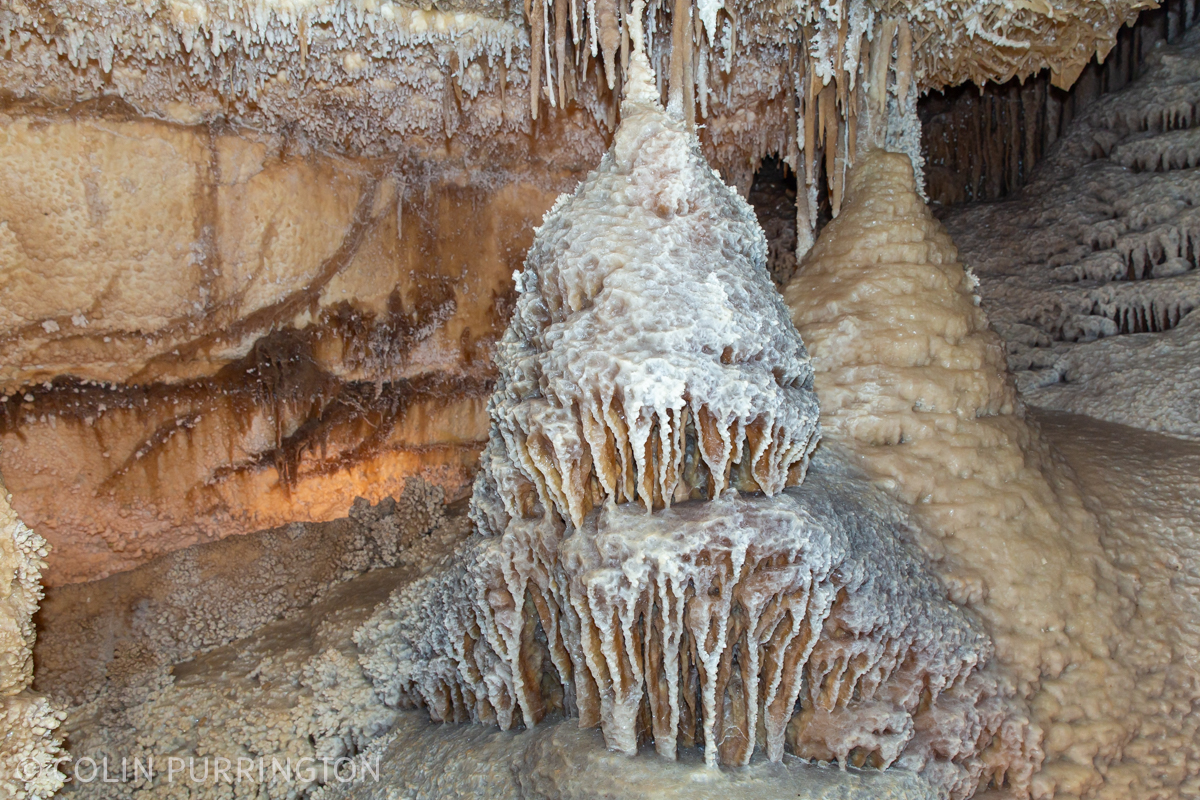
This formation looks like a frosted dessert. I wonder what caused the more recent accretions to be white.
Almost every surface was wet and dripping, so this cave is active and growing. These popcorn-like speleothems are corraloids.
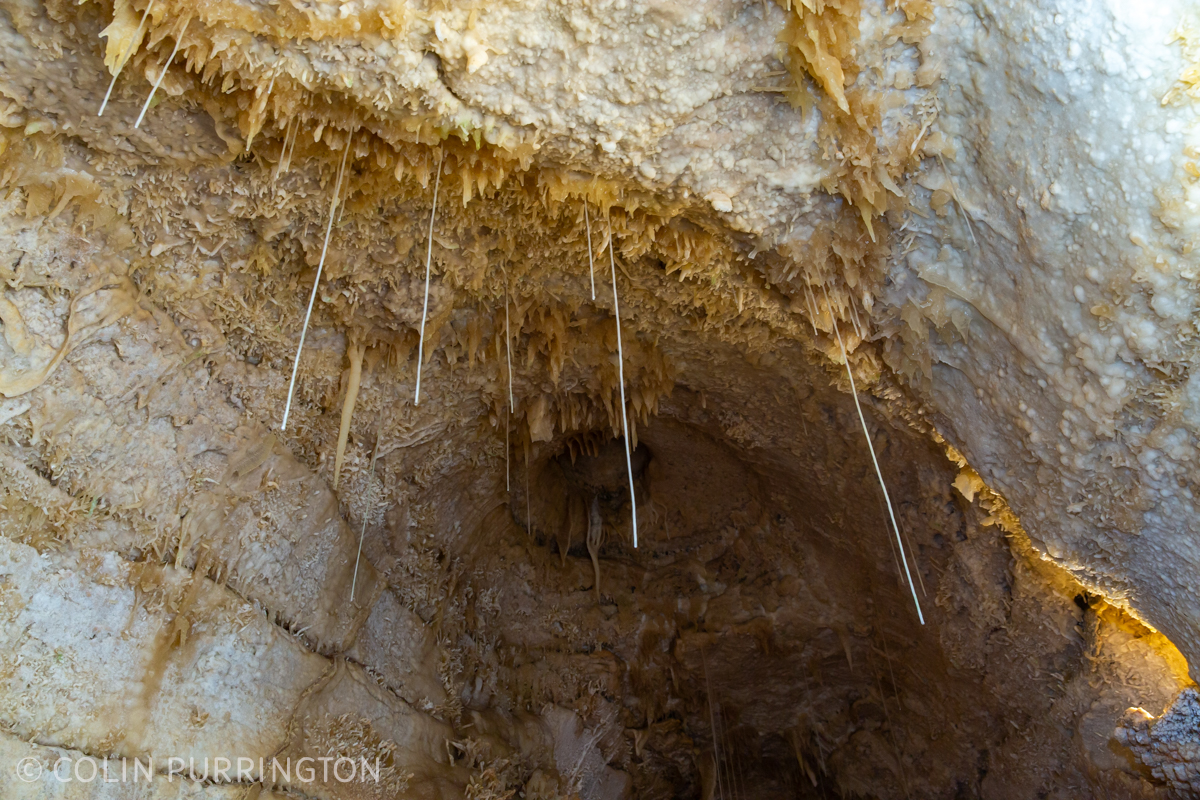
These tubular stalactites (“soda straws”) are hollow but form into normal stalactites if the hole becomes clogged. Apparently quite rare in commercialized caves such as this, so it’s good that these were out of reach to most people. The longest ever found (Wonder Cave in Malaysia) is over 9 meters long.
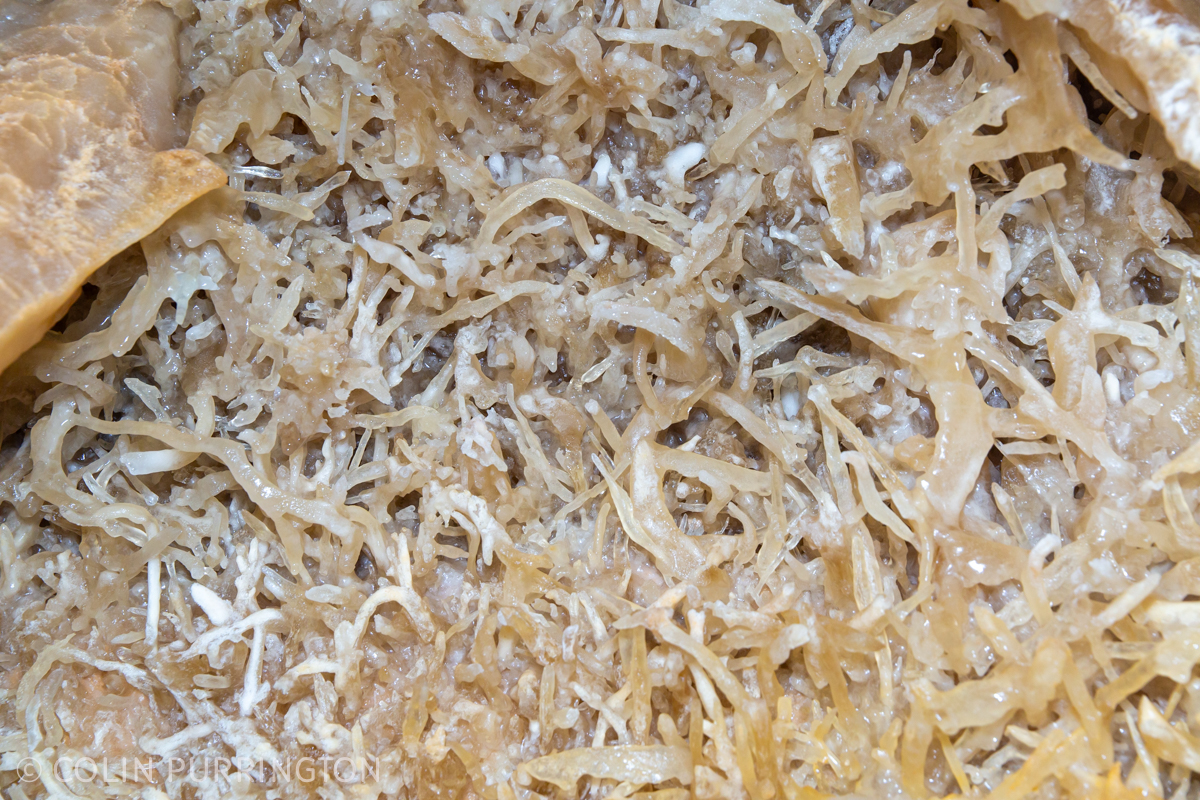
Helictites are formed when capillary pressure forces very small amounts of water onto one side of a structure. The cave was littered with these formations.
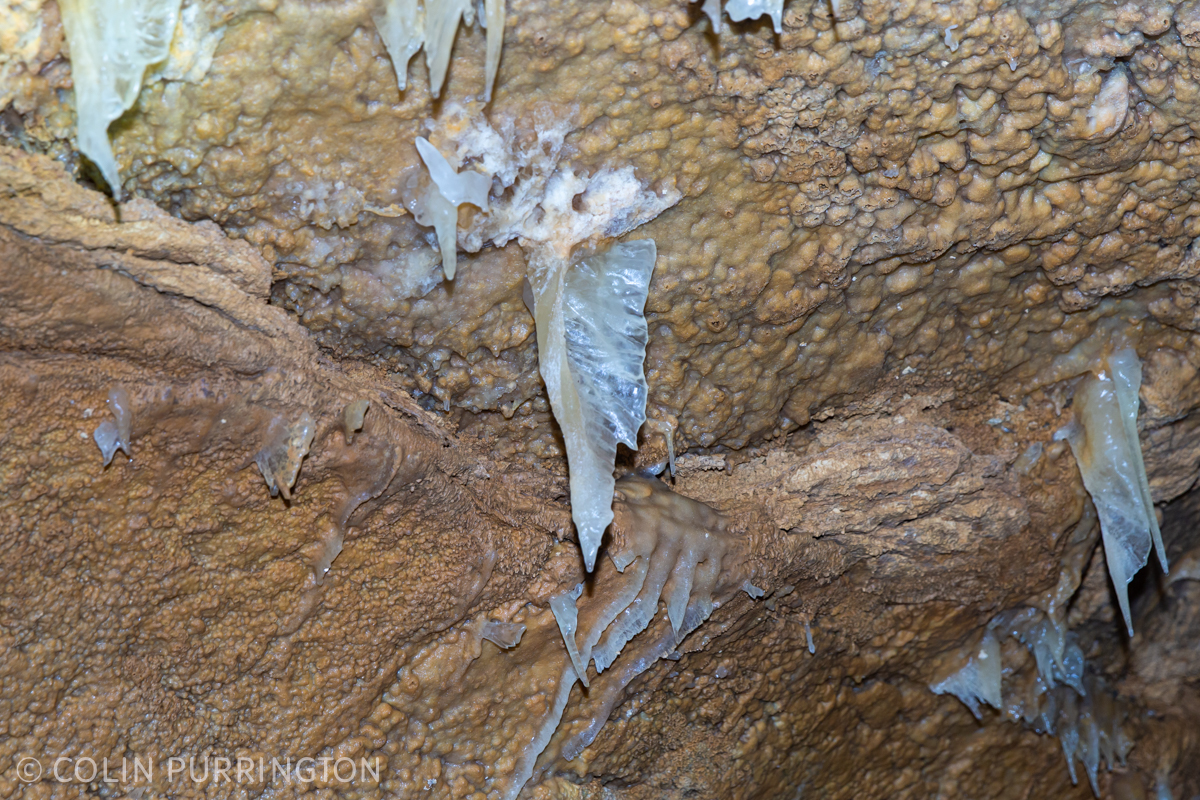
Fishtail helictites were everywhere and in multiple different hues due to different mineral contents.
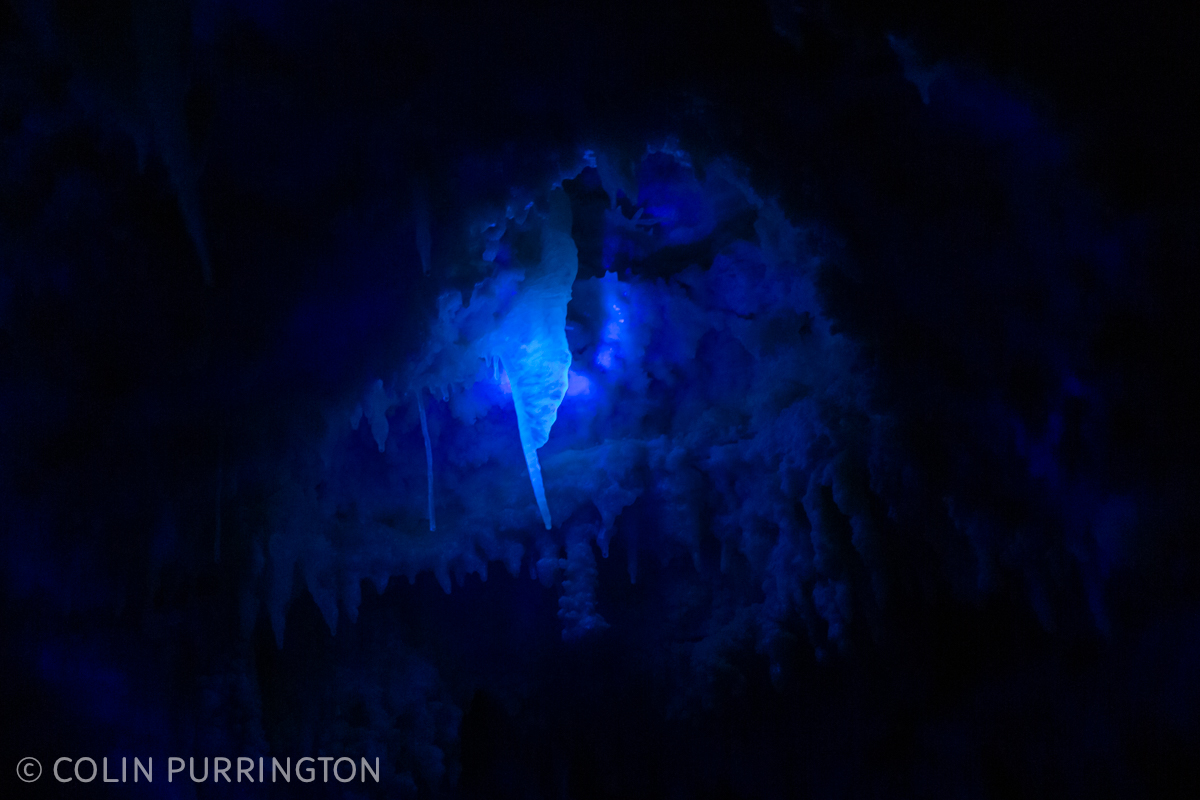
Here’s a fishtail helictite illuminated with a UV flashlight. Thanks to excited impurities, it continued to emit light after the flashlight was turned off.
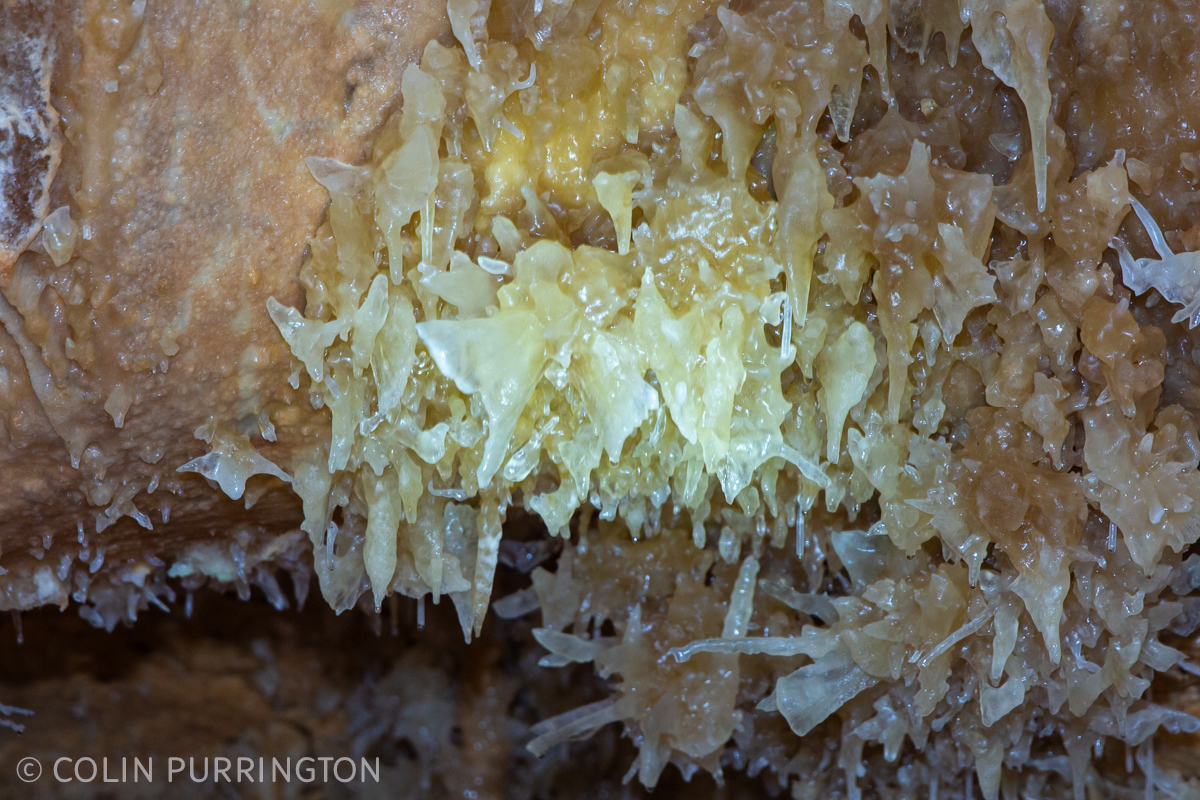
This group of helictites once contained the crown jewel of the cave, a two-bladed speleothem that resembled a butterfly. It was damaged in 2006 by some guy (of course it was a guy) who snapped off most of the right wings. You can make out the left wings a bit to the left of center. Here’s a link to what it used to look like. Thanks to that incident there is now a Texas law that makes vandalizing caves a felony.
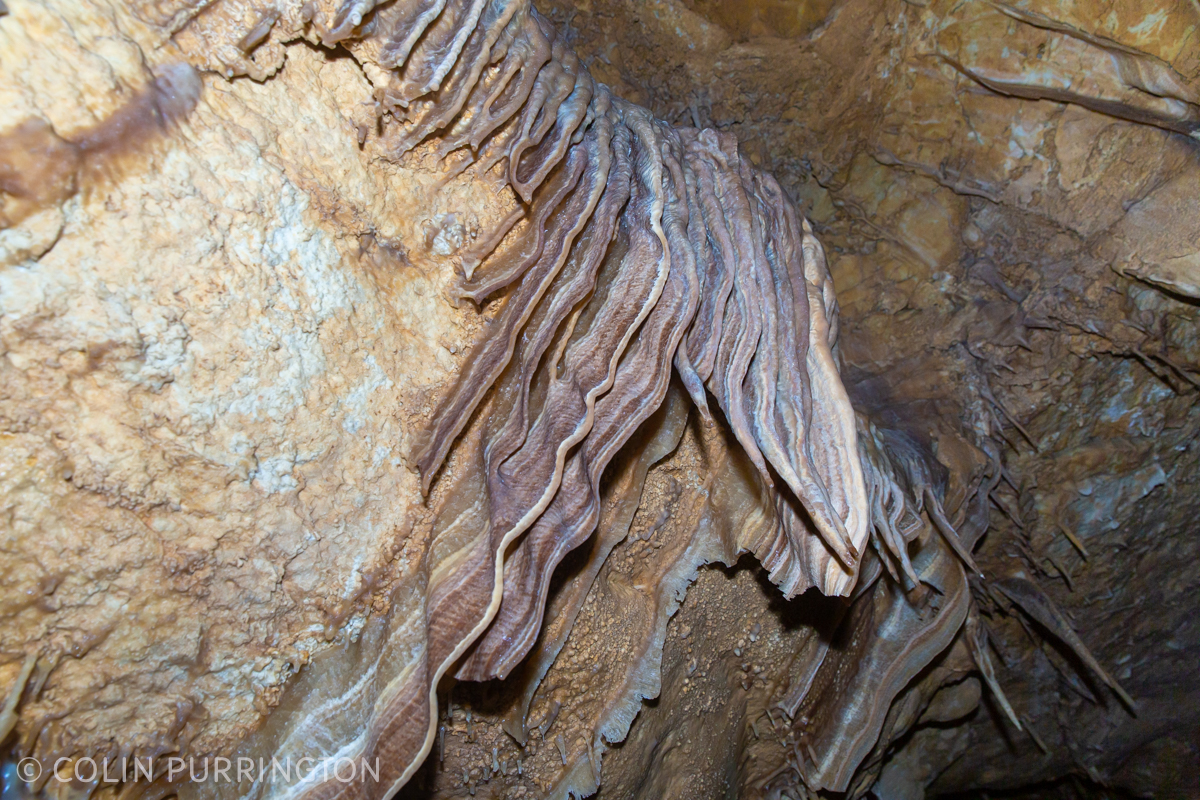
These travertine draperies are fairly common in the cave and bear a striking resemblance to bacon.
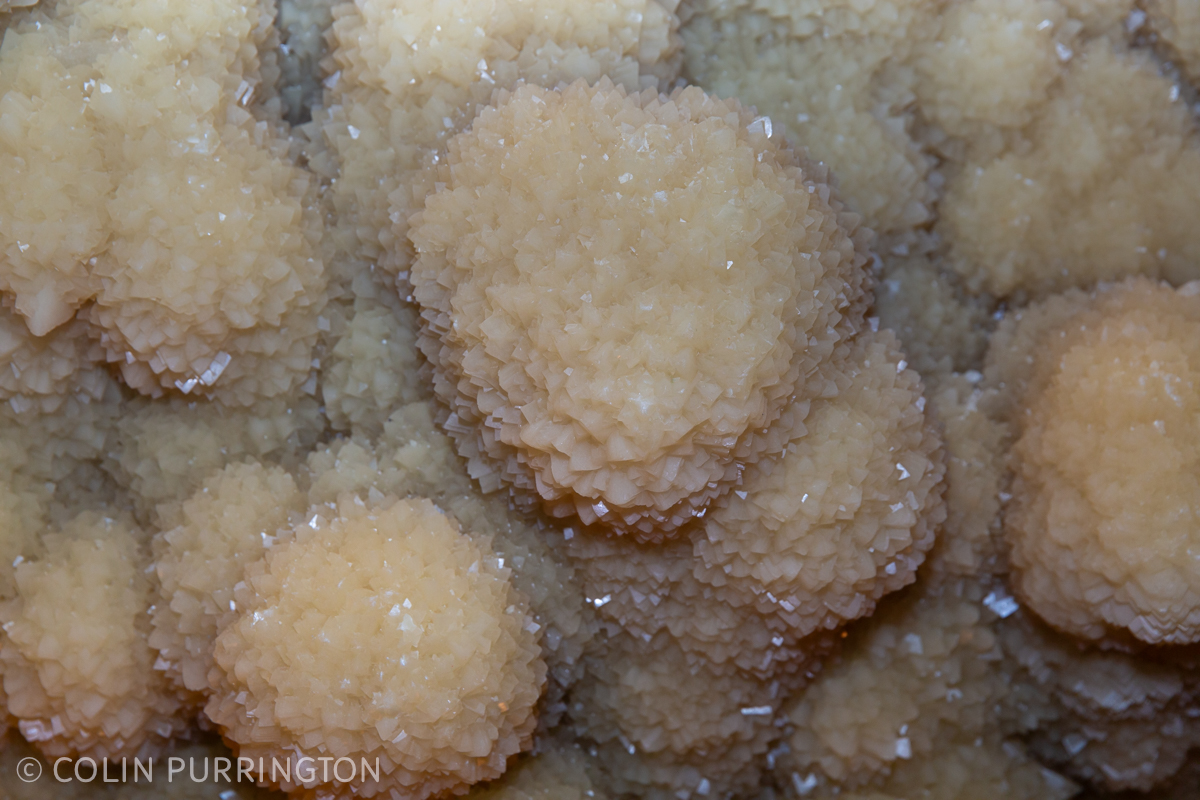
Pleasing clumps of crystals. Possibly calcite but I’m not sure.
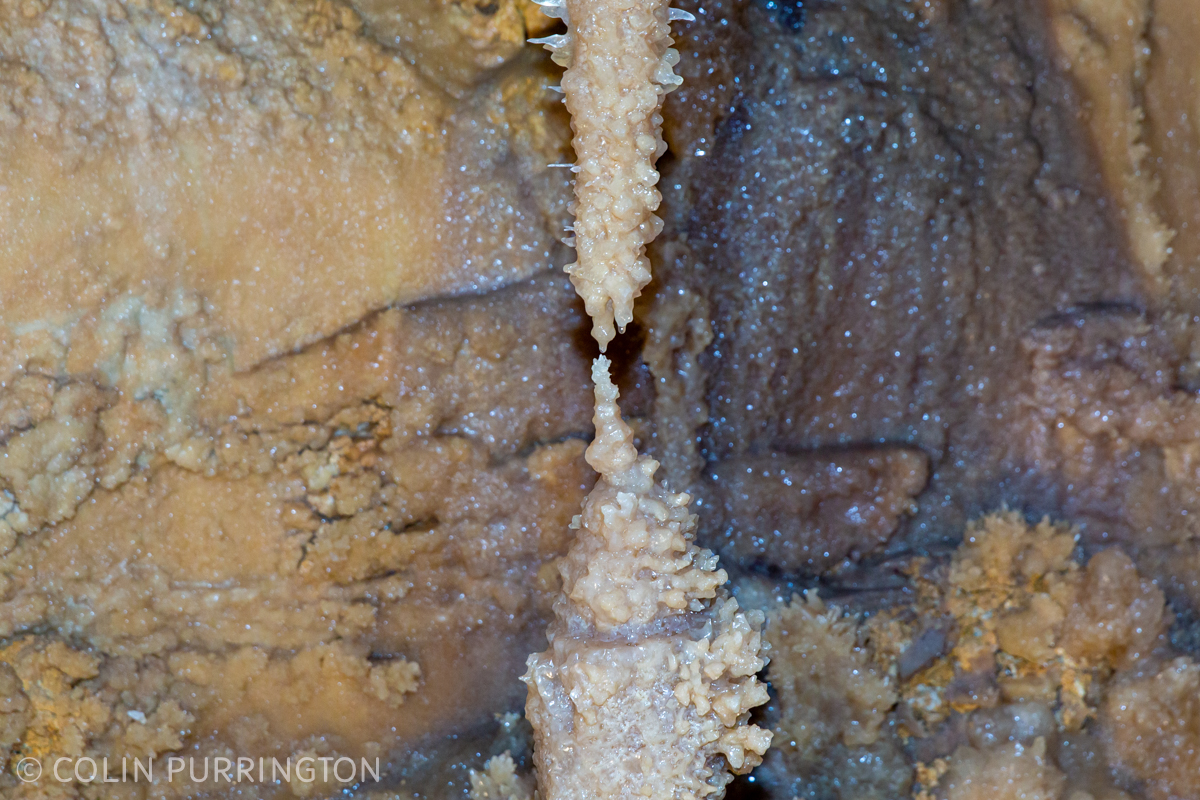
Here’s a stalactite just about to make contact with the stalagmite below. Maybe another hundred years?
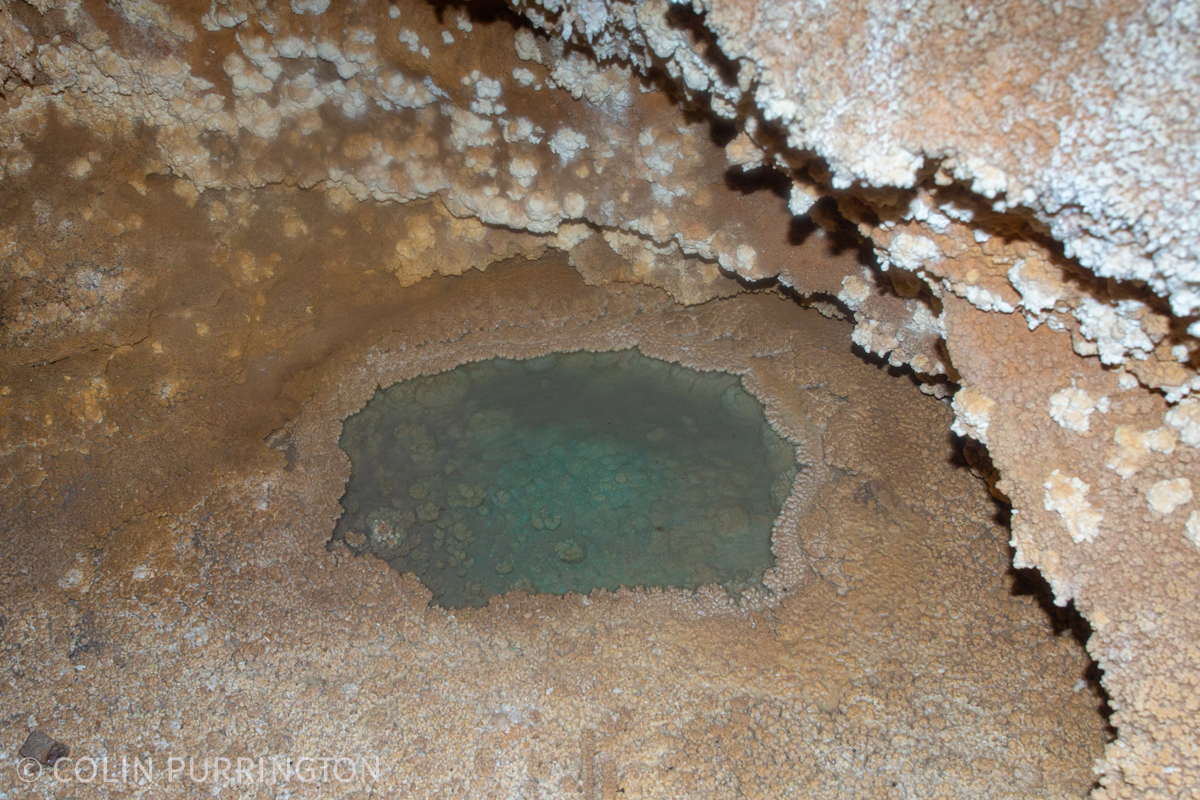
One of several beautiful pools filled with motionless water. Nothing alive in any of them as far as I could tell.
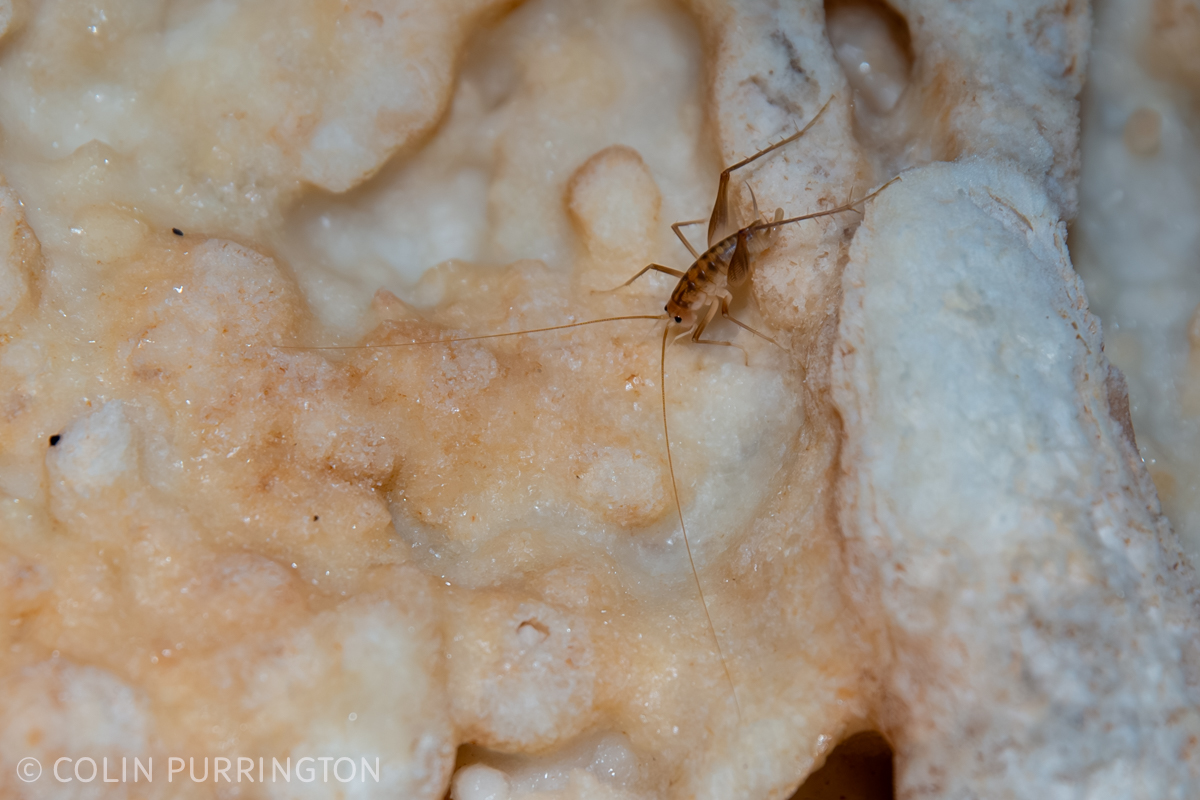
Camel crickets were the only thing I could find alive inside the cave. But they are likely eating something, and more than just each other (which they do). I suspect that visitors to the cave shed enough organic material to support some fungal growth, so perhaps that would be enough to attract a population of crickets. I’d be very interested in spending a few days looking for more life down there. But I suspect I’d have better hunting in other caves. I’d love, for example, to find some of the beetles (Rhadine reyesi) that dig up cave cricket eggs.
More photographs are here if you want to see my full collection (~66).
If you are visiting Big Bend National Park, staying a night near the caves is a great way to break up the drive. Depending on which direction you’re coming from, choose either Sonora or Ozona if you want to be near the caves. And if you can plan ahead, you might consider scheduling a “Discovery Challenge Tour” or a “Photography Tour” instead of taking the canned tour. This would help you avoid crowds and also to hang with like-minded folks, a desire that grew acute during my 90 minute tour. You might need to arrange those a month in advance because the guy who leads them has a life, I’m told.
Here are some photographs of greenhouse camel crickets (Tachycines asynamorus) that I recently found in and around my house. It’s called the greenhouse camel cricket because when it (and related T. japanica) first came to Europe from Asia it was a common insect in conservatories. I’m not positive, but I think before that invasion the name “camel cricket” was more commonly applied to the praying mantis (mantids have long necks just like camels).
Note that the Latin name for this species used to be Diestrammena asynamora. Full details are in Qin et al. 2018. Nobody seems to use the new name except iNaturalist. But I use iNaturalist a lot so I’m going to give the new name a try.
This is a juvenile that I found in my bathroom sink. I think they go through 10 instars and I’m guessing this is a 3rd instar male (lacks an ovipositor). It was pretty cute.
Camel crickets love to eat cat feces (don’t judge) so it’s pretty common to find them lurking here, sometimes in large groups. I don’t think the females lay eggs in cat litter but I’ve always been curious. Not curious enough to examine more closely, though.
This is the same individual as above but shows the ovipositor and impressive length of the antennae. The antennae apparently have the ability to sense heat. That’s probably a fact most people don’t want to know.
This female was in the woodpile near my garage. It was a cold day so she didn’t immediately launch herself away. They often seem to jump at you, a behavior that doesn’t endear them to folks who think the crickets are actually spiders. I think their jump can max out at 1 1/2 meters, which is pretty impressive. They can’t fly, though, because they lack wings (and are thus silent). Note that placing woodpiles near your house is one way people inadvertently introduce camel crickets into their houses.
These three gooey splotches are frass. If you have a large population of camel crickets your wall will become darkened with this spots. I’ve been trying to figure out why they are liquid but haven’t come up with any explanations yet.
If you’re fascinated by greenhouse camel crickets there’s a great article at Your Wild Life that describes how different species are invading the United States. If you just want to kill them I have a few ideas.
Camel crickets (“sprickets”) feed on fungi that grow on damp basement walls. When they can’t find fungus they are reported to eat carpet, cardboard, wood, and even each other. They absolutely adore cat litter (pic at bottom of post). There’s even an Australian species that eats one of its own legs when sufficiently hungry (watch the video if you dare). Here’s a pic of one I found in my bathroom:
Camel crickets often hide during the day, but you can tell you have a large population when they smear frass all over your walls
Frass is poop, by the way (that’s why “Frass Canyon Vineyards” is such a funny nickname for Fess Parker Vineyard). When camel crickets migrate out of the basement in search of food and moist places to lay their eggs, they tend to creep the bejesus out of unsuspecting family members … which is why I was motivated to make this page.
Some ways to get rid of them
1. Make sticky traps out of duct tape, then bait with a piece of dry cat food or equivalent. Any food works. Indeed, once the first cricket gets stuck they’ll all be on that trap trying to eat the first one even before it’s dead. If you’re too lazy to make your own sticky trap, just search for “mouse sticky traps” on your favorite online retailer, or buy them at a big-box home improvement store.
If you like doing stupid science projects to impress your friends, put different types of bait on the traps. If you have kids, pit them against each other with the challenge of identifying the most effective bait (Fruit Loops versus Lucky Charms??). You can reward the kid that comes up with the most crickets at the end of the week. Or you can punish the loser — depends on your parenting style!
2. Place containers of soapy water in your basement. Camel crickets love water and will fall into these containers and drown. The soap is just a way to counteract the waxy coating on their exoskeletons so they sink faster.
3. Buy an electronic rat trap (e.g. on Amazon). I prefer this method over everything else because it’s instant death rather than something slow (insects have brains and neurons just like you). Get the kind that is activated by moisture not heat (infrared) because otherwise it won’t work (insects are poikilotherms) . FYI, electronic traps have enough amperage to cause a cricket to explode, complete with a satisfying crackle. On this note, make sure you don’t set the trap near something flammable like open cans of paint thinner. Also, make sure your basement doesn’t have a gas leak. That would be bad.
4. Hunt them with an airsoft gun. You can use biodegradable ammunition if you don’t want to pick up the pellets. This big problem with that, however, is that the surviving crickets will eat the pellets. Another option is a Bug A Salt, something I don’t own but perhaps I’ll get one from Christmas if my Mom is reading my blog (unlikely). Note that if you get a weapon for each member of your family this can be a fun bonding experience and can even qualify for Family Home Evening if you live in Utah. Family Home Evening is Monday night, by the way, just in case you’re not Mormon. Don’t pass up the opportunity to play music that fits the task, such as the soundtrack from The Descent, Aliens, or Starship Troopers. Remember to wear safety goggles to protect from ricochets.
5. If your family is looking for fun bonding activity but is against weapons, get each member a bug-zapping racket (e.g., like this one). I own one of these and can confirm that they kill houseflies efficiently and are moderately enjoyable to use. The flies spark, sizzle, and pop in a satisfying way, and chasing the flies around the house with a racket does, in fact, burn more calories that hunting them with rubber bands (which I’m very, very good at if you were curious). Pro tip: don’t touch the wires on the rackets (it hurts). I’ve tested this, just like I’ve foolishly tested electric fences in my youth (XY syndrome). If you have a family member with a heart condition or Pacemaker who might react poorly to electrical shocks, keep the racket out of their reach.
6. Less exciting, but also fun for kids is a long-armed bug vacuum. Here are a bunch on Amazon. I don’t get kickbacks from Amazon so don’t feel obliged to even click that link. Just know that there are such things and they look mildly fun.
7. Buy a Siamese cat. We had one of these and she was a ruthless camel cricket predator. Hunted them down and ate them, leaving only legs. Kind of creeped us out, truth be told. But whatever. Our other cat, a Himalayan, is completely useless. She’ll only eat wet food, and only if it’s a particular kind and at room temperature. But I digress.
8. Release mice in your basement. Mice just love to eat camel crickets. And then, to get rid of the mice, go to the pet store and buy one of those giant centipedes from the tropics. Watch this video if you doubt that a centipede can kill and eat a mouse. Don’t watch the video if you’ve just eaten. And don’t watch the video if you ever plan to travel to the Amazon. Actually, don’t that video.
9. Keep chameleons in your basement. When I was growing up in squalor in East Lansing, Michigan, my parents bought two chameleons to keep the roach population under control. They had the run of the house and were adorable to boot. When I was young I thought everyone had chameleons for this same reason (ah, foolish youth). Anyway, I’m sure chameleons will eat camel crickets. Just make sure to give them a heat lamp and a water source. Don’t release chameleons if you have a giant centipede.
10. Attack them with a weed trimmer. If they are in spots that are easy to reach and in large numbers, this might work. My family used a weed trimmer to control snails in our vegetable garden when we lived in Salt Lake City, and it was great fun. “Great fun” for a teenager in Salt Lake City is probably a questionable phrase but I do have fond memories of this. They might be false fond memories, though. I wore safety goggles so the juices and shell shards wouldn’t get in my eyes. The big problem with doing this in your basement is that the cricket juice and attached limbs will just get sprayed all over the walls, and then you’ll have that to deal with. Of course, the camel crickets left alive will slowly eat the surfaces clean (I’m an optimist).
11. Buy a Roomba vacuum bot. I don’t own one of these but my sister does and she swears by it (for cleaning floors, not crickets). If you have one, give it a try in the basement. Ideally, attach a bowl of food to it in some way so the little bastards move toward it. Or put food in the center of your basement in a way that is protected from the Roomba, then let the robot loose around this location. If you are Roomba rep, maybe you could gift one to me with the expectation that I might be good advertising. Come on, you know it would.
12. If you have a spare vacuum, buy a Belkin WeMo motion switch at Targét and set it up next to a secured pile of food. Then plug your vacuum cleaner into the power switch component of the motion switch (which will get activated by the motion) and position the vacuum attachment tube really close to the pile of food. If your basement is dark, also set up a little battery-operated, motion-sensing light so that cricket movement causes the little area to be illuminated enough for the motion sensor to work. Then use the Belkin smartphone app to make 2 rules. Rule 1: when motion sensed, turn switch on, then off immediately (this sucks up the cricket and returns unit to sensing mode). Rule 2: when switch activated, send notification (this tells you that a cricket has been sucked). Rule 2 isn’t really necessary, but it sure is fun to get those notifications on your phone during a boring meeting. You can silently whisper, “Yessssss. Yea, life sucks, you creepy little bastard. Die, die, die.” If you’re really Type A, you can link up the device with IFTTT so that number of sucks per day is recorded in a spreadsheet. All of the above details are illustrated in my post, “Using motion-activated vacuum cleaner to control camel crickets.” There’s even a movie, for all you doubters. Yes, indeed, I am Type A. How did you guess??
13. Use diatomaceous earth. You can buy bags of this at most hardware stores, or online. Just spread it around areas where crickets congregate. The sharp, microscopic diatoms (they are long-dead algae with hard, silicized cell walls) work their way into crickets’ limb joints and in between segment plates … and also scrape off the protective layer of wax on the crickets’ exoskeletons. They probably die of dehydration, though entomologists argue about the exact cause of death. Entomologists will argue about anything. Please note, however, that diatomaceous earth is composed of fossilized organisms that are millions of years old; if objects older than 6000 years tend to undermine your world view, don’t buy it.
14. Use insecticides. Camel crickets are insects, so any broad-spectrum insecticide will work (e.g., Raid). I’ve heard of people using Niban (imidacloprid) granules, too … but don’t use that if you have or like honey bees. Note, also, that if you make your basement too toxic you can’t lock your kids down there. Also this: if you dose your insects up and you have pets, pets might be snacking on dosed insects.
15. Waterproof your basement. Once you cut off the moisture supply, you cut off of the fungal growth and the crickets will starve … though it might never get your population to the zero you want. I’ve actually spent a few years re-mortaring my basement and it turns out it’s a lot of work, which is why it’s way down on this list. I’ve gone through about 700 lbs of cement already, plugging gaping holes in the foundation and also applying at least 1/2″ of cement to all surfaces. It really sucks and it’s actually not doing a whole lot to control my cricket population. And my back hurts.
16. Buy a dehumidifier. If you can drop the moisture level to where fungi cannot grow, the crickets will starve. Again, this won’t get rid of all them but the numbers will go down if you keep the unit on all the time. I have one that vents water to outside via a hose, so I don’t need to monitor it at all. I say that not to brag. I’m just saying.
17. Move to a different house. This is a really attractive option for me. Our town’s nickname is Swampmore. I should’ve known better.
Good luck. More pics below in case of interest. If you know somebody who just “adores” camel crickets, you can even order prints.