Beach finds on Prince Edward Island

Here are some photographs from a 2024 trip to Prince Edward Island. Plus assorted blurbs because I try to learn something about the species I come across. At the very end are three mystery organisms that have stumped me.

Crustaceans

Atlantic rock crab (Cancer irroratus). It looked sad. Also of minor note: all the tiny little shells in the sand.

Northern acorn barnacles (Semibalanus balanoides) growing on a snail. I wonder how they fare compared to ones that develop on rocks.

Mollusks

As a segue, here are some common periwinkles (Littorina littorea) inside empty barnacle shells. I wonder how often the snails become trapped inside after they add whorls to their shells.

PEI is famous for its Eastern oysters (Crassostrea virginica) so it was no surprise they were growing everywhere. That said, I was surprised. Trillions of them, I suspect, if you count all the babies (spats). Females are said to produce 100 million eggs when they spawn, which is rather impressive.

Blue mussels (Mytilus edulis) were also present in uncountable numbers. This patch seemed to have very prominent growth rings and I wonder whether the farmed ones are smoother. Could just be my imagination, of course.

Northern horse mussel (Modiolus modiolus). These are very large but the word on the street is that they are not good for eating. The alga is Fucus serratus (saw wrack).

Common Atlantic slippersnails (Crepidula fornicata) on the inside of some shell. Unfortunately there’s nothing for scale so you can’t tell how tiny and adorable these are. Approximately the size of a corn kernel.

Three-lined mudsnail (Ilyanassa trivittata). A scavenger, but apparently has a taste for the egg-case of northern moonsnails (below).

Northern moonsnail (Euspira heros). This is a snail of unusual size (SOUS) and uses a mechanical drill and acid to bore into clams and other snails, including other moonsnails. But they also eat algae, as shown by carbon isotope analysis (source). This video is a short and entertaining primer on how they do it. The resulting hole is always countersunk.

Atlantic jacknife (Ensis leei). Despite persistent effort I could not locate a restaurant on Prince Edward Island that served razor clams. Likely because I went in October. I will need to go back.

Tunicates

Chain (or violet) tunicate (Botrylloides violaceus). This invasive is loathed by oyster and mussels farmers on the island because it fouls cages, ropes, boats, etc., all of which need to be blasted clean with high-pressure hoses. And if you don’t, the combined weight of the tunicate is enough to break the mussels’ attachments to the rope that suspends them in the water. They also compete for food. And it gets worse because this is just one of four invasive tunicates in the area. But they are pretty!

Plants

Gutweed (Ulva intestinalis). I didn’t take a close-up but I read that the fronds have hollow parts that trap oxygen and allow it to float when the tide comes back in. Although it’s very green, the reddish rock and combover reminded me of somebody. That’s why I took this photo.

Mermaid’s tresses (Chorda filum) attached to a rock. Fronds can get as long as a school bus. It’s a brown alga.

Furcellaria lumbricalis. This is a red alga and the only member of the genus. Apparently loaded with carrageenan. But apparently not as easy to harvest as giant Irish moss (an asexual, hexaploid variant of Chondrus crispus), a red alga that used to be harvested with horses on Prince Edward Island before the population crashed (invasive green crabs and potatoes are on shortlist of culprits). Even the Irish Moss Interpretative Centre has closed.

Sea wrack (Fucus serratus). Apparently quite tasty, and it’s an invasive so you should.

Dead man’s fingers (Codium fragile), another invasive. Often called oyster thief because it attaches to farmed bivalves, which then get washed away by strong waves. Per one source it causes millions of (CAD) dollars of losses every year.

New York aster (Symphyotrichum novi-belgii). This wasn’t in the intertidal but it was close enough so I wanted to include. I’m a sucker for compact plants that are just barely hanging on.

Insects

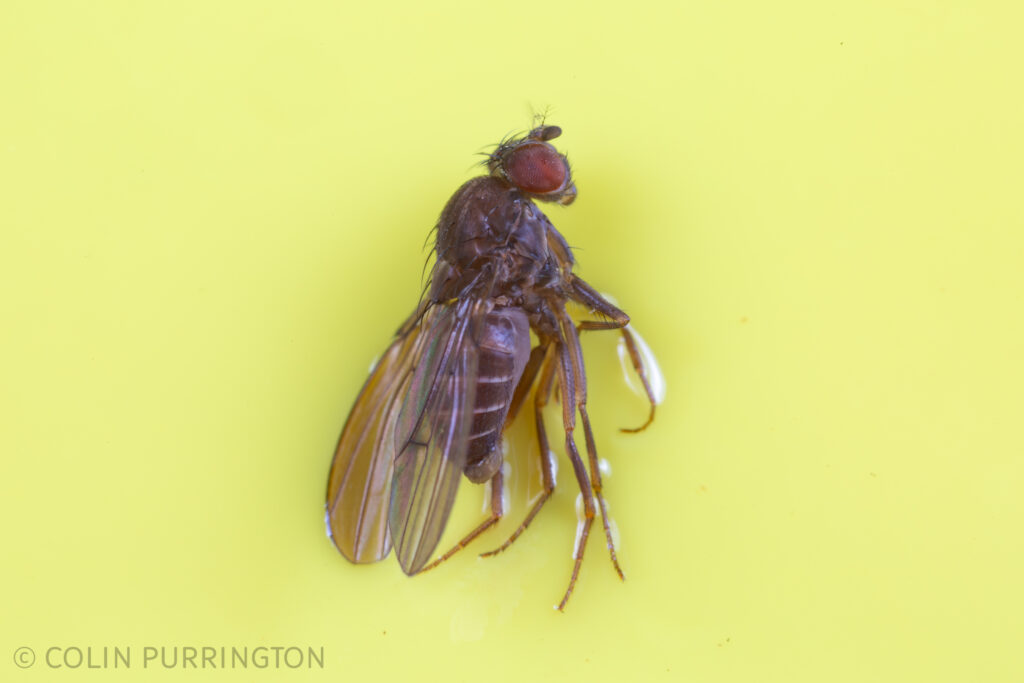
Black kelp fly (Coelopa frigida). There were millions of these but it still took probably 100 tries before I could get a decent image. Small, frenetic, and easily spooked. And only 126 observations on iNaturalist for North America, as a likely result. I would like to go back with my real camera and flash setup. Larvae are said to eat the bacteria that grow on decomposing seaweed.

Telmatogeton japonicus. These were even harder than kelp flies to photograph, and that’s my excuse for it being out of focus. And for the sake of full disclosure I’m not positive about the identification. If confirmed, my iNaturalist observation would be the first for Prince Edward Island.

Peryphus sp. This is a subgenus of Bembidion, my father’s favorite carabid. As he often complained, they are really fast and hard to capture. And hard to identify which is probably why my dad liked them.

Black vine weevil (Otiorhynchus sulcatus). This is an invasive agricultural pest and I was surprised to see it on the beach. But it turns out that it has a rather wide host range so I guess not unusual.

For such a beautiful and large wasp I thought somebody on iNaturalist would offer up an identification. After almost a year, nothing. I’m guessing that it was going after some sort of cavity-nesting bee that uses beetle bore holes in driftwood as nests. All the logs had plugs like this so some bee is really utilizing the wood.

Spiders

Thin-legged wolf spider (Pardosa sp.) that was under a rock. I’d wager that it was mainly eating kelp flies. Species identification is only possible with dissection.

Trochosa sp. that has recently molted. This also can’t be taken to species level because the patterns aren’t visible until after the new exoskeleton ages a bit.

Mysteries

I’m assuming this is some sort of venting product made by a sand-dwelling organism such as a clam, worm, or crab. Here’s the iNaturalist observation if you’d like to weigh in.

This sort of looks like a sponge (e.g., Clionaidae, Halichondriidae) but I truly have no idea. Definitely creepy, and I wonder whether those barnacles were victims of something slow moving. Here’s my iNaturalist observation if you can help.

I think this might be some sort of fungus (e.g., Collemopsidium halodytes) or a lichen. It was especially common in depressions in rocks where water might pool. More ideas are on my iNaturalist observation. I would be grateful for suggestions.

As always, if you see a mistake please let me know.

In case you’re a camera nerd, all photographs were taken with an OM TG-7 that I purchased for the trip. It’s waterproof, shoots RAW, does focus-stacking (poorly), and weighs a lot less than the Canon DSLR that I usually lug around with me.

June trip to Lake Mohonk

Here are some of my favorite photographs from a recent stay at Mohonk Mountain House in New Paltz, New York. I also have a few non-macro pics at the end in case you’re curious what the place looks like.

This is Loxocera cylindrica (Psilidae). They puncture and hoover up fluids from leaves, resulting in patches of brown discoloration that give the family its common name (rust flies). Larvae mature inside stems of inland sedge (Carex interior), which tend to grow around calcareous swamps and marshes.

This was so small I assumed it was a spider with just six legs. Eventually figured out it was a gall fly (Cecidomyiidae) when I loaded the photographs onto my computer. It was hanging on spider silk, a behavior that is apparently quite common in the family.

And one more fly: Limonia indigena. BugGuide, my go-to source for obscure facts, says that members of the genus spend their youth in gelatinous tubes on moist surfaces that harbor algae.

This is a Hart’s jumping spider (Tutelina harti) that was thinking about leaping onto my camera. I’ve always wondered whether spiders see the lens and assume it’s an eye. I love the white stripe below the eyes.

Caddo agilis, a diminutive, predaceous harvestman. I first encountered this several years on the exact same patch of moss. The reason why they are assumed to be hunters is partly because they have such big eyes. They are also are incredibly fast runners. The stuff of nightmares, to be honest.

Shaler’s Fabiola moth (Fabiola shaleriella). This is another repeat species for the location, and I always seem to find them on the same stretch of rock. Like most small moths people have no idea what the larvae eat. I’m wondering whether it might use lichen.

This is some sort of bristletail, wingless insects that move like predators but apparently eat lichen. The small photograph doesn’t do justice to the scales and eyes so below is a close-up.

I’m hoping that the eyes can help with identification but so far nobody has weighed in on iNaturalist. They are apparently very hard to narrow down.

This is a larva of Feralia jocosa (Noctuidae), which apparently goes by the common names “the joker” and “jocose sallow.” It’s munching on eastern hemlock (Tsuga canadensis). Adults are gorgeous but I’m not sure what is so funny about them. Probably an inside joke.

As in many parts of North America the eastern hemlocks at Lake Mohonk are getting hammered by the invasive hemlock wooly adelgid (Adelges tsugae). There were no signs of the beetles (three different species) and silver flies (two Leucotaraxis spp.) that are known to attack them.

The spongy moths (Lymantria dispar) were everywhere this year and seem happy eating everything, even toxic mountain laurel (Kalmia latifolia) that deer won’t touch.

I’m not exactly sure what this tiny mushroom is, but possibly a moss bell (Galerina hypnorum). If genus is correct then very likely highly poisonous, thanks to amatoxins, the same compounds that are in death caps (Amanita phalloides).

Finally, below are some scenes from around the hotel. It’s such a beautiful place. Do not go if you’re trying to lose weight.

If you want to see more photographs of Mohonk Mountain House please check out my gallery on Smugmug.

Tougher Than Tom’s Mosquito TNT review

I tested the Mosquito TNT in my Pennsylvania yard and have concluded that they do not control mosquitoes. Moreover, they kill a considerable number of non-target organisms, including pollinators, and provide a habitat for developing flies that feed on the decaying carcasses of previous victims. My full review is below. I include instructions for reporting the product to federal and state regulators, plus tips on how to get your money back if the company refuses to honor its refund policy.

Marketing claims

The company says the four-trap kit ($39.99 plus tax) will make a 1-acre yard “mosquito-free” for 30 days. At the end of this period you dump out the contents and add fresh bait (sold separately for $19.99).

Marketing materials assert that female mosquitoes are attracted to the containers because they emit carbon dioxide, which is produced by two pairs of “inert” (i.e., not inert) ingredients (yeast and D-glucose; sodium bicarbonate and citric acid). The active ingredient, sodium lauryl sulfate is said to make them drown faster.

Note that in reality the device would not be able to produce enough CO2 to attract mosquitoes, and certainly not for 30 days. And the active ingredient, sodium lauryl sulfate, is not listed anywhere in the primary literature as a chemical that can kill adult mosquitoes.

My test results

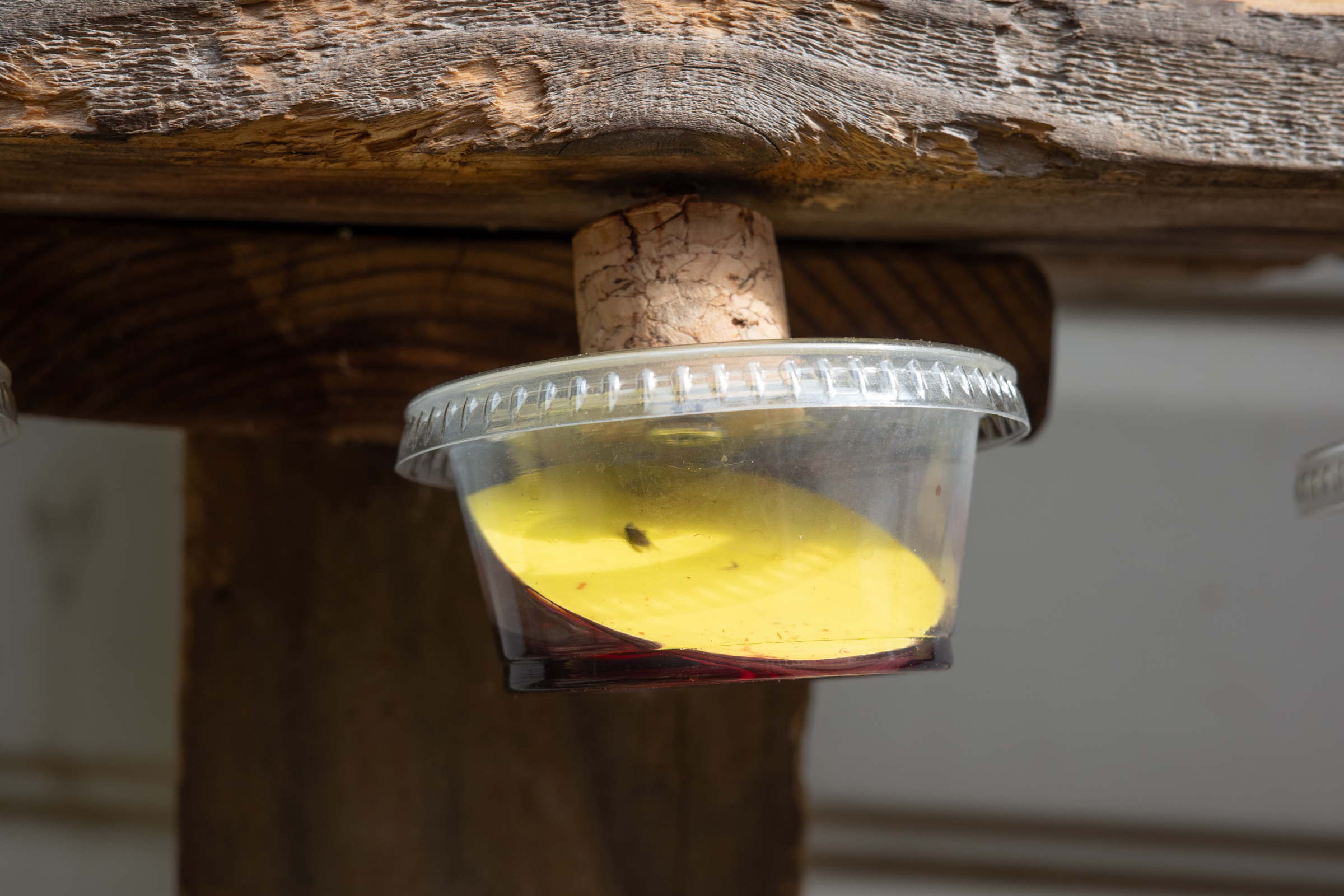
I took photographs of the four traps every several days as a way to record what types of insects were being killed. By far the most common were flies (fruit flies, blow flies, picture-winged flies, etc.), wasps (yellowjackets and hornets), earwigs, and beetles. Initially they were attracted by the sugar and yeast, but eventually the rotting carcasses attracted species that feed on decaying organic matter. Some of these latter individuals laid eggs, resulting in rather large white larvae moving around in the fluid. After about 20 days the stench was enough to make me gag whenever I got close. At no point during my inspections did I notice a single mosquito.

Below are photographs of the other three Mosquito TNTs. Like the trap above, these did not kill any mosquitoes. One had trapped two bumblebees. Although these seemed to attract fewer insects, all contained living fly larvae.

Containers are filled with living larvae

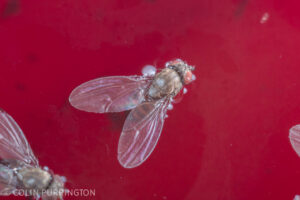
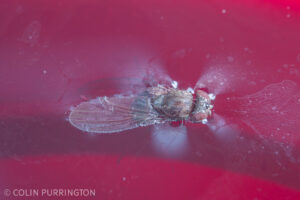
After several weeks, the fluid was teaming with larvae of humpbacked flies (Phoridae). Here’s a photograph followed by a video.

I wasn’t able to rear any of the above to adulthood but did succeed for a different species, below, which I’ve tentatively identified as Coboldia fuscipes, a type of minute scavenger fly (Scatopsidae).

Ads are misleading

Many of Tougher Than Tom’s ads assert that the dead insects inside the traps are mosquitoes, even though the insects appear to be fruit flies, bottle flies, and wasps. I.e., the company uses gaslighting to convince people that traps work even though it is very apparent they do not.

Another tactic is to show images that have been Photoshopped to falsely convey high efficacy. For example, the image below has mosquitoes that were copied from a photograph taken in Germany by Steffen Kugler. It’s unclear whether Tougher Than Tom has legally licensed that photograph.

Photoshopped illustration copyright Zachary Snyder Collins of Tougher Than Tom (from Amazon listing).

Tougher Than Tom also uses “user-generated content” (UGC) to push the Mosquito TNT on TikTok, Instagram, and YouTube. Users seem to be following a script that frequently includes how safe the ingredients are, how yards become “mosquito-free,” and how traps eliminate worries over mosquito-borne diseases (all claims that violate FIFRA). None shows mosquitoes inside the Mosquito TNT. The UGCs rarely disclose a financial relationship with the company even though that is required by the FTC.

How to get a refund

Tougher Than Tom has generous return language (“100% guaranteed,” “hassle-free refunds,” “If Tom’s products don’t work for you, you get your money back!“) but tends to ignore refund requests. For those who persist, company then insists that traps need to be mailed back at customer’s expense. To get around these tactics, I highly recommend posting a review on Trustpilot. The company seems to monitor this site and will usually try to appease consumers in an effort to maintain a good standing on the review site. Tougher Than Tom will try to get your review removed by flagging it for “illegal content”, so contact Trustpilot and report that, too (and contact me, please, if you’d like). You can also leave reviews at the Better Business Bureau and PissedConsumer.

If that doesn’t work, file a complaint with the Attorney General in your state. You can do this by conducting an internet search for “file complaint with attorney general [your state]” and then submitting a short form. The office will then contact Tougher Than Tom on your behalf, using legal language that may get the company’s attention. It’s easy.

How to file a state or federal complaint

If you’d like to help protect other consumers, you can report the company for making false or misleading claims.

To locate the person in charge of pesticide registration and enforcement in your state, click on this map. These people have the power to revisit a product’s registration status as well as levy fines against the company for shipping to the state without a registration. In your email, provide details of what your traps have captured and attach photographs if possible.

You can also report the company to the EPA and the FTC. For these communications it is also helpful to attach screenshots of the marketing materials that led you to believe that the product eliminated mosquitoes. And if you noticed zero mosquitoes inside your traps, mention that, too.

Here’s the company contact information to share in your report:

Tougher Than Tom
2028 E Ben White Blvd, Suite 240-1328, Austin, TX 78741
(413) 400-0067
owner: Zachary Snyder Collins
zach@simplystrive.com

Further information

  • The Mosquito TNT is a 69-cent wasp trap made in China.
  • I highly recommend reading the consent agreement (PDF) between the company and the EPA. The company had to pay $80,880 in fines for violating federal pesticide laws.
  • The owner of Simply Strive (“Tougher Than Tom”), Zachary Snyder Collins (photo), likely got into the mosquito-control business from fellow Austin resident Nick Olnyk, founder of Grandpa Gus, a company that had an identical product lineup before being sold a few years ago. I think Collins copied the “folksy, honest grandpa” marketing schtick from Grandpa Gus.

Where can the Mosquito TNT be sold?

From searching databases and regulations, I think the following states allow the product to be sold: Alaska, Arizona, Arkansas, California, Colorado, Delaware, Florida, Georgia, Hawaii, Idaho, Iowa, Kansas, Kentucky, Michigan, Mississippi, Montana, New Hampshire, New Jersey, New York, North Carolina, North Dakota, Pennsylvania, South Dakota, Tennessee, Texas, Vermont, Virginia, Wisconsin, and D.C. This information can always change, of course and there’s not way to sign up for updates.

The search revealed that the following states do not allow sales: Alabama, Connecticut, Illinois, Indiana, Louisiana, Maine, Maryland, Massachusetts, Minnesota, Missouri, Nebraska, Nevada, New Mexico, North Carolina, Ohio, Oklahoma, Oregon, Rhode Island, South Carolina, Washington, West Virginia, and Wyoming. Again, this information can change, so my listing might be out of date.

However, Tougher Than Tom’s website indicates that sales are prohibited only in New Mexico and Tennessee. And the company’s Amazon listing says product cannot be shipped to Oklahoma, North Carolina (which allows sales, actually), and Maine. That these two sources list different states suggests that the company is not paying close attention to where the device may legally be shipped. The company is probably regularly shipping the product to states that have denied a registration. E.g., per a review that Tougher Than Tom features on its website, it has shipped the device to Minnesota (jpg screenshot).

Other reviews

Contact

If you have a question, information you think I should provide, or find errors, send me an email.