Category Archives: travel

Gallery of dead potatoes in silk-lined coffins

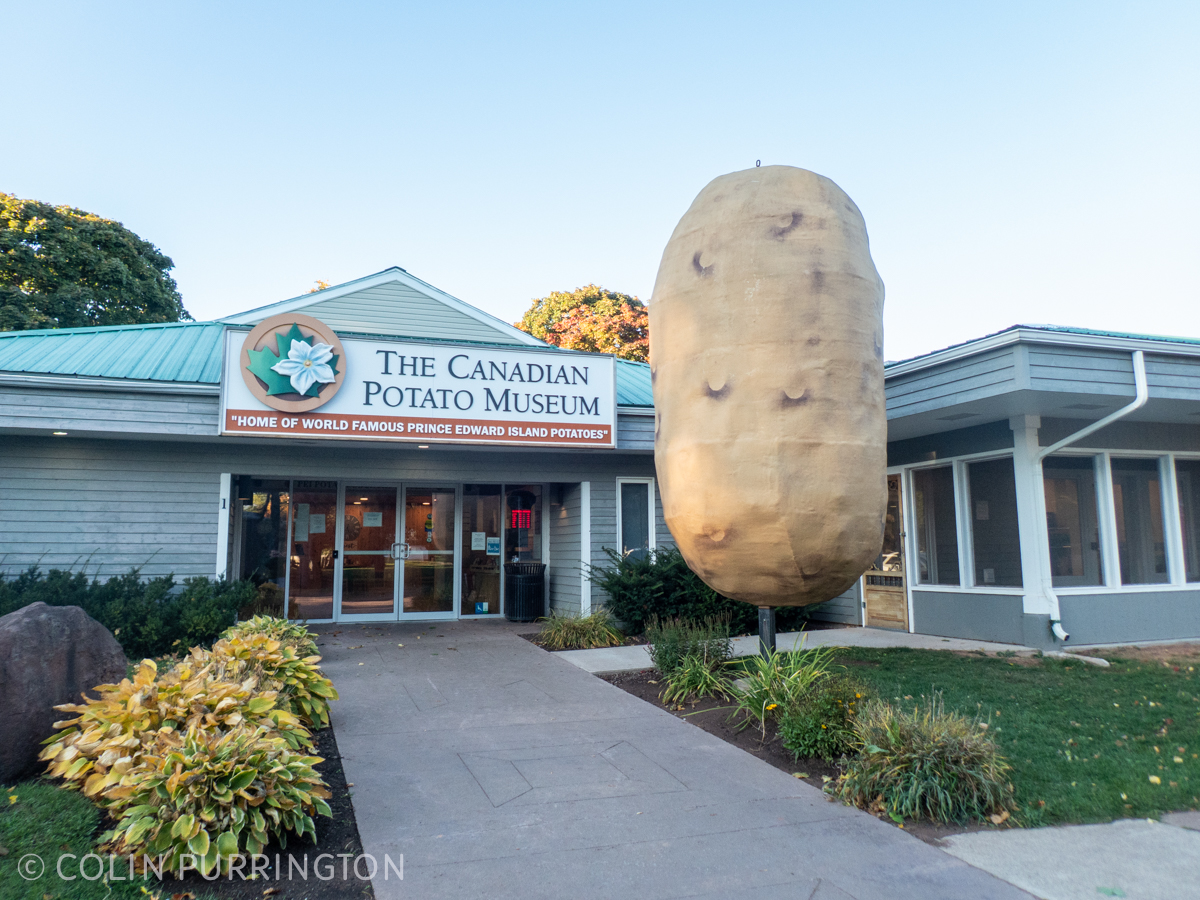
In case you never get to visit The Canadian Potato Museum on Prince Edward Island, here are photographs from the excellent exhibit on diseases and pests of potatoes. I’ve included all the accompanying interpretive signs in case you want the gruesome details but it’s really all about the adorable coffins. Poor little spuds. RIP.

Bacterial soft rot is primarily caused by Pectobacterium carotovorum (aka Erwinia carotovora).

Bacterial ring rot is caused by Clavibacter sepedonicus (formerly called Clavibacter michiganensis subsp. sepedonicus). Note that the potato has fallen off its attachment point higher up in the coffin.

Blackleg is caused by Pectobacterium atrosepticum.

Fusarium dry rot is caused by several species of Fusarium, of course. But also by Gibberella pulicaris, which was formerly in the genus, I gather).

Skin spot is caused by the fungus, Polyscytalum pustulans.

Potato wart is caused by the chytrid fungus, Synchytrium endobioticum. Lesions make the potatoes unmarketable, which is bad, but also result in fields being quarantined and potentially never farmed again.

Many types of slugs eat potatoes.

The potato-rot nematode is Ditylenchus destructor. As in several other coffins, the potato seems to have become unglued.

White grubs are the larvae of scarab beetles (Scarabidae) in the genus Phyllophaga (May beetles, June bugs, … and sometimes even July beetles). Fun fact: they crawl on their backs.

Wireworms are the larvae of click beetles (Elateridae).

Potato scab is caused by the potato scab gnat (Pnyxia scabiei), a member of the Sciaridae. Fun fact: the females are wingless (and have no halteres!)

The flea beetle most associated with potato is Epitrix cucumeris.

The most common millipede in potato fields is the spotted snake millipede (Blaniulus guttulatus).

Blackheart is not a disease but rather a physiological response to low oxygen during growth or storage. High temperatures during transport and storage are the main culprits. Blossom-end rot is caused by the same conditions.

In case you are curious, the coffins were designed by Meredith and Tom Hughes for the “The Amazing Potato” exhibit (1991-1994) at Canada’s Museum of Science and Technology in Ottawa. There are, apparently, undisplayed coffins because the O’Leary building was too small to house them all.


But you should definitely visit. You can pose in front of the 14-foot potato out front, stroll through the world’s largest exhibit of potato-related farm machinery, shop for trinkets such as squishy stress potatoes, and dine in the Potato Country Kitchen (don’t skip the seaweed pie made with Chondrus crispus, a red alga; it’s a recipe from Ireland). It’s open from May 12 to October 10.

June trip to Lake Mohonk

Here are some of my favorite photographs from a recent stay at Mohonk Mountain House in New Paltz, New York. I also have a few non-macro pics at the end in case you’re curious what the place looks like.

This is Loxocera cylindrica (Psilidae). They puncture and hoover up fluids from leaves, resulting in patches of brown discoloration that give the family its common name (rust flies). Larvae mature inside stems of inland sedge (Carex interior), which tend to grow around calcareous swamps and marshes.

This was so small I assumed it was a spider with just six legs. Eventually figured out it was a gall fly (Cecidomyiidae) when I loaded the photographs onto my computer. It was hanging on spider silk, a behavior that is apparently quite common in the family.

And one more fly: Limonia indigena. BugGuide, my go-to source for obscure facts, says that members of the genus spend their youth in gelatinous tubes on moist surfaces that harbor algae.

This is a Hart’s jumping spider (Tutelina harti) that was thinking about leaping onto my camera. I’ve always wondered whether spiders see the lens and assume it’s an eye. I love the white stripe below the eyes.

Caddo agilis, a diminutive, predaceous harvestman. I first encountered this several years on the exact same patch of moss. The reason why they are assumed to be hunters is partly because they have such big eyes. They are also are incredibly fast runners. The stuff of nightmares, to be honest.

Shaler’s Fabiola moth (Fabiola shaleriella). This is another repeat species for the location, and I always seem to find them on the same stretch of rock. Like most small moths people have no idea what the larvae eat. I’m wondering whether it might use lichen.

This is some sort of bristletail, wingless insects that move like predators but apparently eat lichen. The small photograph doesn’t do justice to the scales and eyes so below is a close-up.

I’m hoping that the eyes can help with identification but so far nobody has weighed in on iNaturalist. They are apparently very hard to narrow down.

This is a larva of Feralia jocosa (Noctuidae), which apparently goes by the common names “the joker” and “jocose sallow.” It’s munching on eastern hemlock (Tsuga canadensis). Adults are gorgeous but I’m not sure what is so funny about them. Probably an inside joke.

As in many parts of North America the eastern hemlocks at Lake Mohonk are getting hammered by the invasive hemlock wooly adelgid (Adelges tsugae). There were no signs of the beetles (three different species) and silver flies (two Leucotaraxis spp.) that are known to attack them.

The spongy moths (Lymantria dispar) were everywhere this year and seem happy eating everything, even toxic mountain laurel (Kalmia latifolia) that deer won’t touch.

I’m not exactly sure what this tiny mushroom is, but possibly a moss bell (Galerina hypnorum). If genus is correct then very likely highly poisonous, thanks to amatoxins, the same compounds that are in death caps (Amanita phalloides).

Finally, below are some scenes from around the hotel. It’s such a beautiful place. Do not go if you’re trying to lose weight.

If you want to see more photographs of Mohonk Mountain House please check out my gallery on Smugmug.

Termite bait stations in New Orleans’ sidewalks

In honor of Mardi Gras I thought I’d make a short post about the small circular metal plates on sidewalks (banquettes) in the French Quarter of New Orleans. When I visited there in February, I initially thought they were surveyor control points or property markers, but that made no sense because there were sometimes a dozen per block, plus the bolts in the center seem to show signs of wear and tear as if they were being used a lot. A reverse image search quickly revealed they had something to do with termites, specifically the introduced species, Coptotermes formosanus, that arrived sometime on or before 1957. Details below (as it were).

The plates are remnants of Operation Full Stop, a USDA-led project that was funded in 1998 by a $5 million earmark in the Federal budget. Part of the funding was to develop a bait system that would deliver poisons to deserving termites in a 15-block area of the French Quarter. Inside a 3″ hole drilled into the sidewalk and deep enough to reach the soil level is a bait station supplied by Terminix. I think the station is manufactured by Sentricon and included a chitinase that killed the termites by preventing their ability to molt. Here’s a bait station inside a hole that was missing its cap plate:

The cap plate is a rather clever device that makes a water-tight seal as the snake eye bolt on the plate is tightened. It was the brainchild of the late Edgar S. Bordes, Jr., I gather.

Per Martin 2016, this baiting effort caused a reduction in termite populations from 1998 to 2011, the year the funding ran out. And most of the ~3000 homeowners that received the bait stations have opted to pay a pest-control service to maintain them. But this article implies that many of the termites are in the walls of homes and businesses and perhaps don’t regularly visit the ground level and so might not encounter the poisons inside the bait stations. Therefore, many homeowners are hiring specialists to examine their walls with infrared cameras, acoustical detectors, miniature radars, and snake scopes. If I invested in a home in New Orleans I would spend tens of thousands of dollars to buy all of those devices so I could monitor my walls whenever I wanted.

If you’d like to see more plates, just browse Google Maps of the French Quarter in Street View mode. E.g., here’s the sidewalk in front of 916 St. Louis St.

Happy Mardi Gras!

Alley near House of Blues with two termite bait stations (bottom of pic).