Category Archives: Photography

Photographs from Ridley Creek State Park

Last week when I was at Ridley Creek State Park I crossed paths with a tree tour led by wildlife biologist Gary Stolz (PA Dept of Conservation and Natural Resources). I promised the group that I’d post photographs of things I’d seen at the park. Here are the highlights:

Long-tailed giant ichneumon wasp

Long-tailed giant ichneumonid wasp (Megarhyssa macrurus)
Megarhyssa macrurus

The largest and most colorful was clearly the long-tailed giant ichneumon wasp (Megarhyssa macrurus) that I found ovipositing into a red maple. Actually, there were perhaps a half-dozen of them, all presumably targeting the larvae of Tremex columba (a sawfly) that were busy eating the tree. The presence of the sawflies is given away from probably a mile away (I’m guessing here) due to the odor of the symbiotic fungus they use to help digest the wood. Once on the tree, though, the ichneumon probably locates a larva by sensing the vibrations it makes when chewing. The ovipositor is approximately 2″ long and is tipped with a cutting edge (as you might guess). It also drips out a fluid that helps dissolve the wood. An amazing insect to watch.

Green’s giant ichneumon wasp

(Green's giant ichneumonid wasp) Megarhyssa greenei
Megarhyssa greenei

Also on the same tree were several Green’s giant ichneumon wasps (Megarhyssa greenei). This species has a shorter ovipositor (among several other differences) but does pretty much the same thing as the species above.

Unknown wasp in Tribe Ephialtini

Ovipositing wasp in Tribe Ephialtini.

Also beautiful but much smaller (perhaps 12 mm), I found this wasp ovipositing into a nearby tree that was completely dead and covered with moss. I’m still working on an ID (it’s something in the Ephialtini). Which means, like many of the insects I photograph, I’m hoping that an expert will eventually help me identify it. Sometimes that process can years but I’ll update this page if there’s any movement. For those curious, I post photographs to iNaturalist and BugGuide for help. And I often ask my Dad (Foster Forbes Purrington), an entomologist.

Coelichneumon navus

Coelichneumon navus (female)
Coelichneumon navus

The last wasp of the day is Coelichneumon navus, another ichneumonid but with a concealed ovipositor. This species has been known to parasitize fall webworm (Hyphantria cunea) and cypress looper moth (Iridopsis pergracilis), but like many of the 100,000 or so members of the family Ichneumonidae not much is known about its natural history. I found two caterpillars on this tree but haven’t yet ID’d them.

Gnophomyia tristissima

Gnophomyia tristissima

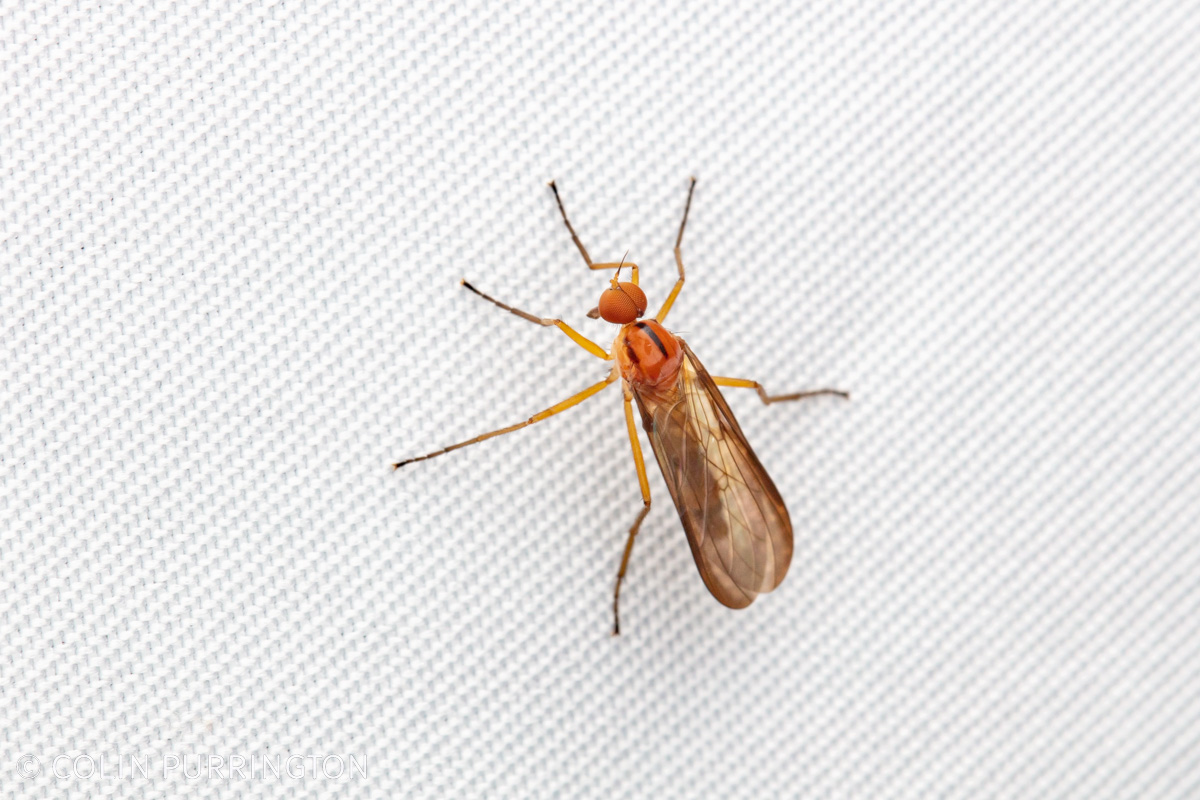
Another insect with no common name, Gnophomyia tristissima live, love, and die around rotting hardwood logs. These are crane flies and can be identified by their bright yellow halteres (remnants of their second pair of wings) and black bodies. This photograph shows mating but afterwards the male seems to guard the female while she oviposits (if you want to see that, click on image to be taken to a site that has additional photographs). I spent about 30 minutes watching and photographing them and could have stayed longer. But the mosquitoes were exsanguinating me.

American nursery web spider

American nursery web spider (Pisaurina mira)
Pisaurina mira

Earlier on my walk I found a rather orange American nursery web spider (Pisaurina mira). It was also rather large.

Banded fishing spider?

Juvenile banded fishing spider (Dolomedes vittatus)
Dolomedes vittatus?

I can usually narrow down spiders given their eye arrangement and details of web (or lack thereof), but this is stumping me. My tentative guess is that it’s a freshly-molted (teneral), juvenile banded fishing spider (Dolomedes vittatus). I’m trying to get this confirmed so check back if you’re curious. Astute readers will notice that it’s on a tree, not near water, but apparently there are few members of Dolomedes that can live away from water just fine. This is one of those species.

Northern water snake

Northern water snake (Nerodia sipedon)
Nerodia sipedon

This was the first time I’ve seen a northern water snake (Nerodia sipedon) but apparently they are super common. This one was perhaps 2 feet long but they get as big as 4 1/2 feet. Non-venomous, though, in case you were wondering.

Sulphur tufts?

Sulphur tufts (Hypholoma fasciculare) on log
Hypholoma fasciculare?

I’m still working on an identification but my current guess is sulphur tufts (Hypholoma fasciculare). Or, if you prefer, sulfur tufts. I really enjoy photographing young mushrooms but the consequence is that they are harder to identify.

That’s it! If you have any questions, send me a note or leave a comment.

Template for a town mosquito-control plan

I created this page because I think all towns should have a webpage detailing its mosquito plan. If you are a mayor please feel free to copy and adapt — and contact me if you have questions. The bright blue text does not have active links but is formatted to indicate that a town should have something that can be linked. Note: there’s a Mosquitoville in Vermont but my usage of the name is just a coincidence.

The Borough of Mosquitoville coordinates with residents and county and state officials to help minimize the numbers of mosquitoes as well as any disease risk they might present. In addition to the information on this page we will also send timely, more-detailed tips via Twitter, Facebook, Nextdoor, and email (register here) as well publish notices in the town paper. We also have a yearly demonstration at the Mosquitoville Farmers Market where we show how to prevent mosquitoes from breeding and how to kill larvae. If you are on Facebook, please join the Mosquitoville Residents Against Mosquitoes group for sharing news and strategies with your neighbors.

Prevention tips

Mosquitoes require standing water to breed so by eliminating places where water can pool, residents can largely eliminate mosquitoes. Even a bottle cap left outside can hold enough water to support dozens of larvae.

  1. Here are some objects that should be drained after every rain: watering cans, garbage cans, garbage can lids, recycling bins, lips of plastic bins when stored upside-down, kiddie pools (and lips, when stored upside-down), plastic kid toys, inflatable pool furniture, pool covers, grill covers, plant pot saucers, unused glazed pots, pet water bowls, wheelbarrows, trash bags waiting for pickup, plastic tarps on firewood, unattached tires.
  2. If tree holes or bamboo stalks collect water, fill with sand.
  3. Clean gutters regularly so that water doesn’t pool.
  4. Replace all corrugated gutter extenders with pipes that do not collect water.
  5. Landscape area that receives air conditioner condensate so that puddle not formed.
  6. For places and objects that cannot be easily drained (bird baths, fish ponds, rain barrels), add granules of Bti, a bacterium (Bacillus thuringiensis israelensis) that kills mosquito larvae and nothing else. Mosquitoville Hardware sells it. You can also buy it online. Bti should be reapplied every several weeks. It is completely safe for mammals, birds, fish, and spiders. It is also safe for all other insects except mosquitoes, so using it liberally will not kill beneficial insects such as butterflies.
  7. Sprinkle Bti on plants that hold water (e.g., bromeliads).
  8. If you see pooled water on town property, report it to the Public Works Department at (800-867-5309; publicworks@mosquitoville.org). Examples are trash bins at parks, abandoned tires, construction material at job sites, ditches, road swales. All Public Works vehicles have a generous supply of Bti dunks and granules and employees are eager to put them to good use — don’t hesitate to call!

Egg and larvae traps

For residents who are crafty, equip black containers with stagnant water, a few decaying leaves, a stick, and crumbled Bti dunks. Female mosquitoes will lay eggs in these containers and then the larvae will be killed almost instantly by the Bti when they hatch. If you have multiple traps on your property you can interrupt the reproduction of mosquitoes — just remember that you have to keep refreshing the Bti. You can also make containers that trap the larvae under screening (Instructables directions), which is great because you don’t need to keep replacing the Bti during the summer.

Killing adults

  1. Prune ground vegetation that provides hiding places for mosquitoes during the day. Without moist vegetation to hide in many adults will die on hot, dry days (research). Removing English ivy is especially recommended (the species is an invasive weed that also damages trees and buildings).
  2. If you are crafty, attach fine mess fabric to a fan and place fan next to where you sit outside. Then coat fabric with pyrethroid spray (most outdoors stores carry this). When mosquitoes approach to bite they will be sucked onto the pyrethroid-coated fabric, which kills them on contact. This is also is highly recommended strategy for chicken coops.
  3. Purchase a propane-fueled carbon dioxide bait trap. These can be expensive but if you paid a lot for your yard, consider them as investments akin to a home security system. Situate the trap near the source of mosquitoes, not where the family congregates (tips). Companies are improving the designs constantly so do research to see which ones are right for your area.
  4. Purchase cheaper, odor-based mosquito traps. These do work on some mosquito species, though not as well as the propane systems. “Bug Zappers” do not work (they mainly kill moths).
  5. Arm your family with electronic mosquito racquets. These are traditionally marketed for controlling houseflies but also work with mosquitoes. Killing just one mosquito might seem futile but that’s one less female laying hundreds of eggs.

Third-party insecticide fogging

Mosquito Shield sign in yard

There are several companies in the area (e.g., Mosquito Shield, Mosquito Squad, Mosquito Joe) that will come and spray your yard with pyrethroids (synthetic neurotoxins) to kill mosquitoes. However, there are some side-effects of doing this and we urge residents to consider them before proceeding. The primary consequence is that pyrethroids also kill fish, butterflies, moths, solitary bees, fireflies, crickets, etc., not just mosquitoes. Outside cats are also at risk (dogs are not). Another concern is that honey bees pick up the dried pesticide when they walk on treated plants, contaminating honey (research article) produced by local beekeepers (there are approximately 15 hives in Mosquitoville). If you do decide to hire a company to spray pyrethroids (approximately $800 per season), please inform your neighbors in advance and be present when the spraying happens. Also, please insist that the company provide a paper copy of the Material Data Safety Sheet (MSDS) of the active ingredient of the spray before giving them any money. The MSDS information is important because different pyrethroids have different risk profiles. If a company refuses to give you this document just find a different company.

If you are a neighbor of somebody who contracts with a third-party pest-control company, please know that you can write to the company and request to be notified in advance of every spraying. You can also request a paper copy of the ingredients of the spray.

For more information please see “Effects of mosquito sprays on humans, pets, and wildlife“.

Repellents

Most mosquito species cannot reproduce without a blood meal, so using repellents is a big part of control efforts. The CDC regularly evaluates repellents for efficacy and includes the following in its recommendations: DEET, picaridin, IR3535, oil of lemon eucalyptus, para-methane-diol, and 2-undecanone. If something is not on this list it is likely to be ineffective even if there are articles on the internet stating otherwise. For example, plants labeled as “citronella mosquito plants” (Pelargonium citrosum) have no repellency against mosquitoes when evaluated in actual experiments.

West Nile Virus

The State regularly tests mosquitoes and dead birds in Mosquito County for the presence of West Nile Virus (WNV), a disease that resides in birds but is transmitted to humans by members of the genus Culex. In addition, they monitor the number of human cases of WNV that are reported by physicians. If testing shows disease prevalence above a certain level, State officials may order that larvicides and/or adulticides be sprayed from airplanes, helicopters, or trucks in certain towns. Aerial spraying is usually the default because Culex mosquitoes are high up in trees with the birds. We will inform residents that spraying will happen, what chemicals will be used (e.g., naled), and communicate exactly when spraying starts and stops. Residents should cover bee hives, cover vegetables (if feasible), makes sure pets and children are inside, and (if applicable) bring in monarch butterfly larvae along with extra milkweed leaves. Although the sprays are relatively safe for vertebrates, the insecticides applied are broad-spectrum so you might notice a drop in non-target organisms like butterflies, fireflies, and bees.

If you find a dead bird, please call the Dead Bird Hotline so that a State official can collect the carcass and test it for West Nile Virus. Do not touch the bird.

Please note that Mosquitoville cannot prevent the state from spraying. However, we remind the local authorities that we are a Bee Friendly City as well as a Monarch City and that we prefer to be sprayed only when human health is threatened.

Zika Virus

The Borough of Mosquitoville is currently not in an area with any reported Zika in either mosquitoes or humans. We are, however, in an area with Aedes sp., vectors of Zika, so we regularly monitor the CDC’s page on Zika and will alert residents if the disease is reported in the state.

Pesticide Hypersensitivity Registry

If you are hypersensitive to pesticides, please complete and mail in the forms to place yourself on the registry. Then if state-mandated sprays are delivered by trucks, drivers will automatically turn off the sprayers when they come to your property. You will also be notified by the State in case you wish to leave the area during spraying.

Apiary registration

Beekeepers are encouraged to register their hives with the State so that sprayers can skip over your property if spraying for West Nile Virus is ordered. Honey bees are acutely sensitive to pyrethroids and spraying at night only minimizes the risk. On a very warm night, for example, hundreds of bees will be outside the hive fanning and thus would be coated with the pesticide fog. Honey bees also pick up pesticide residue that is dried onto plants.

Asian tiger mosquitoes (dead)Mosquito identification

Best practices for preventing and killing mosquitoes vary by species so to be most effective in controlling populations, identify the ones in your yard. If you can take a macro photograph of eggs, larvae, or adult, you can get often get identifications by posting the image on iNaturalist. The CDC has a useful PDF. The U.S. Army has a more detailed guide (PDF).

Additional resources

Mosquito control tips

How to help your community create an effective mosquito management plan” PDF from the Scott Hoffman Black and others at the Xerces Society.

Questions or concerns?

Please contact frontdesk@mosquitoville.org.

iNaturalist observations

10 reasons why you should be using iNaturalist

iNaturalist is a free site that allows nature fans to share — and learn more about — organisms they’ve found on hikes, in their yards, or attached to their bodies. All you do after signing up is upload a photograph, make an identification guess (or not — no pressure), then solicit ID help from the built-in AI as well as from the approximately 80,000 active users, some of whom know how to identify things. But it’s a community, so you (yes, you) can also weigh in on IDs for photographs taken by other members (but again, no pressure).

Below are some reasons to give it a try. The first several are general, the later ones for scientists or professional naturalists. 

1. Get your photographs identified

Galapagos sea lion (Zalophus californianus wollebaeki)

If you post nature pics on the Internet, it’s so much better to caption them with either common name or Latin name so that people can easily find the image in Google searches and such. Plus people just like to know. Saying something is a “seal” is fine but when you have a Galápagos sea lion you should say so (because there 12+ species of seal)You should also use iNaturalist even if you think you know what it is. E.g., to make sure you’ve captured a Galápagos sea lion not a Galápagos fur seal, both of which are in the Galápagos. Using iNaturalist to get IDs is also better than posting a photograph to Twitter, Instagram, or Facebook and asking the world, “Anyone know what this is?” Your followers on those other social media accounts might not be giving you accurate information. Just saying.

2. Educate yourself

Nazca boobies (Sula granti) in a field of flowering goat's head

Nature in the general sense is nice and all, but after you figure out exactly what something is you’ll have the magic key to find further information that might be truly interesting. E.g., Nazca boobies (Sula granti) have an interesting name but if you Google the name you can learn that males court females by offering them sticks and stones even though this species doesn’t even build nests (behavior is an evolutionary holdover from ancestors that did, presumably). Another reason to search for more information is to be reminded that for the vast majority of species, even rather common ones, we know surprisingly little. And knowing this is a good thing because then youngsters and young at heart will realize that going into a biology-related field is a way to explore the unknown. Appreciating and protecting life on earth is easier when you know the details, and you can’t get them just by knowing a lot about polar bears and other charismatic megafauna.

3. Use and improve your ID skills

Great frigatebird (Fregata minor)

Your friends and family might roll their eyes whenever you call out bird names when one zips by, but those identification skills are cherished on iNaturalist. Nobody will make fun of you! By providing IDs you are helping those new to nature get more out of nature and in, perhaps, helping voters and politicians appreciate see that policies can directly help or hurt particular species on the planet, even in your home town. You will also be providing IDs to over-educated professionals who might be posting pics of organisms outside their research speciality, but who might someday return the favor. iNaturalist also provides an environment where you can teach yourself how to ID new organisms. E.g, I learned that great frigatebirds (Fregata minorcan be distinguished from magnificent frigatebirds (Fregata magnificensby their green sheen. Tricks like this can be useful when traveling to new places, and you can use iNaturalist like a study guide to prepare for such trips. E.g., if you’re shelling out tens of thousands of dollars to travel to exotic places like the Galapagos, spend the year before learning the flora and fauna so that once you land you know what’s going on (your guide might not). All you do is subscribe to the place and challenge yourself to learn how to identify submissions (you’re going to need a few books, too).

4. It will make you happier and healthier

Galápagos flycatcher (Myiarchus magnirostris) on weathered lava

iNaturalist is like a mental Fitbit, recording what you’ve seen instead of the number of steps. And then when you revisit memories of being outside you’ll become happier! At least that’s the research. I’m just hand-waving here that iNaturalist will make those memories fonder and more vivid, but it’s not too much of a stretch. At the very least it’s true for me. It’s also reasonable to think that if iNaturalist motivates you to go outside more often, losing excess weight or achieving those 10,000 steps will be that much easier. But I’m not a real doctor, so consult your physician to see whether nature is right for you. And please check for ticks (take a photo if you find them).

5. Meet interesting people

Happy naturalists

People who are active on iNaturalist are by definition curious and have open minds. Those are the peeps you are looking for these days. Right? Unlike some other social media places, users are also actual people … and some of them live near you. So when you see on iNaturalist that there will be a meet-up at a local park, join them. Or if you’re in one of those areas where iNaturalists are rare and shy, you can organize an even and invite folks. 

6. Be a better parent

Taking photographs of a Galapagos land iguana

If you have young kids who are still fascinated by nature instead of electronics and air conditioning, encourage this interest by modeling a similar interest, even if feigned. If, for example, your little girl is fond of spiders, take pics of the ones she finds, upload to iNaturalist, then show her the eventual identification results and help her Google the species name for more information. You don’t need to have a biology degree to do that.

7. Be a better teacher

Biodiversity lecture

If you’re a biology teacher, you really, really need to become proficient in iNaturalist. E.g., if you teach kindergarten and want to tap into kids’ innate interest in nature, submit pics of organisms that your students find in the classroom or during recess. You can say each Monday, “Good morning boys and gorls — find me an organism!” You take a pic, then share ID, courtesy the folks on iNaturalist, with your students on a subsequent day (oh, the suspense!). Pair those IDs with an age-appropriate book on very hungry caterpillars, itsy bitsy spiders, or whatever. And if you’re a college teacher, you could assign a local, interesting species to each of your students, tasking them with (e.g.) figuring out how to ID it and to explain its distribution and conservation status … and after several weeks ask students to make presentations supplemented with natural history tidbits from the primary literature. Ideally, an exercise should challenge the students to contribute to iNaturalist (e.g., if they can make themselves an expert for species X, they should be able to weigh in on IDs). There are thousands of ways to incorporate iNaturalist into classrooms and homeschooling. iNaturalist has a page to get you started. Here’s a video tutorial if you like to watch.

8. Manage your land better

Galapagos project

If you manage a natural area, you can use iNaturalist to create a permanent, dynamic, searchable database of all the species found there. It’s probably your job to do that in some regard, but iNaturalist allows you to crowdsource the task — just ask to visitors to upload their pics to iNaturalist and, voila. It’s really easy to set it up: draw a polygon around your area in Google’s MyMaps, export KML map file to desktop, upload map to iNaturalist to create a “new place”, then create a Project that automatically shows all observations in your area. The setup process takes approximately 15 minutes. If this sounds useful, just do it right now but tell your boss that it took weeks. 

9. Get alerts when a species is observed

Galapagos carpenter bee (Xylocopa darwini) on goat's head

If you are in charge of tracking the spread of spotted lanternfly, emerald ash borer, or any of the other thousands of invasive species that keep biologists up at night, just “subscribe” to that particular taxon for the park, county, state, or country of interest, then sit back and wait for the email indicating that somebody has found that species area of interest. It’s so much better than all those report-an-invasive apps or 1-800 numbers that require people to know that something is invasive and also be motivated to download an app or look for number to call. You can also use the subscription feature to monitor a place for a species that might be your research focus (e.g., perhaps you want to know when the Galapagos carpenter bee colonizes a new island).

10. Mine it for data

Galapagos marine iguana sneezing

There over 12,700,000 observations on iNaturalist, and that means if you’re looking for something rare or just trying to quantify something, you might be able to extract data to address a hypothesis from the comfort of your couch. For example, you might want to know whether marine iguanas close their eyes when they sneeze but don’t want to make the trip to the Galapagos to find the answer (though you probably do). You can also track when a species is first seen flowering in an area for the past 10 years … which might have something to do with climate change. Or you might notice that there’s a new, undescribed species (!), in which case you can contact the observer, write a paper together, and be famous (some examples). Finally, if you need DNA or measurements from a particular species you can hit users up to do this. My suggestion to scientists and teachers who are too busy is to just sign up and then subscribe to your study organism, something that will take 5 mins, max. Once you start seeing variation, natural history comments, and interesting questions from users you’ll be hooked. The are numerous ways to make it interesting and useful … you just have to toggle the settings in the right way.

I have more reasons why you should be using iNaturalist but 10 is the limit for lists of 10 so I’ll end here. Thanks in advance for sharing this post with your friends. We need them, too.

Oh, there’s an app, too: iPhone, Android.