
Although scientists have known for decades that bug zappers do not control mosquitoes, gullible Americans buy 1.75 million of them every year. To help get the word out I thought I’d create a more exhaustive listing of why they are a waste of money.
- They kill very, very few mosquitoes. By one count, 0.2% of the insects killed by a bug zapper were mosquitoes. I.e., they make essentially no difference in the number of mosquitoes in your yard. People who insist otherwise are delusional or lying. Companies that claim the devices kill mosquitoes can get sued.
- They can kill thousands of insects per day that are not mosquitoes. There’s no justification for this senseless slaughter even if you have somebody in your household who doesn’t “like” bugs. It’s also the case that zappers fail to fully kill many of the larger insects such as June beetles, so they are trapped inside dying, which nobody should be OK with. Plus an indirect consequence of removing tens of thousands of insects from your yard is that local birds will have less to feed to their young. And local bats will have less to eat. And you’ll have fewer pollinators flitting around your flower bed. Etc.
- Causes light pollution. That means you, and your neighbors, don’t get to see as many stars in the night sky.
- Causes noise pollution. That crackle (20-70 dB) might be hugely satisfying to those believing (falsely) that each sound is a from an exploding mosquito, but neighbors will probably be annoyed. Example 1 (reddit). Example 2 (Facebook). Example 3 (Houzz). Example 4 (Anchorage Daily News). Many homeowners associations (e.g., Estes Park, Fortville, IN) have bans against devices that make loud noises.
- Mist from exploding insects might contaminate your food when you are eating nearby. Research shows the debris from the explosion can travel up to 2 meters, and germs on the exterior of insects is thrown farther than that contained inside their guts (source). People who have yards filled with dog feces should take note of that finding. Same if you live close to where dead animals are common.
- Can deliver a painful shock if you stick your finger inside (e.g., like this report). Not usually a problem because of the presence of safety grilles but sometimes those fall off (e.g, Stinger Insect Zappers).
- Can catch fire and burn your house down. This is not a theoretical risk (Australia incident, Wisconsin incident). One model sold by Lowe’s caused 14 fires in the 1980s.
- Wastes electricity. It will cost something on the order of $15/year per this video (YouTube) just to keep the bulb going. But energy consumption spikes whenever the zapping takes place so the true cost is higher.
- They MIGHT confuse fireflies. Artificial light definitely interferes with firefly mating (article in New York Times), but I couldn’t find any research specifically using bug zapper bulbs (335 to 380-nm range). Several papers however suggest that near-ultraviolet light might be perceived by some species (Lall 1981, Carlson and Copeland 1985, Owens et al. 2018, Owens and Lewis 2022). The best support for my concern is from Moubarak and Niven 2026, who speculate that the translucent quality of the pronotal shield of fireflies has evolved to block UV light (presumably for reasons).
- They MIGHT attract yellow jackets. Again, I haven’t seen any research on this but my concern is based on the observation that yellow jackets forage for dead insects. E.g., all those insects on your car’s grille and windshield are often scavanged by yellow jackets. In general, you don’t want yellow jackets hanging out on your patio.
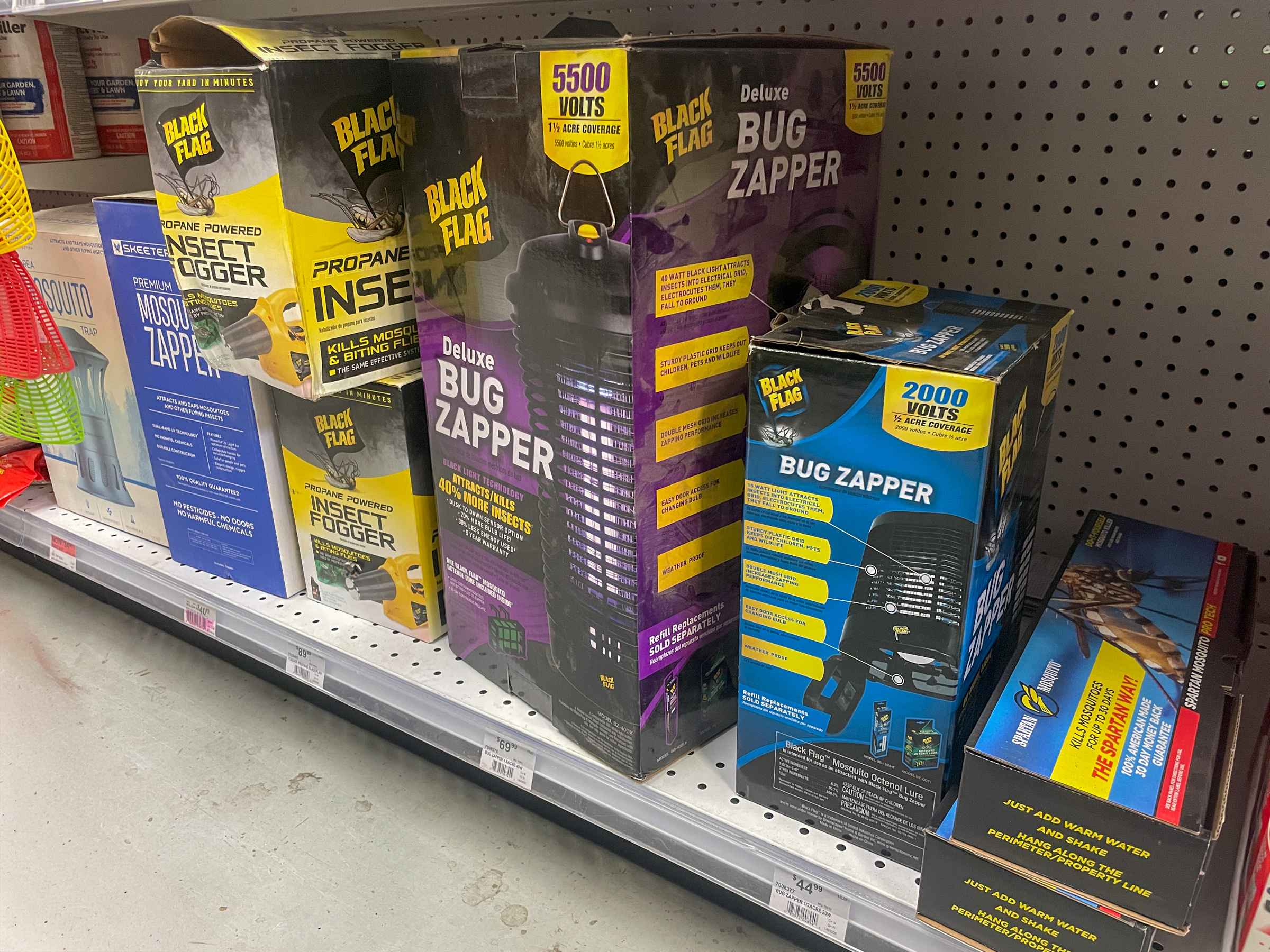
Do the ones with octenol packets control mosquitoes?
No, there’s zero evidence that the addition of an attractant makes bug zappers an effective mosquito-control device, which is unsurprising given that devices don’t emit carbon dioxide (see Rueda et al. 2001). Here’s what the EPA has to say about the attractant packets (bolding mine):
“The reported results indicate variability, that is, some insect species were repelled, some were attracted, and some were unaffected by octenol. Product label claims state that the octenol makes electronic devices more effective in killing certain mosquitoes and biting flies. The statements do not claim to control mosquitoes, only to make the electronic insect killers more effective.”
It’s very likely that the reason companies include these lures is so that they can use the word “mosquito” on the box but do so without making a claim that device attracts, kills, or control mosquitoes. I.e., it helps fool consumers into believing the product is going to work specifically on mosquitoes while shielding the company from litigation targeting false claims. The packets also provide a way to charge more money for refills.
Why are bug zappers still legal?
Pesticides and pesticidal devices that kill large numbers of non-target organisms generally receive greater scrutiny by state regulatory agencies and the EPA, but bug zappers seem to be given a pass. For example, the EPA normally requires companies to complete a “non-target insect study” but that has been waived. I don’t know exactly why the EPA does this but I’m guessing it’s because bug zappers have been around since before the EPA, and the agency is too busy to deal a device that is hugely popular with Americans.
That said, it doesn’t mean citizens can’t agitate to get them regulated like other pesticidal devices. If you’d like to submit a complaint, here is a listing of state and federal agencies that solicit reports. If you write them, some important facts to mention might be that the bulk of insects killed by bug zappers are likely pollinators (e.g., moths), and that all of the insects killed make it likely that local bird and bat populations are harmed. I.e., bug zappers clearly have negative environmental effects and likely not subtle. In a 1996 paper it was estimated that bug zappers killed over 71 billion insects each year in the United States. That number is likely much higher in 2026.
Resources
- “Do bug zappers work? Yeah—about as well as any other indiscriminate wildlife slaughter” (New York Times)
- “Bug zappers are harmful not helpful” (Donald Lewis)
- “An electric death trap for the fly” (Popular Mechanics)