
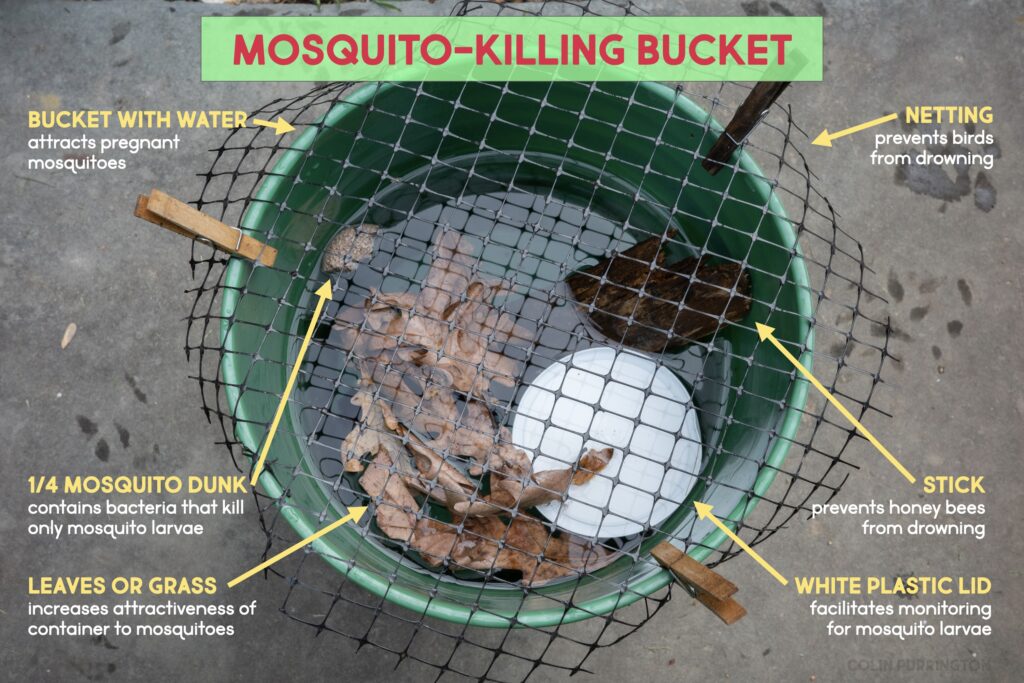
An easy way to kill thousands of mosquitoes each summer is to set out a container of water, add a handful of leaves or hay, then drop in 1/4 of a Mosquito Dunk, a compressed, shelf-stable form of Bacillus thuringiensis israelensis (“Bti”) that kills larvae. Pregnant females will oviposit onto the water surface as well as onto the sides of the container and when the larvae begin to feed they’ll be killed by the toxins produced by the bacteria. Just add a fresh chunk of Mosquito Dunk every three weeks to ensure the system is operating as needed.
Tips
- Cover the container with chicken wire or netting to prevent birds and chipmunks from drowning. You can also use hydroponic lids that have a built-in basket or use a 3D printer to fabricate spacers. Or drill a bunch of 1″ holes in the bucket lid. If you have toddlers around make sure they can’t fall inside (drowning risk).
- Add a long stick that can fit through the mesh so that innocent insects that fall into the water have a way to crawl back out. The presence of wet wood will also increase the oviposition rate of certain species of mosquitoes (e.g., Aedes spp. will deposit eggs directly on the wood).
- Add a white yogurt lid so that you can more easily see whether there are larvae wriggling around. I like to cut the rim off the lid so that it sinks a few mm lower. Alternatively, spray-paint the bottom of the bucket white.
- Deploy multiple traps to maximize the effect (I have six in my 1/4-acre yard). More is better in part because some mosquito species (e.g., Aedes) exhibit skip-oviposition behavior, leaving just a few eggs in a bucket and then flying off in search of more sites.
- Set traps out in early spring so that the leaves have time to decompose and become attractive to female mosquitoes.
- Site near vegetation or at the bases of larger trees. Avoid areas that get a lot of direct sunlight.
- Set up a reminder on your phone to add more Mosquito Dunks. NB: if you forget, the buckets will be generating mosquitoes.
- If you’re traveling for more than three weeks during the summer, dump out all your buckets and start over when you return.
- Purge your yard of all other objects that might retain stagnant water so that mosquitoes are forced to leave their eggs in the trap.
- Make some for your neighbors, especially those who are spraying pyrethroids. Include a print-out of this page so that they understand how to use it.
- Get local folks on board by writing a letter to your local paper (e.g., here’s my March 2026 blurb in The Swarthmorean). The more people who use these traps the better.
Are they working?
To determine whether mosquitoes are ovipositing, look for egg rafts on the surface of the water. You can also check for eggs of Asian tiger mosquitoes (Aedes albopictus) on the edges of the container, above the waterline, or on pieces of wood that are floating on the surface. If there are eggs and no larvae (video below), the Bti is doing its thing. If you see larvae in the water, dump everything and start over or add some fast-acting Mosquito Bits (kills in minutes, just as safe) along with a fresh chunk of Mosquito Dunk. If you don’t trust yourself to ID larvae, send me a pic or tag me on social media. Mosquito larvae look a lot like newly-hatched tadpoles, fyi.
Safety
Bti toxins are completely nontoxic to mammals, birds, and all insects except mosquitoes, black flies, and fungus gnats. For an overview of the mode of action and safety, please see this report (PDF).
Sources of Bti
If you can’t find Mosquito Dunks search for any of the following: Biosolutions Bactive, Bonide Mosquito Beater Water Soluble Pouches, Bactimos Briquets, Terro Mosquito Larvacide Pouches, VectoBac Water Dispersible Granules.
Printable version
I made a 2-page PDF of the above in case anyone needs something to hand out to friends and neighbors.
Other sites with similar information
- Homegrown National Park
- Native Nurseries
- Northern Virginia Bird Alliance
- Popular Science
- Sidewalk Nature
- Doug Tallamy (YouTube)
- WAMU (YouTube)
- Jocelyn in Florida (Instagram)
- Blue Duck Lawn Care (Tiktok)
- The Ever Hopeful Gardener (Tiktok)
- The Garbage Queen, UPDATE (Tiktok)